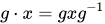
The exceptional isomorphisms between classical groups extend beyond the split case and admit a uniform description over arbitrary fields using central simple algebras with involution.[2][3] In this formulation, orthogonal, symplectic, and unitary groups arise from algebras equipped with involutions, and the low-rank coincidences  and
and  persist for all such forms.[2][3]
More precisely, the isomorphism identifies symplectic groups attached to degree-4 algebras with symplectic involution with spin groups attached to 5-dimensional quadratic spaces, via constructions involving trace-zero symmetric elements and the Pfaffian norm.[2][3] Similarly, the isomorphism relates unitary groups of degree 4, defined using a quadratic étale algebra and a unitary involution, to spin groups in dimension 6, via Clifford algebras and discriminant algebras.[2][3] In the split case these constructions reduce to the realization on  , but over general fields they describe all inner and outer forms of the corresponding groups.[2][3]
These phenomena are controlled by Galois cohomology, which classifies forms of reductive algebraic groups.[9] The exceptional isomorphisms therefore identify not only the split groups but also their twisted forms over local and global fields.[2][9] This has consequences in the theory of automorphic forms and the Langlands program, where low-rank orthogonal and general spin groups are often studied via symplectic, linear, or unitary groups using functorial transfer and theta correspondence.[10][11]
Over a field  of characteristic different from 2, the low-rank exceptional isomorphisms of root systems and give rise to corresponding isomorphisms (or central isogenies) among classical algebraic groups.[2][3] In the split case, these include
 and
and
 These identifications arise from explicit constructions: for , from the action of
  on the 5-dimensional irreducible summand of ; and for , from the action of
  on .[2][3]
The non-split forms can be described using central simple algebras with involution.[2][3] Let  be a simple algebra over with center
  . An involution
  is said to be of the first kind if it acts trivially on , and of the second kind otherwise. In the latter case, is a quadratic étale extension
  (that is, either
  or a separable quadratic field extension), and
  induces the nontrivial -automorphism of
  . Involutions of the first kind are further classified as orthogonal or symplectic, while those of the second kind are called unitary.[2]
For the exceptional isomorphism , the non-split form may be described as follows. On the  side, one considers a central simple algebra
  of degree 4 over a quadratic étale algebra , equipped with a unitary involution
  . On the
  side, one considers a central simple algebra of degree 6 over , equipped with an orthogonal involution . There is a canonical correspondence between such pairs
  and
and  , under which one obtains isomorphisms of algebraic groups
 In the split case and
  , this reduces to the classical identifications
  and
and  .[2][3]
For , the non-split form relates symplectic and orthogonal groups. If  is a central simple algebra of degree 4 over with symplectic involution, then there is a canonically associated 5-dimensional quadratic space
  , and corresponding isomorphisms
 Conversely, every 5-dimensional quadratic space arises in this way from the even Clifford algebra. In the split case this recovers the isomorphisms
  and
and  .[2][3]
In the split cases, the constructions are similar to the exceptional isomorphisms over the complex numbers.[2][3]
If  is a 4-dimensional symplectic space, then contraction with
  defines a map
  , and its kernel
 is a 5-dimensional subspace carrying a natural quadratic form preserved by
  .[2][3]
For the isomorphism in the split case, if  is a 4-dimensional vector space, then
  is 6-dimensional and carries a natural symmetric bilinear form, defined by identifying
  with ; this form is preserved by
  , giving the homomorphism
  .[2][3]
To describe the non-split forms more explicitly, one uses standard constructions from the theory of central simple algebras with involution. Throughout this subsection, assume that the characteristic of is not equal to 2.[2]
If is a central simple algebra over with symplectic involution, define
 There is also a reduced trace map
 which in the split case
  is the ordinary matrix trace. One defines the trace-zero subspace[2]

If has degree 4, then  is a 5-dimensional vector space over . The involution determines a quadratic form on this space, called the Pfaffian norm, denoted
  . In the split case
  with the standard symplectic involution, this quadratic form is the natural quadratic form on the 5-dimensional irreducible summand of .[2][3]
More concretely, if  , the reduced norm
  satisfies
 and is uniquely determined by this property. This quadratic form is nondegenerate on .[2]
This construction yields the exceptional isomorphisms[2][3]


Conversely, if is a 5-dimensional quadratic space, one forms its Clifford algebra  and its even Clifford algebra
  . The algebra is a central simple algebra of degree 4 over , equipped with a canonical symplectic involution , and the above construction recovers up to isomorphism.[2][3]
For the exceptional isomorphism , one proceeds as follows. Let be a quadratic étale algebra, and let be a central simple algebra of degree 4 over equipped with a unitary involution . Thus induces the nontrivial -automorphism of (Galois conjugation in the field case, or exchange of the two factors if ).[2]
From one constructs a central simple algebra of degree 6 over , equipped with an orthogonal involution , called the discriminant algebra of . In the split case  , this corresponds to the action of on , which preserves a natural quadratic form and yields the isomorphism .[2][3]
Conversely, if is a central simple algebra of degree 6 over with orthogonal involution, its Clifford algebra  has center a quadratic étale algebra , and one obtains a degree-4 central simple algebra over equipped with a canonical unitary involution. These constructions are mutually inverse up to isomorphism, and give[2][3]
The preceding descriptions are simplest over fields of characteristic different from 2. In characteristic 2, the orthogonal side is more naturally expressed in terms of quadratic pairs rather than orthogonal involutions: if  is a central simple algebra with quadratic pair, then is a symplectic involution, and the additional linear form
  is needed to recover the corresponding quadratic form.[2][3]
(A quadratic pair on a central simple algebra over a field is a pair  , where is an involution of the first kind on and
 is a linear map satisfying
 When , this notion is equivalent to that of an orthogonal involution, since is then determined by . In characteristic
  , however, an involution alone does not determine the corresponding quadratic data, and the extra linear form is needed. Quadratic pairs are therefore the natural characteristic-2 analogue of orthogonal involutions.)[2]
For the exceptional isomorphism , let be a central simple algebra of degree 4 with symplectic involution. In characteristic 2, the relevant 5-dimensional quadratic space is built from the space
 of symmetrized elements, rather than from
  . More precisely, Knus–Merkurjev–Rost–Tignol identify the corresponding quadratic space with
 where
where  is the trace-zero subspace and
  is the Pfaffian trace form. In this way the exceptional isomorphism persists in characteristic 2, but the orthogonal group is replaced by the group attached to this quadratic space, and the resulting map is best understood as an isogeny of algebraic groups rather than as a classical double cover with kernel
  .[2][3]
For the exceptional isomorphism , the correct characteristic-2 object on the side is a central simple algebra of degree 6 with quadratic pair . Its Clifford algebra is then a central simple algebra of degree 4 over a quadratic étale extension, equipped with a canonical unitary involution. Conversely, a degree-4 central simple algebra with unitary involution has an associated discriminant algebra of degree 6 with quadratic pair. Thus the equivalence between the and forms remains valid in characteristic 2, but it is expressed using quadratic pairs rather than orthogonal involutions.[2][3]
In the split case, the construction using the action of  on
on  still gives the corresponding low-rank isogeny, but the invariant structure on the orthogonal side is again a quadratic pair. Likewise, the construction may still be viewed through the 5-dimensional summand attached to a degree-4 symplectic algebra, provided it is formulated in terms of and the quadratic form .[2][3]