Exponential response formula
From Wikipedia, the free encyclopedia
| Differential equations |
|---|
| Scope |
| Classification |
| Solution |
| People |
In mathematics, the exponential response formula (ERF), also known as exponential response and complex replacement, is a method used to find a particular solution of a non-homogeneous linear ordinary differential equation of any order.[1][2] The exponential response formula is applicable to non-homogeneous linear ordinary differential equations with constant coefficients if the function is polynomial, sinusoidal, exponential or the combination of the three.[2] The general solution of a non-homogeneous linear ordinary differential equation is a superposition of the general solution of the associated homogeneous ODE and a particular solution to the non-homogeneous ODE.[1] Alternative methods for solving ordinary differential equations of higher order are method of undetermined coefficients and method of variation of parameters.
Applicability
The ERF method of finding a particular solution of a non-homogeneous differential equation is applicable if the non-homogeneous equation is or could be transformed to form ; where are real or complex numbers and is homogeneous linear differential equation of any order. Then, the exponential response formula can be applied to each term of the right side of such equation. Due to linearity, the exponential response formula can be applied as long as the right side has terms, which are added together by the superposition principle.



Complex replacement
Complex replacement is a method of converting a non-homogeneous term of equation into a complex exponential function, which makes a given differential equation a complex exponential.
Consider differential equation .

To make complex replacement, Euler's formula can be used;

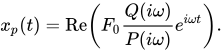
Therefore, given differential equation changes to . The solution of the complex differential equation can be found as , from which the real part is the solution of the original equation.


Complex replacement is used for solving differential equations when the non-homogeneous term is expressed in terms of a sinusoidal function or an exponential function, which can be converted into a complex exponential function differentiation and integration. Such complex exponential function is easier to manipulate than the original function.
When the non-homogeneous term is expressed as an exponential function, the ERF method or the undetermined coefficients method can be used to find a particular solution. If non-homogeneous terms can not be transformed to complex exponential function, then the Lagrange method of variation of parameters can be used to find solutions.
Linear time-invariant operator
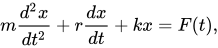
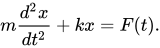
The differential equations are important in simulating natural phenomena. In particular, there are numerous phenomena described as high order linear differential equations, for example the spring vibration, LRC circuit, beam deflection, signal processing, control theory and LTI systems with feedback loops.[1][3]
Mathematically, the system is time-invariant if whenever the input has response then for any constant "a", the input has response . Physically, time invariance means system’s response does not depend on what time the input begins. For example, if a spring-mass system is at equilibrium, it will respond to a given force in the same way, no matter when the force was applied.


When the time-invariant system is also linear, it is called a linear time-invariant system (LTI system). Most of these LTI systems are derived from linear differential equations, where the non-homogeneous term is called the input signal and solution of the non-homogeneous equations is called the response signal. If the input signal is given exponentially, the corresponding response signal also changes exponentially.
Considering the following th order linear differential equation


and denoting

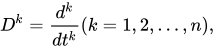
where are the constant coefficients, produces differential operator , which is linear and time-invariant and known as the LTI operator. The operator, is obtained from its characteristic polynomial;



by formally replacing the indeterminate s here with the differentiation operator



Therefore, the equation (1) can be written as

Problem setting and ERF method
Considering LTI differential equation above, with exponential input , where and are given numbers. Then, a particular solution is


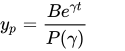
provide only that .

Proof: Due to linearity of operator , the equation can be written as


On the other hand, since

substituting this into equation (3), produces

Therefore, is a particular solution to the non-homogeneous differential equation.

Thus, the above equation for a particular response is called the exponential response formula (ERF) for the given exponential input.
In particular, in case of , a solution to equation (2) is given by

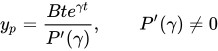
and is called the resonant response formula.
Example
Let's find the particular solution to 2nd order linear non-homogeneous ODE;

The characteristic polynomial is . Also, the non-homogeneous term, can be written as follows



Then, the particular solutions corresponding to and , are found, respectively.


First, considering non-homogeneous term, . In this case, since and .



from the ERF, a particular solution corresponding to can be found.

- .
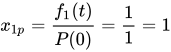
Similarly, a particular solution can be found corresponding to .

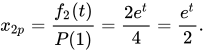
Let's find a particular solution to DE corresponding to 3rd term;

In order to do this, equation must be replaced by complex-valued equation, of which it is the real part:

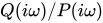
Applying the exponential response formula (ERF), produces

and the real part is
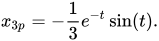
Therefore, the particular solution of given equation, is


Comparison with method of undetermined coefficients
The undetermined coefficients method is a method of appropriately selecting a solution type according to the form of the non-homogeneous term and determining the undetermined constant, so that it satisfies the non-homogeneous equation.[4] On the other hand, the ERF method obtains a special solution based on differential operator.[2] Similarity for both methods is that special solutions of non-homogeneous linear differential equations with constant coefficients are obtained, while form of the equation in consideration is the same in both methods.
For example, finding a particular solution of with the method of undetermined coefficients requires solving the characteristic equation . The non-homogeneous term is then considered and since is not a characteristic root, it puts a particular solution in form of , where is undetermined constant. Substituting into the equation to determine the tentative constant yields




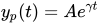


therefore
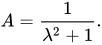
The particular solution can be found in form:[5]
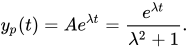
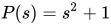
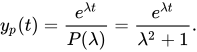
On the other hand, the exponential response formula method requires characteristic polynomial to be found, after which the non-homogeneous terms is complex replaced. The particular solution is then found using formula
Generalized exponential response formula
The exponential response formula method was discussed in case of . In the case of , the resonant response formula is also considered.

In the case of , we will discuss how the ERF method will be described in this section.

Let be a polynomial operator with constant coefficients, and its -th derivative. Then ODE


- , where is real or complex.
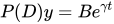
has the particular solution as following.
- . In this case, a particular solution will be given by .(exponent response formula)

- but . In this case, a particular solution will be given by .(resonant response formula)

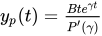
- but . In this case, a particular solution will be given by


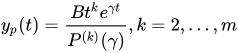
Above equation is called generalized exponential response formula.
Example
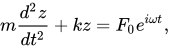
To find a particular solution of the following ODE;

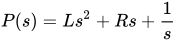
the characteristic polynomial is .

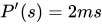
By the calculating, we get the following:

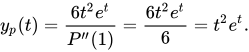
Original exponential response formula is not applicable to this case due to division by zero. Therefore, using the generalized exponential response formula and calculated constants, particular solution is









![{\displaystyle {\begin{aligned}y_{p}&=\operatorname {Re} \left({\frac {F_{0}te^{i\omega t}}{P'(\gamma )}}\right)\\[4pt]&=\operatorname {Re} \left({\frac {F_{0}t(\cos(\omega t)+i\sin(\omega t))}{2mi\omega }}\right)\\[4pt]&=\operatorname {Re} \left({\frac {-F_{0}t(i\cos(\omega t)-\sin(\omega t))}{2m\omega }}\right)\\[4pt]&={\frac {F_{0}t\sin(\omega t)}{2m\omega }}\\[4pt]&={\frac {F_{0}}{2{\sqrt {km}}}}t\sin(\omega t).\end{aligned}}}](https://wikimedia.org/api/rest_v1/media/math/render/svg/cf95f64146267b91c11819dda5cfb163b7a01664)









![{\displaystyle {\begin{aligned}I_{p}&=\operatorname {Im} \left({\frac {E_{0}e^{i\omega _{0}t}}{P(i\omega _{0})}}\right)\\&=\operatorname {Im} \left({\frac {E_{0}e^{i\omega _{0}t}}{i\omega _{0}R}}\right)\\&=\operatorname {Im} \left({\frac {-E_{0}(i\cos(\omega _{0}t)-\sin(\omega _{0}t))}{\omega _{0}R}}\right)\\[4pt]&={\frac {-E_{0}\cos(\omega _{0}t)}{\omega _{0}R}}\end{aligned}}}](https://wikimedia.org/api/rest_v1/media/math/render/svg/8279c1f7dabe59704a4f29a9bc241b12e991d6b2)