FHI-aims
From Wikipedia, the free encyclopedia
| FHI-aims | |
|---|---|
 | |
| Developer | FHI-aims developers group |
| Stable release | 250822
/ 22 August 2025 |
| Written in | Fortran, MPI |
| Operating system | Linux |
| Type | Density Functional Theory (simulation), Computational chemistry |
| License | Academic / Commercial |
| Website | fhi-aims |
FHI-aims (Fritz Haber Institute ab initio materials simulations) is a software package for computational molecular and materials science written in Fortran. It uses density functional theory and many-body perturbation theory to simulate chemical and physical properties of atoms, molecules, nanostructures, solids, and surfaces. Originally developed at the Fritz Haber Institute in Berlin, the ongoing development of the FHI-aims source code is now driven by a worldwide community of collaborating research institutions.[1]
The FHI-aims software package is an all-electron, full-potential electronic structure code utilizing numeric atom-centered basis functions for its electronic structure calculations. The localized basis set enables the accurate treatment of all electrons on the same footing in periodic and non-periodic systems without relying on the approximation for the core states, such as pseudopotentials. Importantly, the basis sets enable high numerical accuracy on par with the best available all-electron reference methods while remaining scalable to system sizes up to several thousands of atoms. In order to achieve this for bulk solids, surfaces or other low-dimensional systems and molecules, the choice of basis functions is crucial. The workload of the simulations is efficiently distributable for parallel computing using the MPI communication protocol. The code is routinely used on platforms ranging from laptops to distributed-parallel supercomputers with ten thousand CPUs, and the scalability of the code has been tested up to 100,000's of CPUs.[2]
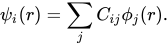
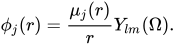
The primary production methods of FHI-aims are density functional theory as well as many-body methods and higher-level quantum chemistry approaches.[3] For the exchange-correlation treatment, local (LDA), semi-local (e.g., PBE, PBEsol), meta-GGA, and hybrid (e.g., HSE06, B3LYP) functionals have been implemented. The resulting orbitals can be used within the framework of many-body perturbation theory, such as Møller-Plesset perturbation theory or the GW approximation. Moreover, thermodynamic properties of the molecules and solids are accessible via Born-Oppenheimer molecular dynamics and path integral molecular dynamics methods. The first step is to expand the Kohn-Sham orbitals packages into a set of basis functions Since FHI-aims is an all-electron full-potential code that is computationally efficient without compromising accuracy, the choice of basis function is crucial in order to achieve the said accuracy. Therefore, FHI-aims is based on numerically tabulated atom-centered orbitals (NAOs) of the form: As the name implies, the radial shape is numerically tabulated and, therefore, fully flexible. This allows the creation of optimized element-dependent basis sets that are as compact as possible while retaining a high and transferable accuracy in production calculations up to meV-level total energy convergence. To obtain real-valued , here denotes the real parts () and imaginary parts () of complex spherical harmonics, with an implicit function of the radial function index .[4]