In exogenous growth models, the production function can be represented by:[1]
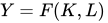
with Y total production, K capital, and L labor.
So a representative agent will attempt to maximize a profit function:[2]

where  is the cost to the firm, r the rental rate of capital, w the wage rate for labor, and P is the price of the output.
As in microeconomics supply and demand models, first-order conditions that the derivative of this function with respect to capital and labor will be zero at the functions maximum. Thus (assuming P = 1) we can calculate the wages and the rental rate of capital:
![{\displaystyle w=D_{L}[F(K,L)]\,}](https://wikimedia.org/api/rest_v1/media/math/render/svg/b461586bd18f6a15d4ed4b7a6177bd59faca3411) and
and ![{\displaystyle r=D_{K}[F(K,L)]\,}](https://wikimedia.org/api/rest_v1/media/math/render/svg/8a4233f2f5f056747a396fd1179fd6defc1fe846) .
.
Now we can write the expenditure allocated to labor as ![{\displaystyle wL=D_{L}[F(K,L)]*L\,}](https://wikimedia.org/api/rest_v1/media/math/render/svg/482d15972e097b18365b9f6dc3ac1acbc689a020)
and to capital as ![{\displaystyle rK=D_{K}[F(K,L)]*K\,}](https://wikimedia.org/api/rest_v1/media/math/render/svg/9b7d3fa265291e4f5c7e02379e355915f5318e14)
So the factor share devoted to labor is:
![{\displaystyle wL/Y=D_{L}[F(K,L)]*L/F(K,L)\,}](https://wikimedia.org/api/rest_v1/media/math/render/svg/8487303670bfdbc98aa38841c55facb11bf6ce62)
and the factor share devoted to capital is:
![{\displaystyle rK/Y=D_{K}[F(K,L)]*K/F(K,L)\,}](https://wikimedia.org/api/rest_v1/media/math/render/svg/3f54cc0220d142fecd8055490d7030c69b6fb5ac)