Favre averaging is carried out for all dynamical variables except the pressure. For the velocity components,  , the Favre averaging is defined as:

where the overbar indicates the typical Reynolds averaging, the tilde denotes the Favre averaging and  is the density field. The Favre decomposition of the velocity components is then written as:
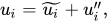
where  is the fluctuating part in the Favre averaging, which satisfies the condition
  , that is to say,
  . The normal Reynolds decomposition is given by
 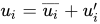 , where
  is the fluctuating part in the Reynolds averaging, which satisfies the condition
  .
.
The Favre-averaged variables are more difficult to measure experimentally than the Reynolds-averaged ones, however, the two variables can be related in an exact manner if correlations between density and the fluctuating quantity is known; this is so because, we can write:
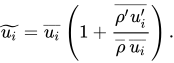
The advantage of Favre-averaged variables are clearly seen by taking the normal averaging of the term  that appears in the convective term of the Navier-Stokes equations written in its conserved form. This is given by[4][5]

As we can see, there are five terms in the averaging when expressed in terms of Reynolds-averaged variables, whereas we only have two terms when it is expressed in terms of Favre-averaged variables.