February 17 (Eastern Orthodox liturgics)
Day in the Eastern Orthodox Church calendar
From Wikipedia, the free encyclopedia
February 16 - Eastern Orthodox liturgical calendar - February 18

All fixed commemorations below are observed on March 2 (March 1 on leap years) by Eastern Orthodox Churches on the Old Calendar.[note 1]
For February 17th, Orthodox Churches on the Old Calendar commemorate the Saints listed on February 4.
Saints
- Saint Mariamne, Equal to the Apostles, sister of Apostle Philip (1st century)[1][2][3][4][5]
- Saint Auxibius of Soli, Bishop of Soli in Cyprus (102)[1][3][6][7]
- Martyrs Donatus, Romulus, Secundian, and 86 Companions, at Concordia (Portogruaro), near Venice (304)[8][9][note 2]
- Great-martyr Theodore the Tyro (c. 306)[1][3][11][12]
- Martyr Theodoulos, at Caesarea Palestina (308)[13][14][note 3]
- Saint Mesrop Mashtots of Armenia (440)[1]
- Holy Emperor Marcian (457) and St. Pulcheria, his wife (453)[1][3][15][16]
- Venerable Martyr Theocteristus, Abbot of Pelekete Monastery near Prusa (8th century)[3][17] (see also: November 10 and February 28)
Pre-Schism Western saints
- Martyrs Faustinus and Companions, a group of forty-five martyrs honoured in Rome.[9][note 4]
- Saint Lommán of Trim (Luman), a nephew of St Patrick and the first Bishop of Trim in Meath in Ireland (c. 450)[9][18][19]
- Saint Habet-Deus, Bishop of Luna in Tuscany in Italy, probably martyred by the Arian Vandals (c. 500)[9]
- Saint Fortchern, Bishop of Trim in Ireland, he later lived as a hermit (6th century)[9][20]
- Saint Guevrock (Gueroc; Kerric), Abbot of Loc-Kirec, he also helped St Paul of Léon (6th century)[9][note 5]
- Saint Fintan of Clonenagh, a disciple of St Columba, he led the life of a hermit in Clonenagh in Leix in Ireland, Confessor (603)[9][10][22][23][note 6]
- Saint Finan of Lindisfarne, Bishop of Lindisfarne (661)[1][9][16][21][24][25][note 7]
- Saint Silvinus of Auchy, enlightener of the area near Thérouanne, then a monastic in the Benedictine abbey of Auchy-les-Moines (fr) (c. 718)[9][10][26][note 8]
Post-Schism Orthodox saints
- St. Euxiphius I, Bishop and Wonderworker, listed in some synaxaria as one of the "300 Allemagne Saints" in Cyprus (late 12th century)[3][27][note 9] (see also: September 17)
- Venerable Theodore the Silent, of the Kiev Caves Monastery (13th century)[1][16][30][31]
- Venerable Theodosius, monastic founder at Mt. Kelifarevo (1363),[note 10] and his disciple St. Romanus (c. 1370), of Turnovo, Bulgaria.[1][16][32][33]
- New Martyr Michael Mavroeidis of Adrianopolis (1490)[1][3][16][34]
- Saint Hermogenes of Moscow, Patriarch and Wonderworker of Moscow and all Russia (1612)[1][35][36][37]
- New Martyr Theodore of Byzantium, at Mytilene (1795)[1][3][38][39]
- New Hieromartyr Theodore of Adjara, Hieromonk, at Mt. Athos (1822)[1][16][40][note 11]
- Venerable Barnabas, Elder of Gethsemane Skete, of St. Sergius Lavra (1906)[1][16][41]
- Saint Nicholas Planas, Priest, of Athens (1932)[1][16][42][note 12][note 13] (see also: March 2 - New Calendar date)
- New Hieromartyr Joseph Zograph of Dionysiou, Hieromonk, at Mt. Athos (1819)[44]
New martyrs and confessors
Other commemorations
- Uncovering of the relics (867â869) of Martyr Menas the Most Eloquent, of Alexandria (ca. 313)[1][16][35][45][46]
- Weeping "Tikhvin" Icon of the Most Holy Theotokos, at the Kozak Skete of St. Elias on Mt. Athos.[1][42][47]
- Repose of Elder Agapitus of the Kiev Caves (1887)[1]
- Repose of Schemamonk John (Shova) of Kolitsou Skete, Mt. Athos (2009)[1]
Icon gallery
 Great-martyr Theodore the Tyro.
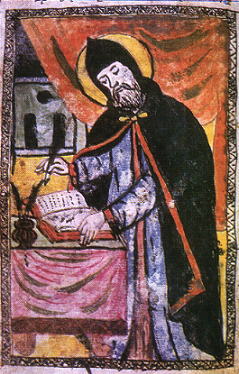 St. Mesrop Mashtots of Armenia.
 Venerable Theodosius of Turnovo, monastic founder at Mt. Kelifarevo
 Saint Hermogenes of Moscow, Patriarch and Wonderworker of Moscow and all Russia.
 Saint Nicholas Planas of Athens (1851â1932).
 The Theotokos of Tikhvin in the golden riza.


.jpg)
.jpg)

Notes
- The notation Old Style or (OS) is sometimes used to indicate a date in the Julian Calendar (which is used by churches on the "Old Calendar").
The notation New Style or (NS), indicates a date in the Revised Julian calendar (which is used by churches on the "New Calendar"). - "Guevrock was a native of Great Britain, who followed his master St. Tugdual to Brittany, and was named by him Superior of a new monastery in the place since called Loc-Kiric. He lived in seclusion until called by St. Paul of Léon to assist him in the government of his diocese. In the exercise of this duty he exhibited great zeal and charity, and was favoured with miraculous gifts. He was attending the Bishop in his visitation when seized with his last illness at a place called Landerneau. There he gave up his soul to God, but his body was conveyed to his own Abbey of Loc-Kiric. His relics were preserved with veneration for a length of time, but were lost during the invasions and civil disturbances which occurred at a later period."[21]
- Numerous disciples attached themselves to this ascetic and he became their abbot.
- Born in Ireland, he became a monk at Iona in Scotland and succeeded St Aidan in the Northumbrian Church. With St Cedd and others he enlightened parts of the south of England.
- A courtier who gave up his worldly life to preach the Gospel. He enlightened the area near Thérouanne in the north of France. After some forty years of unceasing work, during which he paid the ransoms of many slaves, he went to the monastery of Auchy-les-Moines, where he lived the few remaining years of his life as a monk.
- The 300 Allemagne Saints came to Cyprus from Palestine, and lived as ascetics in various parts of the island. According to some of their lives in the Great Synaxaristes, after the dissolution of the Second Crusade (1147 - 1149), they decided to live the monastic life in the Jordan desert. However since the Latins there disturbed them, they relocated to Cyprus and dispersed over the island.[28][29] Included among the "300 Allemagne Saints" are:
- Venerable Anastasios the Wonderwoker of Cyprus, September 17
- Venerable Abbacum the Ascetic of Cyprus, Wonderworker, December 2
- Venerable Cassian the Martyr (Kassianos), December 4
- Venerable Calantius of Tamassos (Kalandios), April 26
- Martyr Constantine of Cyprus (Constantine of Allemagne), Wonderworker, July 1
- See also: November 27.
- The Holy Synod of the Georgian Apostolic Orthodox Church canonized Holy Martyr Theodore on October 17, 2002.
- (in Russian) ÐланаÑ, Ðиколай (Russian Wikipedia).
- Troparion (tone 5):
- "Let us praise our protector, the godly Nicholas; as one endowed with blest virtue, he shone forth as a true priest of the Most High God, and was his fervent worshipper. For, by his holy life on earth, he hath left us most sublime, divine and unfailing teachings of long suffering, meekness, patience, unfeigned humility and true God-like love."
- "Humble of spirit and pure of heart, illustrious in life and dispassionate of a truth, wast thou, O wise one. Thou didst illumine all by thy virtues and dost grant grace unto them that draw nigh unto thee; and by thine intercessions, thou dost heal them that call upon thee, O Father Nicholas."[43]