February 7 (Eastern Orthodox liturgics)
Day in the Eastern Orthodox Church calendar
From Wikipedia, the free encyclopedia
February 6 - Eastern Orthodox liturgical calendar – February 8

All fixed commemorations below are observed on February 20 by Eastern Orthodox Churches on the Old Calendar.[note 1]
For February 7th, Orthodox Churches on the Old Calendar commemorate the Saints listed on January 25.
Feasts
- Afterfeast of the Meeting of our Lord in the Temple.[1]
Saints
- Martyr Agathangelus, in Damascus (3rd century)[2]
- The 1,003 Martyrs of Nicomedia (303)[3][4][5][6]
- Martyr Theopemptus[7] and the Six Martyrs of Phrygia, by fire (c. 305)[3][5][8]
- Martyr Audatus (Adaucus), in Phrygia (4th century)[9][note 2]
- Saint Parthenius, Bishop of Lampsacus on the Hellespont (4th century)[3][5][11][12][13][note 3]
- Saint Mastridia of Jerusalem, woman ascetic of the desert (c. 580)[3][14]
- Venerable Luke the Younger (Luke of Mt. Steiris, Luke Thaumaturgus, Luke of Hellas), founder of the Monastery of Hosios Loukas (946 or 953)[3][5][15][16][note 4]
- Saint Aprionus of Cyprus, Bishop.[3][14][18][note 5]
- Venerable Peter of Monovatia, ascetic.[5][14][19]
- Venerable Sarapion of Cyprus.[20][note 6]
Pre-Schism Western saints
- Hieromartyr Augulus (Avgul, Augurius, Aule), Bishop of Augusta, Britain (c. 303)[3][14][21][22][23][note 7][note 8][note 9]
- Saint Chrysolius, an Armenian who enlightened the north-east of France, where he became bishop and was martyred (4th century)[22][25][note 10]
- Saint Juliana of Bologna (435)[10][22][note 11]
- Saint Anatolius, Bishop of Cahors in France (5th century?)[22]
- Saint Laurence of Siponto, called Majoranus, Bishop of Siponto in Italy, who built the church of St Michael on Mt. Gargano (c. 546)[22][note 12][note 13]
- Saint Tressan (Trésain), a missionary from Ireland, he was ordained priest by St Remigius, and preached in Mareuil on the Marne in France (550)[22][27][28]
- Saint Fidelis, Bishop of Mérida (c. 570)[22][note 14]
- Saint Meldon (Medon), from Ireland, he became a hermit in France and reposed at Péronne (6th century)[22][29][note 15]
- Saint Ronan (Ronane, Roman), Bishop of Kilmaronen (7th century)[14][31]
- Saint Richard the Pilgrim (Richard of Wessex), King and Confessor, father of Saints Willibald, Wunnibald and Walburga (720)[10][14][22][24][32][note 16]
- Saint Amulwinus, Bishop of Lobbes in Belgium and the successor of St Erminus (c. 750)[22]
- Saint Romuald, Abbot (1027)[33]
Post-Schism Orthodox saints
Other commemorations
- Repose of Archimandrite Gennadius, ascetic of the Roslavl Forests (1826), and commemoration of his disciple, Abramius, desert-dweller of Whitehoof Convent (1868), and the latter’s spiritual daughter Abbess Alexandra (1883)[3]
- Repose of Archimandrite Cyril (Pavlov) of St. Sergius Lavra, confessor to patriarchs Alexy II, Alexy I and Pimen (2017)[3]
Icon gallery
 Venerable Luke the Younger (Luke of Mt. Steiris, Luke Thaumaturgus, Luke of Hellas)
 Sanctuary of Monte Sant'Angelo on Mt. Gargano.
 Altarpiece and shrine of Saint Richard the Pilgrim, in San Frediano, at Lucca.
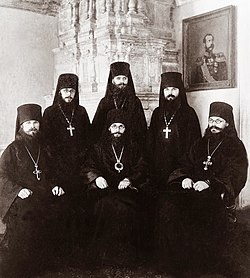 Archimandrite Barlaam (Ryashentsev), among the clergy of the Moscow Theological Academy (sitting, front left)
_-_Luke_of_Steiris_01.jpg)


.jpg)
Notes
- The notation Old Style or (OS) is sometimes used to indicate a date in the Julian Calendar (which is used by churches on the "Old Calendar").
The notation New Style or (NS), indicates a date in the Revised Julian calendar (which is used by churches on the "New Calendar"). - Kontakion. Fourth Tone. "God, Who by judgments known to Him chose thee ere thou wast formed that thou, O Luke, mightest be right well-pleasing unto Him, from the womb made thee His own and He sanctified thee; as His own true faithful servant hath He shown thee forth and hath set aright thy footsteps, ever guiding thee as the Friend of man; thou rejoicest before Him now."[17]
- He is recorded in the Synaxarion of Constantinople.
- He is not mentioned in the Synaxaria. His memory is recorded in the 'Patmiako' Codex 266.
- "AUGULUS is named on this day in the Roman Martyrology, and in all the ancient calendars, as a bishop, who suffered martyrdom in London. No Acts of his are known to exist; but the conjecture of historians is, that he suffered in the persecution of Diocletian, about the same time as St. Alban."[24]
- Having left Armenia during the persecution of Diocletian, he won martyrdom in Flanders. His relics were venerated in Bruges in Belgium.
- A matron in Bologna in Italy whose piety and charity were praised by St Ambrose of Milan. Her husband left her to become a priest with her consent and she devoted herself to bringing up her four children and to the service of the Church and the poor.
- Bishop Laurence of Siponto witnessed an apparition of the Archangel Michael on Mount Gargano near Manfredonia in southern Italy about the year 490 AD, in memory of which the famous Monastery of the Archangel was founded.
The Sanctuary of Monte Sant'Angelo is the oldest shrine in Western Europe dedicated to the archangel Michael and has been an important pilgrimage site since the middle ages. The historic site and its environs are protected by the Parco Nazionale del Gargano. In 2011, it became a UNESCO World Heritage Site as part of a group of seven, inscribed as Longobards in Italy. Places of the power (568-774 A.D.). - "The Liber de apparitione Sancti Michaelis in Monte Gargano (BHL 5948),...recounts the foundation of the shrine and church at the Monte S. Angelo on the Gargano peninsula... ...A date of composition for the Liber de apparitione between c. 663 and 750 is more than feasible, and the period soon after the annexation of Siponto in the 660s most likely."[26]
- Eastern by origin, he travelled to Spain with some merchants and settled in Mérida, where he became a disciple of St Paul, bishop of the city, whom he later succeeded.
- "Of this Irish saint and bishop, who left his native land and died at Peronne, nothing is known. His acts have been lost. Yet, at one time he must have been famous, for many churches are dedicated to him. He is sometimes called Medan. In the revelations of S. Fursey, reference is made to S. Meldan."[30]
- A noble from the west of England and father of Sts Willibald, Winebald and Walburga. He reposed at Lucca on a pilgrimage to Rome.
- See: (in Russian) Варлаам (Ряшенцев). Википедии. (Russian Wikipedia).