Fermat quotient
From Wikipedia, the free encyclopedia
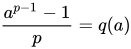
In number theory, the Fermat quotient of an integer a with respect to an odd prime p is defined as[1][2][3][4]
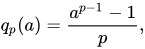
or
- .
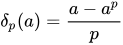
This article is about the former; for the latter see p-derivation. The quotient is named after Pierre de Fermat.
If the base a is coprime to the exponent p then Fermat's little theorem says that qp(a) will be an integer. If the base a is also a generator of the multiplicative group of integers modulo p, then qp(a) will be a cyclic number, and p will be a full reptend prime.
From the definition, it is obvious that

In 1850, Gotthold Eisenstein proved that if a and b are both coprime to p, then:[5]
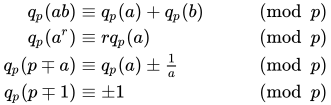
Eisenstein likened the first two of these congruences to properties of logarithms. These properties imply
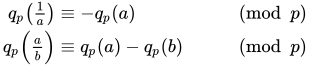
In 1895, Dmitry Mirimanoff pointed out that an iteration of Eisenstein's rules gives the corollary:[6]

From this, it follows that:[7]

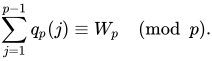
Lerch's formula

Special values
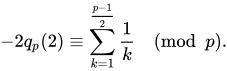
Eisenstein discovered that the Fermat quotient with base 2 could be expressed in terms of the sum of the reciprocals modulo p of the numbers lying in the first half of the range {1, ..., p − 1}:
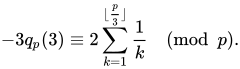
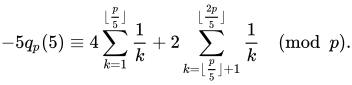
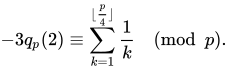
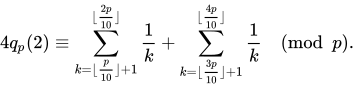
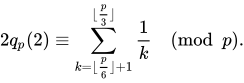
Later writers showed that the number of terms required in such a representation could be reduced from 1/2 to 1/4, 1/5, or even 1/6:
Eisenstein's series also has an increasingly complex connection to the Fermat quotients with other bases, the first few examples being: