Ferocactus macrodiscus
From Wikipedia, the free encyclopedia
| Ferocactus macrodiscus | |
|---|---|
 | |
Scientific classification  | |
| Kingdom: | Plantae |
| Clade: | Tracheophytes |
| Clade: | Angiosperms |
| Clade: | Eudicots |
| Order: | Caryophyllales |
| Family: | Cactaceae |
| Subfamily: | Cactoideae |
| Genus: | Ferocactus |
| Species: | F. macrodiscus |
| Binomial name | |
| Ferocactus macrodiscus (Mart.) Britton & Rose 1922 | |
| Synonyms | |
| |
Ferocactus macrodiscus is a species of cactus (family Cactaceae) in the genus Ferocactus from Guanahuato and Oaxaca States, Mexico.[2]
It has a globular body about 4 inches (10 cm) high and up to 18 inches (46 cm) wide, with typically in maturity 13 to 21 vertical ridges or ribs, based on its adherence to the primary Fibonacci series. Areoles are 5 to 10 mm long with 1-4 central spines that are 3.5 cm long and 6-8 radial spines that are 2-3 cm long. Spines range from yellow to red, and curved. The plant blooms from early spring to summer. It is most noteworthy for its pink, approx. two inch (5 cm) wide flowers, which have approximately 200 tepals arranged in a continuous spiral series from perfect sepals on the outside gradually morphing into perfect petals near the center. Fruits are red and spherical 4 x 3 cm with 2 mm long dark brown seeds. [3]
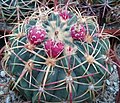 fruits
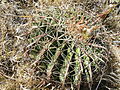 Plant
Plant

.jpg)
Distribution
Ferocactus macrodiscus is found in growing in Oak forest and grasslands San Luis Potosí, Querétaro, Guanajuato, Puebla and Oaxaca states of Mexico at elevations of 2,300 to 2,600 meters.[4]
 Plant growing in Oaxaca, Mexico
.jpg)


