Ferocactus peninsulae
From Wikipedia, the free encyclopedia
| Ferocactus peninsulae | |
|---|---|
 | |
Scientific classification  | |
| Kingdom: | Plantae |
| Clade: | Tracheophytes |
| Clade: | Angiosperms |
| Clade: | Eudicots |
| Order: | Caryophyllales |
| Family: | Cactaceae |
| Subfamily: | Cactoideae |
| Genus: | Ferocactus |
| Species: | F. peninsulae |
| Binomial name | |
| Ferocactus peninsulae | |
| Synonyms | |
| |
Ferocactus peninsulae is a barrel cactus in the genus Ferocactus of the family Cactaceae.
Ferocactus peninsulae reaches a height of about 70 centimetres (28 in), rarely 2.5 meters, with a diameter of 40 centimetres (16 in). This plant is oval to club-shaped and has 12 to 20 showy, deep ribs. The thorns are grayish-red and have a yellowish or whitish tip. The central spines are banded and 4 to 15 centimeters long with the lowest central spine is flattened and curved in a hook shape and the 6 to 13 different, radial spines are slender occasionally twisted and bristle-like. The funnel-shaped flowers are red to yellow and reach a length of 5–6 centimetres (2.0–2.4 in). The fruits are spherical, yellow, up to 4.5 centimetres (1.8 in) long.[2]
 Plants of Ferocactus peninsulae
 Flowers of 'Ferocactus peninsulae
 Flower of Ferocactus peninsulae
 Thorns of Ferocactus peninsulae


Distribution
Ferocactus peninsulae is found in the Mexican state of Baja California Sur growing on sandy hillsides at an elevation of 0 to 450 meters. Plants grow in association with Mammillaria dioica, Cochemiea setispina, Echinocereus ferreirianus and Lophocereus schottii[3]
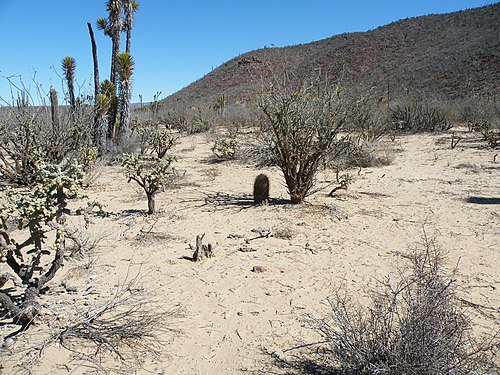 Habitat in Viscaino, Baja California Sur
.jpg)
.jpg)

