Finite Legendre transform
From Wikipedia, the free encyclopedia
The finite Legendre transform (fLT) transforms a mathematical function defined on the finite interval into its Legendre spectrum.[1][2] Conversely, the inverse fLT (ifLT) reconstructs the original function from the components of the Legendre spectrum and the Legendre polynomials, which are orthogonal on the interval [−1,1]. Specifically, assume a function x(t) to be defined on an interval [−1,1] and discretized into N equidistant points on this interval. The fLT then yields the decomposition of x(t) into its spectral Legendre components,
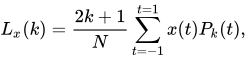
where the factor (2k + 1)/N serves as normalization factor and Lx(k) gives the contribution of the k-th Legendre polynomial to x(t) such that (ifLT)
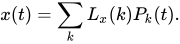
The fLT should not be confused with the Legendre transform or Legendre transformation used in thermodynamics and quantum physics.