In mathematical terms, the first-order approach relaxes the more general incentive compatibility constraint in the principal's problem. The principal decides on an action  and proposes a contract
  to the agent by solving the following program:


- subject to


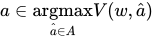
where and  are the principal's and the agent's expected utilities, respectively. Constraint is usually called the participation constraint (where
  is the agent's reservation utility), and constraint is the incentive compatibility constraint.
Constraint states that the action that the principal wants the agent to take must be utility-maximizing for the agent – that is, it must be compatible with her incentives. The first-order approach relaxes this constraint with the first-order condition

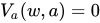
Equation is oftentimes much simpler and easier to work with than constraint , which justifies the attractiveness of the first-order approach. Nonetheless, it is only a necessary condition, and not equivalent to the more general incentive compatibility constraint.