As is the case in percolation theory in general, many of the problems related to first passage percolation involve finding optimal routes or optimal times.
The model is defined as follows.[2]
Let  be a graph. We place a non-negative random variable
  , called the passage time of the edge
  , at each nearest-neighbor edge of the graph . The collection is usually assumed to be independent, identically distributed but there are variants of the model.
The random variable is interpreted as the time or the cost needed to traverse edge .
, at each nearest-neighbor edge of the graph . The collection is usually assumed to be independent, identically distributed but there are variants of the model.
The random variable is interpreted as the time or the cost needed to traverse edge .
Since each edge in first passage percolation has its own individual weight (or time) we can write the total time of a path as the summation of weights of each edge in the path.[3]
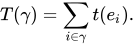
Given two vertices  of one then sets
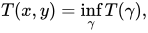
where the infimum is over all finite paths that start at  and end at
  .
The function
.
The function  induces a random pseudo-metric on .
The most famous model of first passage percolation is on the lattice  . One of its most notorious questions is "What does a ball of large radius look like?". This question was raised in the original paper of Hammersley and Welsh in 1969 and gave rise to the Cox-Durrett limit shape theorem in 1981.[4]
Although the Cox-Durrett theorem provides existence of the limit shape, not many properties of this set are known. For instance, it is expected that under mild assumptions this set should be strictly convex. As of 2016, the best result is the existence of the Auffinger-Damron differentiability point in the Cox-Liggett flat edge case.[5]
. One of its most notorious questions is "What does a ball of large radius look like?". This question was raised in the original paper of Hammersley and Welsh in 1969 and gave rise to the Cox-Durrett limit shape theorem in 1981.[4]
Although the Cox-Durrett theorem provides existence of the limit shape, not many properties of this set are known. For instance, it is expected that under mild assumptions this set should be strictly convex. As of 2016, the best result is the existence of the Auffinger-Damron differentiability point in the Cox-Liggett flat edge case.[5]
There are also some specific examples of first passage percolation that can be modeled using Markov chains. For example: a complete graph can be described using Markov chains and recursive trees [6] and 2-width strips can be described using a Markov chain and solved using a Harris chain.[7]