Fitting ideal
From Wikipedia, the free encyclopedia
In commutative algebra, the Fitting ideals of a finitely generated module over a commutative ring describe the obstructions to generating the module by a given number of elements. They were introduced by Hans Fitting (1936).
If M is a finitely generated module over a commutative ring R generated by elements m1,...,mn with relations

then the ith Fitting ideal of M is generated by the minors (determinants of submatrices) of order of the matrix . The Fitting ideals do not depend on the choice of generators and relations of M.


Some authors defined the Fitting ideal to be the first nonzero Fitting ideal .

Properties
The Fitting ideals are increasing

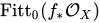
If M can be generated by n elements then Fittn(M) = R, and if R is local the converse holds. We have Fitt0(M) ⊆ Ann(M) (the annihilator of M), and Ann(M)Fitti(M) ⊆ Fitti−1(M), so in particular if M can be generated by n elements then Ann(M)n ⊆ Fitt0(M).