Flag of Åland
From Wikipedia, the free encyclopedia
The flag of Åland (Swedish: Ålands flagga; Finnish: Ahvenanmaan lippu) is a Nordic cross featuring a red cross fimbriated in yellow on a blue field, with the vertical arm shifted toward the hoist. In vexillological terms, it resembles the Swedish flag modified by the addition of a red cross symbolising Finland.[1]


| |
| Use | Civil and state flag, civil and state ensign |
|---|---|
| Proportion | 17:26 |
| Adopted | 1954 |
| Design | A red Nordic cross fimbriated in yellow on a blue field |

The flag was officially adopted in 1954 and was first hoisted in Mariehamn on 3 April of that year.[2] Prior to autonomy, an unofficial horizontal blue–yellow–blue triband was in use until it was prohibited in 1935.[3] The last Sunday of April is observed in Åland as an official flag day dedicated to the regional flag.[1]
History
When Finland gained independence from Russia in 1917, many Ålanders feared the loss of their Swedish cultural identity and language. This concern led to a movement advocating reunification with Sweden. The resulting dispute was referred to the League of Nations, which decided in favour of Ålander autonomy under Finnish sovereignty.
During the early 1920s, Åland unofficially used a blue and yellow tricolour flag, which was banned by the Finnish government in 1935. In 1952, legislation granted Åland the right to adopt its own flag. An initial proposal resembling the Swedish flag with a blue cross was rejected by the President, Juho Kusti Paasikivi. The final design adopted a red cross within the Nordic cross to represent Finland.[4]
Colours
The official colours of the Åland flag are defined in the Landskapsförordning (2004:15) om riktlinjer för Ålands flaggas färger. The regulation specifies the colours using the Natural Color System (NCS), with a tolerance of ±5 NCS units for hue and chromaticity. Pantone and CMYK values are provided as approximate equivalents.[5]
Gallery


 Unofficial tricolour used from the early 1920s until 1935
 Original proposed flag design
 Matts Dreijer's 1939 proposal
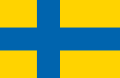 The "Pestflaggan"
 Matts Dreijer's 1946 proposal
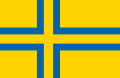 Debate proposal 1
 Debate proposal 2
 Debate proposal 3
- "Finnish" flag proposal


.svg)

.svg)

.svg)
.svg)
.svg)
.svg)
