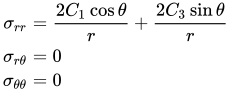
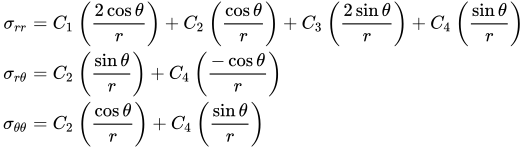
The stresses predicted by the Flamant solution are (in polar coordinates)
where are constants that are determined from the boundary conditions and the geometry of the wedge (i.e., the angles ) and satisfy
where are the applied forces.
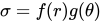
The wedge problem is self-similar and has no inherent length scale. Also, all quantities can be expressed in the separated-variable form . The stresses vary as .
Displacements at the surface of the half-plane
Elastic half-plane loaded by two point forces.
For the special case where , , the wedge is converted into a half-plane with a normal force and a tangential force. In that case
The dependence of the displacements implies that the displacement grows the further one moves from the point of application of the force (and is unbounded at infinity). This feature of the Flamant solution is confusing and appears unphysical.[2]
The displacements in the directions at the surface of the half-plane are given by
If we assume the stresses to vary as , we can pick terms containing in the stresses from Michell's solution. Then the Airy stress function can be expressed as
The constants can then, in principle, be determined from the wedge geometry and the applied boundary conditions.
However, the concentrated loads at the vertex are difficult to express in terms of tractionboundary conditions because
the unit outward normal at the vertex is undefined
the forces are applied at a point (which has zero area) and hence the traction at that point is infinite.
Bounded elastic wedge for equilibrium of forces and moments.
To get around this problem, we consider a bounded region of the wedge and consider equilibrium of the bounded wedge.[3][4] Let the bounded wedge have two traction free surfaces and a third surface in the form of an arc of a circle with radius . Along the arc of the circle, the unit outward normal is where the basis vectors are . The tractions on the arc are
Next, we examine the force and moment equilibrium in the bounded wedge and get
We require that these equations be satisfied for all values of and thereby satisfy the boundary conditions.
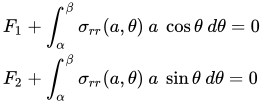
If we assume that everywhere, then the traction-free conditions and the moment equilibrium equation are satisfied and we are left with
and along except at the point . But the field everywhere also satisfies the force equilibrium equations. Hence this must be the solution. Also, the assumption implies that .
Therefore,
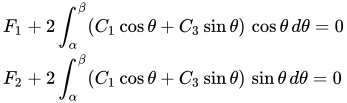
To find a particular solution for we have to plug in the expression for into the force equilibrium equations to get a system of two equations which have to be solved for :
Forces acting on a half-plane
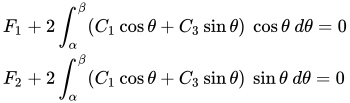
If we take and , the problem is converted into one where a normal force and a tangential force act on a half-plane. In that case, the force equilibrium equations take the form
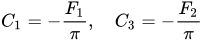
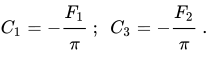
Therefore
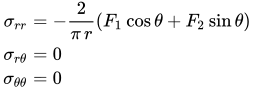
The stresses for this situation are
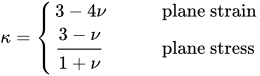
Using the displacement tables from the Michell solution, the displacements for this case are given by
Displacements at the surface of the half-plane
To find expressions for the displacements at the surface of the half plane, we first find the displacements for positive () and negative () keeping in mind that along these locations.
For we have
For we have
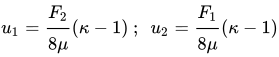
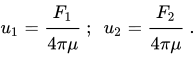
We can make the displacements symmetric around the point of application of the force by adding rigid body displacements (which does not affect the stresses)
and removing the redundant rigid body displacements
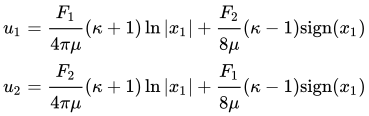
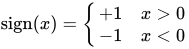
Then the displacements at the surface can be combined and take the form
where
References
↑ A. Flamant. (1892). Sur la répartition des pressions dans un solide rectangulaire chargé transversalement. Compte. Rendu. Acad. Sci. Paris, vol. 114, p. 1465.






![{\displaystyle {\begin{aligned}u_{r}&=-{\cfrac {1}{4\pi \mu }}\left[F_{1}\{(\kappa -1)\theta \sin \theta -\cos \theta +(\kappa +1)\ln r\cos \theta \}+\right.\\&\qquad \qquad \left.F_{2}\{(\kappa -1)\theta \cos \theta +\sin \theta -(\kappa +1)\ln r\sin \theta \}\right]\\u_{\theta }&=-{\cfrac {1}{4\pi \mu }}\left[F_{1}\{(\kappa -1)\theta \cos \theta -\sin \theta -(\kappa +1)\ln r\sin \theta \}-\right.\\&\qquad \qquad \left.F_{2}\{(\kappa -1)\theta \sin \theta +\cos \theta +(\kappa +1)\ln r\cos \theta \}\right]\end{aligned}}}](https://wikimedia.org/api/rest_v1/media/math/render/svg/71b35795e6f56d3f12c80650c0a637512d84e405)










![{\displaystyle {\begin{aligned}\sum f_{1}&=F_{1}+\int _{\alpha }^{\beta }\left[\sigma _{rr}(a,\theta )~\cos \theta -\sigma _{r\theta }(a,\theta )~\sin \theta \right]~a~d\theta =0\\\sum f_{2}&=F_{2}+\int _{\alpha }^{\beta }\left[\sigma _{rr}(a,\theta )~\sin \theta +\sigma _{r\theta }(a,\theta )~\cos \theta \right]~a~d\theta =0\\\sum m_{3}&=\int _{\alpha }^{\beta }\left[a~\sigma _{r\theta }(a,\theta )\right]~a~d\theta =0\end{aligned}}}](https://wikimedia.org/api/rest_v1/media/math/render/svg/ae0856512e14e7141cc84069a1c891480919ddc7)
















![{\displaystyle {\begin{aligned}u_{r}=u_{1}&={\cfrac {F_{1}}{4\pi \mu }}\left[1-(\kappa +1)\ln |x_{1}|\right]\\u_{\theta }=u_{2}&={\cfrac {F_{2}}{4\pi \mu }}\left[1+(\kappa +1)\ln |x_{1}|\right]\end{aligned}}}](https://wikimedia.org/api/rest_v1/media/math/render/svg/6b29278fedebf4e4dc3530eeddfbae884dbd692f)
![{\displaystyle {\begin{aligned}u_{r}=-u_{1}&=-{\cfrac {F_{1}}{4\pi \mu }}\left[1-(\kappa +1)\ln |x_{1}|\right]+{\cfrac {F_{2}}{4\mu }}(\kappa -1)\\u_{\theta }=-u_{2}&={\cfrac {F_{1}}{4\mu }}(\kappa -1)-{\cfrac {F_{2}}{4\pi \mu }}\left[1+(\kappa +1)\ln |x_{1}|\right]\end{aligned}}}](https://wikimedia.org/api/rest_v1/media/math/render/svg/de0794d1191dc1072e677b52e7ba748fb2c170ce)