Flora of Nepal
From Wikipedia, the free encyclopedia

| Part of a series on the |
| Wildlife of Nepal |
|---|
 |

The flora of Nepal is one of the richest in the world due to the diverse climate, topology and geography of the country. Research undertaken in the late 1970s and early 1980s documented 5067 species of which 5041 were angiosperms and the remaining 26 species were gymnosperms.[1] The Terai area has hardwood, bamboo, palm, and sal trees.[2] Notable plants include the garden angelica, Luculia gratissima, Meconopsis villosa, and Persicaria affinis. However, according to ICOMOS checklist (as of 2006), in the protected sites, there are 2,532 species of vascular plants under 1,034 genera and 199 families. The variation in figures is attributed to inadequate floral coverage filed studies.[3] Some of the plants contain medicinal values. It contains certain chemical which is used to heal wound by There are 400 species of vascular plants which are endemic to Nepal. Of these, two in particular are orchids Pleione coronaria and Oreorchis porphyranthes. The most popular endemic plant of Nepal is rhododendron (arboreum) which in Nepali language is called lali guras.[4]
Seeds
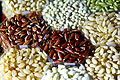
93% of human diet depend upon plants and remaining 7% of food rely on animals that directly or indirectly depends upon plants.[5] Nepalese people consume plants according to the geographical structure of Nepal. Human consume seed, root, whole plants, flower as their food.[6]
Seeds consumed in Nepal usually are:[7][8][9][10][11][12][13][14][15]
 Rice
Rice Maize
Maize Wheat
Wheat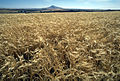 Barley
 Pumpkin
.jpg)


Leaves
Leaves consumed in Nepal usually includes:[16][17][18][19]
Fruits
Fruits of Nepal usually includes:[20][21][22][23][24]
Roots
Some of the roots consumed as food in Nepal are:[25][26][27]
Medical usage
Plants were the main source of therapy till the middle of the 19th century. More than 50% of world population depends on traditional medicine.[28] There are between 1600 and 1900 plant species present in Nepal, and a large variety of them are frequently used in traditional medical practices. These plants are used for their medical benefits and have a profound cultural impact on the nation.[29] The oldest repository that is known to record the medicinal plants used in the Himalayas is known as Rigveda (4500 BC and 1600 BC), which explained the medical usage of 67 plants. The Ayurveda (the foundation of science of life and the art of healing of Hindu culture) explain the therapeutic properties of 1200 plants.[30]
| S.N | Scientific name
(family) |
English name | Nepali Name | Part | Usage |
|---|---|---|---|---|---|
| 1. | Abies spectabilis(Pinaceae) | Himalayan salla | Gobre salla | leaves | used to cure cough and cold[31] |
| 2. | Acacia catechu(Mimosaceae) | Cutch tree | Khair | wood | used to cure cough and cod[31] |
| 3. | Aconitum Ferox (Ranunculaceae) | Himalayan monkshook | Bikh | roots | paste is used for joint pain[31] |
| 4. | Aconitum heterophyllum
(Ranunculaceae) |
Aconites | Bish | rhizome | used to cure fever, body ache cold, cough, running nose etc.[31] |
| 5. | Aesculus indica
(Sapindaceae) |
Indian horse chestnut | Karu | seed | oil extracted from seed is used for joint pain skin[31] |
| 6. | Ageratum conyzoides(Asteraceae) | Ageratum | Gandhe Jhar | leaf | juice extracted is applied to cure wounds.
docoction is also use for diarrhea, dysentery etc.[31] |
| 7. | Amaranthus spinosus(Amaranthaceae) | Prickly amaranth | Bagani dhap | root | paste is applied to heal cuts and wounds[31] |
| 8. | Andrographis paniculata(Acanthaceae) | Kalmegh | Kariyat | whole plant | Plant juice is used to cure infections[31] |
| 9. | Acorus calamus L.
(Araceae) |
Sweet flag | Bojho | root | paste is used to heal wounds in cattles [32] |
| 10. | Ageratum conyzoides L.(Asteraceae) | Goat weed | Gandhe jhar | leaf | juice is used to cure wounds[32] |
| 11. | Aloe Barbadensis Miller Asphodelaceae(Lilaceae) | Aloe vera | Ghiu kumari | leaf | gel extracted from leaf is applied to heal wounds[33][34] |
| 12. | Artemisia dubia Wall. ex Besser (Asteraceae) | Mugwort | Titepati | leaf and rhizome | applied on wounds to stop bleeding[32][35] |
| 13. | Azadirachta indica A. Juss
(Meliaceae) |
Margosa | Neem | leaf | leaf decoction is applied to wounds of cattle and human[32] |
| 14. | Cannabis sativa L.
(Cannabineae) |
Hemp | Bhang | Leaf | extracted juice from leaf applied to wounds[32] |
| 15. | Centella Asiatical(l.) Urb. | Pennywort | Ghodtapre | leaf | juice is used to treat wounds[32] |
| 16. | Curcuma Augustifolia Roxb. (Zingiberaceae) | Turmeric | Beshar | root | paste made of turmeric powder and oil is applied to wounds[33] |
| 17. | Cynodon dactylon(L.) Pers.
(Poaceae) |
Bermuda grass | Dubo | whole plant | paste of whole plant is applied to wounds[citation needed] |
| 18. | Jatropha curcas L.(Euphoriaceae) | Physic nut | Saruwa | Latex | Latex is used to care gums infection[36] |
| 19. | Ocimum tenuflorum L.
(Lamiaceae) |
Holy basil | Tulashi | leaf | leaf juice is applied to wounds [32] |
| 20. | Oxalis corniculata L. (Oxalidaceae) | Indian sorrel | Chari amilo | plant | the juice of the plant is applied to heal wounds[32] |
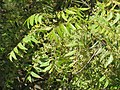 Azadirachta indica
 Abies spectabiis
 Acorus calamus
 Oxalis corniculata
.jpg)


Spices
Herbs and spices are food additives used to enhance taste, color, aroma and to preserve food. Most of the spices have health benefits and are used as traditional medicine.[37] Following are the list of plants used as spices
| S.N | Scientific name
(Family) |
English name | Nepali Name | part use as spices |
|---|---|---|---|---|
| 1. | Acorus calamus L.
(Acoraceae) |
Sweet flag | Bojo | leaves, steam and rhizomes[38] |
| 2. | Allium hypsistum stearn
(Amarylidaceae) |
Jimbu | Jimbhu | Dried leaves[39] |
| 3. | Allium sativum L.
(Amarylidaceae) |
Garlic | Lasun | Leaves and cloves[40] |
| 4. | Allium cepa L.
(Amarylidaceae) |
Onion | Pyaj | Leaf and bulb[41] |
| 5. | Amomum subulatum Roxb.
(Zingiberaceae) |
Black cardamom | Alichi | Dried seed[42] |
| 6. | Cinnamomum tamala (Buch.-Ham.) T.Nees &Eberm
(Lauceae) |
Bay leaf | Tejpat | fresh or dried leaf[43] |
| 7. | Cinnamomum verum J. Presl
(LAuraceae) |
Cinnamon | Dalchini | Dried bark[44] |
| 8. | Coriandrum sativum L.
(Apiaceae) |
Coriander | Dhaniya | Fresh leaves and dried seed[45] |
| 9. | Cuminum cyminum L.
(Apiaceae) |
Cummin | Jeera | Seed[citation needed] |
| 10. | Curcuma Longa L.
(Zingiberaceae) |
Turmeric | Besar | rhizome[46] |
| 11. | Elettaria cardamomum L. Maton
(Zingiberaceae) |
True cardamom | Sukmel | dried seed[47] |
| 12. | Ferula assa-foetida L.
(Apiaceae) |
Asafetida | Hing | rhizome[46] |
| 13 | Mentha arvensis L.
(Lamiaceae) |
Wild mint | pudina/barbari | leaves[48] |
| 14. | Myristica fragrans Houtt.
(Myristicaceae) |
Nutmeg | Jaiphal | seed[49] |
| 15. | Nigella sativa L.
(Rananculaceae) |
Black cumin | Mungrelo | seed[50] |
| 16. | Piper nigrum L.
(Piperaceae) |
Black pepper | Marich | fruit[51] |
| 17. | Sesamum indicum L.
(Pedaliaceae) |
Sesame | Til | seed[48] |
| 18. | Syzygium aromaticum (L.)Merr. & L.M. Perry | Clove | Lwang | flower bud[52] |
| 19. | Trigonella foenumgraecum L.
(Fabaceae) |
Fenugreek | Methi | dried fruits[53] |
| 20. | Zingiber officinale Roscoe(Zingiberaceae) | Ginger | Aduwa | fresh and dried rhizome[54] |


.jpg)

