Flueggea anatolica
From Wikipedia, the free encyclopedia
| Flueggea anatolica | |
|---|---|
Scientific classification  | |
| Kingdom: | Plantae |
| Clade: | Tracheophytes |
| Clade: | Angiosperms |
| Clade: | Eudicots |
| Clade: | Rosids |
| Order: | Malpighiales |
| Family: | Phyllanthaceae |
| Genus: | Flueggea |
| Species: | F. anatolica |
| Binomial name | |
| Flueggea anatolica Gemici | |
Flueggea anatolica is a species of plant in the family Phyllanthaceae, endemic to Turkey. The species exists in only three small, disjunct populations in southern Turkey, at elevations ranging from 300 to 970 metres. It produces small seeds with an active ballistic dispersal mechanism, which show physiological dormancy requiring about 10 weeks of cold stratification to germinate successfully. The plant primarily regenerates through sprouts rather than seeds in the wild, contributing to its vulnerable conservation status. F. anatolica's wood structure features a semi-ring porous pattern with predominantly single vessels that have spiral thickenings and alternately arranged pits, displaying the "Glochidion-type" wood characteristics common in Phyllanthaceae. Conservation efforts focus on seed collection and storage techniques, as the species requires protection due to its extremely restricted range.
Flueggea anatolica is a woody shrub with small seeds that have an average 1000-seed weight of 4.9 grams. The seeds measure about 2.57 mm in length, 1.93 mm in width, and 1.71 mm in thickness, though these dimensions demonstrate significant variation between different populations. The shrub's fruits have an active ballistic dispersal mechanism, meaning they actively eject their seeds during the fruit drying phase, making collection from the ground difficult due to their small size.[2]
Distribution
The species exists in only three small, disjunct populations in southern Turkey. These populations are located in Tarsus (elevation: 300 m), Kozan (380 m), and Andırın (970 m). In these limited areas, F. anatolica individuals arise primarily from sprouts, with regeneration from seeds being rare in the wild. This limited distribution contributes significantly to its endangered status.[2]
Conservation status
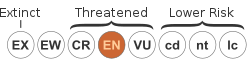
Flueggea anatolica is classified as critically endangered according to Turkey's conservation assessments. As a relatively recently discovered endemic woody plant, it requires urgent conservation attention. Flueggea species are mostly found in relict populations worldwide, with F. anatolica being particularly vulnerable due to its extremely restricted range.[2]
Seed biology and germination
The seeds of F. anatolica show physiological dormancy, which means they require specific environmental conditions to overcome internal germination barriers. These seeds require roughly 10 weeks of prechilling (exposure to cold, moist conditions) at 4°C to break dormancy. After this pretreatment, the seeds germinate best at temperatures between 16–28°C, with 24°C appearing to be optimal for both germination rate and speed. Properly pretreated seeds can achieve germination rates of 90–92%, though they do not germinate during the prechilling period at 4°C itself. Studies have also shown that a warm incubation period (24°C for 4 weeks) prior to prechilling has only a minor effect on breaking dormancy, suggesting that cold stratification is the primary requirement.[2]
Seed storage and viability
For conservation purposes, F. anatolica seeds can be stored at a moisture content of 3–8% and a temperature of 4° C or less. Seeds maintained at these conditions can retain their viability for at least one year, with minimal loss of germination potential. Research indicates that dormant seeds (those that have not been prechilled) store better than nondormant ones, which lose significant viability even under optimal storage conditions. This information is important for ex situ conservation efforts in seed banks, particularly given the species' endangered status.[2]