Focal conics
From Wikipedia, the free encyclopedia

A,C: vertices of the ellipse and foci of the hyperbola
E,F: foci of the ellipse and vertices of the hyperbola

A: vertex of the red parabola and focus of the blue parabola
F: focus of the red parabola and vertex of the blue parabola
In geometry, focal conics are a pair of curves consisting of[1][2] either
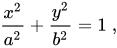
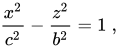
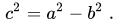
- an ellipse and a hyperbola, where the hyperbola is contained in a plane, which is orthogonal to the plane containing the ellipse. The vertices of the hyperbola are the foci of the ellipse and its foci are the vertices of the ellipse (see diagram).
or
- two parabolas, which are contained in two orthogonal planes and the vertex of one parabola is the focus of the other and vice versa.
Focal conics play an essential role answering the question: "Which right circular cones contain a given ellipse or hyperbola or parabola (see below)".
Focal conics are used as directrices for generating Dupin cyclides as canal surfaces in two ways.[3][4]
Focal conics can be seen as degenerate focal surfaces: Dupin cyclides are the only surfaces, where focal surfaces collapse to a pair of curves, namely focal conics.[5]
In Physical chemistry focal conics are used for describing geometrical properties of liquid crystals.[6]
One should not mix focal conics with confocal conics. The latter ones have all the same foci.