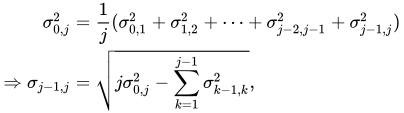
Given that the underlying random variables for non overlapping time intervals are independent, the variance is additive (see variance). So for yearly time slices we have the annualized volatility as
where
 is the number of years and the factor
  scales the variance so it is a yearly one
 is the current (at time 0) forward volatility for the period
 ![{\displaystyle [i,\,j]}](https://wikimedia.org/api/rest_v1/media/math/render/svg/a49617577b80849305bf2c7f3df491451323ed60)
 the spot volatility for maturity
  .
.
To ease computation and get a non-recursive representation, we can also express the forward volatility directly in terms of spot volatilities:[1]
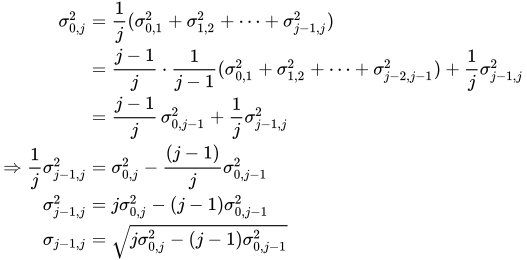
Following the same line of argumentation we get in the general case with  for the forward volatility seen at time
  :
:
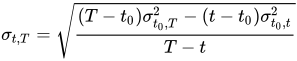 ,
,
which simplifies in the case of  to
to
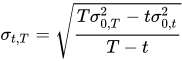 .
.


