Fourier–Bessel series
Infinite series of Bessel functions
From Wikipedia, the free encyclopedia
In mathematics, Fourier–Bessel series is a particular kind of generalized Fourier series (an infinite series expansion on a finite interval) based on Bessel functions.
Fourier–Bessel series are used in the solution to partial differential equations, particularly in cylindrical coordinate systems.
Definition
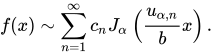
The Fourier–Bessel series of a function f(x) with a domain of [0, b] satisfying f(b) = 0


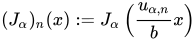
is the representation of that function as a linear combination of many orthogonal versions of the same Bessel function of the first kind Jα, where the argument to each version n is differently scaled, according to [1][2] where uα,n is a root, numbered n associated with the Bessel function Jα and cn are the assigned coefficients:[3]
![{\displaystyle f:[0,b]\to \mathbb {R} }](http://wikimedia.org/api/rest_v1/media/math/render/svg/c2f74d3dedb1846830ea4bfbe8f3a0700a56135f)
Interpretation
The Fourier–Bessel series may be thought of as a Fourier expansion in the ρ coordinate of cylindrical coordinates. Just as the Fourier series is defined for a finite interval and has a counterpart, the continuous Fourier transform over an infinite interval, so the Fourier–Bessel series has a counterpart over an infinite interval, namely the Hankel transform.
Calculating the coefficients
As said, differently scaled Bessel Functions are orthogonal with respect to the inner product

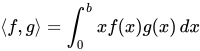
according to
![{\displaystyle \int _{0}^{b}xJ_{\alpha }\left({\frac {xu_{\alpha ,n}}{b}}\right)\,J_{\alpha }\left({\frac {xu_{\alpha ,m}}{b}}\right)\,dx={\frac {b^{2}}{2}}\delta _{mn}[J_{\alpha +1}(u_{\alpha ,n})]^{2},}](http://wikimedia.org/api/rest_v1/media/math/render/svg/370e5ce7548098c9890713c039be4465258496f6)
(where: is the Kronecker delta). The coefficients can be obtained from projecting the function f(x) onto the respective Bessel functions:


where the plus or minus sign is equally valid.
For the inverse transform, one makes use of the following representation of the Dirac delta function[4]

Applications
The Fourier–Bessel series expansion employs aperiodic and decaying Bessel functions as the basis. The Fourier–Bessel series expansion has been successfully applied in diversified areas such as Gear fault diagnosis,[5] discrimination of odorants in a turbulent ambient,[6] postural stability analysis, detection of voice onset time, glottal closure instants (epoch) detection, separation of speech formants, speech enhancement,[7] and speaker identification.[8] The Fourier–Bessel series expansion has also been used to reduce cross terms in the Wigner–Ville distribution.
Dini series
A second Fourier–Bessel series, also known as Dini series, is associated with the Robin boundary condition where is an arbitrary constant. The Dini series can be defined by


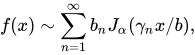
where is the n-th zero of .


The coefficients are given by

