The Fritz John conditions (abbr. FJ conditions), in mathematics, are a necessary condition for a solution in nonlinear programming to be optimal.[1] They are used as lemma in the proof of the Karush–Kuhn–Tucker conditions, but they are relevant on their own.
We consider the following optimization problem:
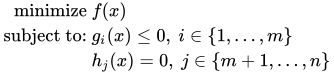
where ƒ is the function to be minimized,  the inequality constraints and
  the equality constraints, and where, respectively,
  ,
,  and
and  are the indices sets of inactive, active and equality constraints and
  is an optimal solution of
  , then there exists a non-zero vector
 ![{\displaystyle \lambda =[\lambda _{0},\lambda _{1},\lambda _{2},\dots ,\lambda _{n}]}](//wikimedia.org/api/rest_v1/media/math/render/svg/e25076573b9439185d47b40d8f29939905230dbe) such that:
such that:
![{\displaystyle {\begin{cases}\lambda _{0}\nabla f(x^{*})+\sum \limits _{i\in {\mathcal {A}}}\lambda _{i}\nabla g_{i}(x^{*})+\sum \limits _{i\in {\mathcal {E}}}\lambda _{i}\nabla h_{i}(x^{*})=0\\[10pt]\lambda _{i}\geq 0,\ i\in {\mathcal {A}}\cup \{0\}\\[10pt]\exists i\in \left(\{0,1,\ldots ,n\}\backslash {\mathcal {I}}\right)\left(\lambda _{i}\neq 0\right)\end{cases}}}](//wikimedia.org/api/rest_v1/media/math/render/svg/b50d43581b08b65ec6bdbc60618b51b75a1b5bba)
 if the
  and
and  are linearly independent or, more generally, when a constraint qualification holds.
Named after Fritz John, these conditions are equivalent to the Karush–Kuhn–Tucker conditions in the case . When  , the condition is equivalent to the violation of Mangasarian–Fromovitz constraint qualification (MFCQ). In other words, the Fritz John condition is equivalent to the optimality condition KKT or not-MFCQ.[citation needed]


![{\displaystyle \lambda =[\lambda _{0},\lambda _{1},\lambda _{2},\dots ,\lambda _{n}]}](http://wikimedia.org/api/rest_v1/media/math/render/svg/e25076573b9439185d47b40d8f29939905230dbe)
![{\displaystyle {\begin{cases}\lambda _{0}\nabla f(x^{*})+\sum \limits _{i\in {\mathcal {A}}}\lambda _{i}\nabla g_{i}(x^{*})+\sum \limits _{i\in {\mathcal {E}}}\lambda _{i}\nabla h_{i}(x^{*})=0\\[10pt]\lambda _{i}\geq 0,\ i\in {\mathcal {A}}\cup \{0\}\\[10pt]\exists i\in \left(\{0,1,\ldots ,n\}\backslash {\mathcal {I}}\right)\left(\lambda _{i}\neq 0\right)\end{cases}}}](http://wikimedia.org/api/rest_v1/media/math/render/svg/b50d43581b08b65ec6bdbc60618b51b75a1b5bba)


