Fujikyu 8000 series
From Wikipedia, the free encyclopedia
| Fujikyu 8000 series | |
|---|---|
 The 8000 series train in January 2018 | |
| In service | July 2014 – present |
| Replaced | 2000 series |
| Entered service | 12 July 2014 |
| Refurbished | 2013-2014 |
| Number built | 3 cars (1 set) |
| Number in service | 3 cars (1 set) |
| Formation | 3 cars per set |
| Capacity | 160 |
| Operator | Fujikyu |
| Line served | Fujikyuko Line |
| Specifications | |
| Car body construction | Steel |
| Car length | 20,650 mm (67 ft 9 in) (end cars) 19,500 mm (64 ft 0 in) (intermediate car) |
| Width | 2,900 mm (9 ft 6 in) |
| Height | 4,050 mm (13 ft 3 in) |
| Doors | 1 per side |
| Maximum speed | 120 km/h (75 mph) |
| Electric system | 1,500 V DC overhead wire |
| Track gauge | 1,067 mm (3 ft 6 in) |
The Fujikyu 8000 series (富士急行8000系, Fuji Kyūkō 8000-kei) is a DC electric multiple unit (EMU) train type operated by the private railway operator Fuji Kyuko (Fujikyu) on Fujisan Limited Express (フジサン特急, Fujisan Tokkyū) limited-stop services on the Fujikyuko Line in Yamanashi Prefecture, Japan, since July 2014.[1]
The three-car train was converted from a former Odakyu 20000 series RSE 7-car "Romancecar" EMU built in 1991, withdrawn in March 2012, and purchased by Fujikyu in November 2013.[1][2] Like the 2000 series trains it supersedes, the exterior of the train is covered in "Mount Fuji" caricatures.[1] The train has a maximum operating speed of 120 km/h (75 mph), but is limited to 60 km/h (37 mph) on the Fujikyuko Line.[3]
Operations
The 8000 series train operates on Fujisan Limited Express limited-stop services on the 26.6 km (16.5 mi) Fujikyuko Line in Yamanashi Prefecture, which runs between Ōtsuki and Kawaguchiko.[1] The train replaced one of the operator's 2000 series sets, which were both rebuilt from the former JR East 165 series Panorama Express Alps Joyful Train excursion EMU sets.[1]
Formation
The sole three-car set is formed as shown below, with car 1 at the Fujisan end.[3]
| Car No. | 1 | 2 | 3 |
|---|---|---|---|
| Designation | Msc1 | Ts | Msc2 |
| Numbering | KuMoRo 8001 | SaRo 8101 | KuMoRo 8051 |
| Weight (t) | 44.1 | 37.3 | 45.2 |
| Seating capacity | 45 | 55 | 60 |
- KuMoRo 8001 was converted from former Odakyu car DeHa 20002, SaRo 8101 was converted from former SaHa 200052, and KuMoRo 8051 was converted from former DeHa 20302.[3]
- Car 1 is designated as an observation car requiring payment of a supplementary fare, while cars 2 and 3 are designated as non-reserved seating.[3]
- Cars 1 and 3 are each fitted with an FPS33F single-arm pantograph.[3]
 Fujikyuko 8000 series EMU in Ōtsuki Station
 Fujikyuko 8000 series car 1
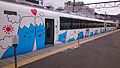 Fujikyuko 8000 series car 2


Interior
Car 1 has an observation lounge area with sofa seating immediately behind the driver's position. The main part of the saloon has rotating unidirectional reclining seating arranged 2+1 abreast with a seat pitch of 1,000 mm (39 in).[3] Fixed 4-person facing seating bays with tables are situated at the end of the car.[3] Cars 2 and 3 have rotating unidirectional reclining seating arranged 2+2 abreast with a seat pitch of 1,000 mm (39 in).[3] Car 2 has a wheelchair-accessible seating area and a universal access toilet.[3]


