Fundamental lemma of sieve theory
From Wikipedia, the free encyclopedia
In number theory, the fundamental lemma of sieve theory is any of several results that systematize the process of applying sieve methods to particular problems. Halberstam & Richert [1]: 92–93 write:
A curious feature of sieve literature is that while there is frequent use of Brun's method there are only a few attempts to formulate a general Brun theorem (such as Theorem 2.1); as a result there are surprisingly many papers which repeat in considerable detail the steps of Brun's argument.
Diamond & Halberstam[2]: 42 attribute the terminology Fundamental Lemma to Jonas Kubilius.
We use these notations:
- is a set of positive integers, and is its subset of integers divisible by
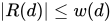
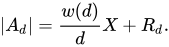
- and are functions of and of that estimate the number of elements of that are divisible by , according to the formula


- Thus represents an approximate density of members divisible by , and represents an error or remainder term.

- is a set of primes, and is the product of those primes
- is the number of elements of not divisible by any prime in that is
- is a constant, called the sifting density,[3]: 28 that appears in the assumptions below. It is a weighted average of the number of residue classes sieved out by each prime.