Every Galois ring GR(pn, r) has a primitive (pr – 1)-th root of unity. It is the equivalence class of x in the quotient ![{\displaystyle \mathbb {Z} [x]/(p^{n},f(x))}](https://wikimedia.org/api/rest_v1/media/math/render/svg/4720060a56369dca3ad805ba72ae08285b3a8965) when f is chosen to be a primitive polynomial. This means that, in
when f is chosen to be a primitive polynomial. This means that, in ![{\displaystyle (\mathbb {Z} /p^{n}\mathbb {Z} )[x]}](https://wikimedia.org/api/rest_v1/media/math/render/svg/79fe6ef9912489bf6bc472b46447f5d134c4a2ca) , the polynomial
, the polynomial  divides
  and does not divide
  for all m < pr – 1. Such an f can be computed by starting with a primitive polynomial of degree r over the finite field
  and using Hensel lifting.[9]
A primitive (pr – 1)-th root of unity  can be used to express elements of the Galois ring in a useful form called the p-adic representation. Every element of the Galois ring can be written uniquely as

where each  is in the set
  .[7][9]
Every Galois ring is a local ring. The unique maximal ideal is the principal ideal  , consisting of all elements which are multiples of p. The residue field
 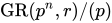 is isomorphic to the finite field of order pr. Furthermore,
  are all the ideals.[6]
The Galois ring GR(pn, r) contains a unique subring isomorphic to GR(pn, s) for every s which divides r. These are the only subrings of GR(pn, r).[10]
The units of a Galois ring R are all the elements which are not multiples of p. The group of units, R×, can be decomposed as a direct product G1×G2, as follows. The subgroup G1 is the group of (pr − 1)-th roots of unity. It is a cyclic group of order pr − 1. The subgroup G2 is 1+pR, consisting of all elements congruent to 1 modulo p. It is a group of order pr(n−1), with the following structure:
- if p is odd or if p = 2 and n ≤ 2, then
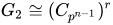 , the direct product of r copies of the cyclic group of order pn−1
- if p = 2 and n ≥ 3, then

This description generalizes the structure of the multiplicative group of integers modulo pn, which is the case r = 1.[11]
Analogous to the automorphisms of the finite field  , the automorphism group of the Galois ring GR(pn, r) is a cyclic group of order r.[12] The automorphisms can be described explicitly using the p-adic representation. Specifically, the map

(where each is in the set ) is an automorphism, which is called the generalized Frobenius automorphism. The fixed points of the generalized Frobenius automorphism are the elements of the subring  . Iterating the generalized Frobenius automorphism gives all the automorphisms of the Galois ring.[13]
The automorphism group can be thought of as the Galois group of GR(pn, r) over , and the ring GR(pn, r) is a Galois extension of . More generally, whenever r is a multiple of s, GR(pn, r) is a Galois extension of GR(pn, s), with Galois group isomorphic to 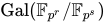 .[14][13]

![{\displaystyle \operatorname {GR} (p^{n},r)\cong \mathbb {Z} [x]/(p^{n},f(x))}](https://wikimedia.org/api/rest_v1/media/math/render/svg/dcdb436b83832ab64d761dc22108a5ab60a27d25)
![{\displaystyle f(x)\in \mathbb {Z} [x]}](https://wikimedia.org/api/rest_v1/media/math/render/svg/cb8266c32dfc2904dc4331ea8906ad341a05ce1c)
![{\displaystyle \mathbb {Z} [x]/(4,x^{3}+2x^{2}+x-1)}](https://wikimedia.org/api/rest_v1/media/math/render/svg/27868fab25d56602a73e5fd7caef10fe8d82b619)
![{\displaystyle (\mathbb {Z} /4\mathbb {Z} )[\xi ]}](https://wikimedia.org/api/rest_v1/media/math/render/svg/2b6ec13cf0fb562ab9d005fc16b2b9490e2320ec)


![{\displaystyle (\mathbb {Z} /4\mathbb {Z} )[x]}](https://wikimedia.org/api/rest_v1/media/math/render/svg/82730be1bcda68611474545fc5555273cf88baea)



