Gammarus desperatus
From Wikipedia, the free encyclopedia
| Gammarus desperatus | |
|---|---|
 | |
| G. desperatus in Chaves County, New Mexico, United States | |
Scientific classification  | |
| Kingdom: | Animalia |
| Phylum: | Arthropoda |
| Class: | Malacostraca |
| Order: | Amphipoda |
| Family: | Gammaridae |
| Genus: | Gammarus |
| Species: | G. desperatus |
| Binomial name | |
| Gammarus desperatus Cole, 1981 | |
Gammarus desperatus, commonly known as Noel's Amphipod, is a species of small, amphipod crustacean in the family Gammaridae.
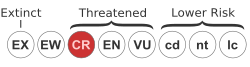
Noel's Amphipod was formerly found at three sites in New Mexico, but it has since been extirpated from two of these sites.[1] Noel's Amphipod only survives within Bitter Lake National Wildlife Refuge.[1] It is listed as critically endangered on the IUCN Red List,[1] and as an endangered species under the United States Endangered Species Act.[2]
Noel's Amphipods are small aquatic invertebrates found in freshwater. Noel's amphipods are a brownish-green color, with kidney-shaped eyes and red stripes running along numerous different segments.[3] They have two sets of antennae that are covered in setae, which are hair-like structures found on many invertebrates.[4] Noel's Amphipod is also known to have 5–7 spines located near the head.[5] Males are somewhat bigger than females, with sizes ranging from 8.5 to 14.8 millimeters.[3]
Life history
Noel's amphipods complete a full life cycle in one year. Due to the short life span of the species, individuals have a fast growth rate and reach sexual maturity usually within two months. The breeding times range from February to October depending on water temperatures.[3] When a male and female amphipod come together to mate, the male grasps the female with its gnathopods and guards her for up to seven days to defend against potential rival males.[6] During this period of mate-guarding, the pair continue to feed and swim until the female molts.[3] Shortly after molting, the female releases the eggs into the marsupium (egg pouch), and the male then fertilizes the eggs. The female incubates the eggs in the egg pouch until the young hatch, then releases them after a few hours or days.[6] The Noel's amphipod produces a brood of 15 to 50 young amphipods.[3]
Ecology
Diet
Noel's amphipods are omnivorous and feed on algae, underwater vegetation and decaying matter. They often are seen feeding on biofilms that form on submerged aquatic vegetation; these biofilms consist of algae, diatoms, bacteria, and fungi. Microbial foods associated with periphyton or aquatic plants, such as algae and bacteria, are essential for juvenile amphipods.[7]
Behavior
Noel's amphipods exhibit a period of mate-guarding in which the male is territorial over the female and protects his mate from other males that compete for the ability to fertilize the female's eggs.[6] This species is mostly nocturnal due to its sensitivity to light, and is mostly active only during the nighttime.[3]
Habitat
The amphipods require clean, shallow, cool, and permanently flowing well-oxygenated waters of streams, ponds, ditches, sloughs, and springs.[6][3] In addition to this, this species is very sensitive to pH changes in the water, and also requires high levels of calcium for survival.[6] These amphipods are often found underneath stones and amongst submerged aquatic vegetation. They are extremely sensitive to water contamination and do not tolerate habitat desiccation, standing water or sedimentation.[3] In summary, this species is very sensitive to habitat degradation.
Range
Noel's amphipod was formerly found at three sites in New Mexico, but it has since been eradicated from two of these sites.[1] Noel's amphipod only survives within Bitter Lake National Wildlife Refuge at the Sago Spring Wetland Complex, Bitter Creek, and along the western boundary of Unit 6.[6]