Gammoid
From Wikipedia, the free encyclopedia


In matroid theory, a field within mathematics, a gammoid is a certain kind of matroid, describing sets of vertices that can be reached by vertex-disjoint paths in a directed graph.
The concept of a gammoid was introduced and shown to be a matroid by Hazel Perfect (1968), based on considerations related to Menger's theorem characterizing the obstacles to the existence of systems of disjoint paths.[1] Gammoids were given their name by Pym (1969)[2] and studied in more detail by Mason (1972).[3]
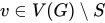
Let be a directed graph, be a set of starting vertices, and be a set of destination vertices (not necessarily disjoint from ). The gammoid derived from this data has as its set of elements. A subset of is independent in if there exists a set of vertex-disjoint paths whose starting points all belong to and whose ending points are exactly .[4]


A strict gammoid is a gammoid in which the set of destination vertices consists of every vertex in . Thus, a gammoid is a restriction of a strict gammoid, to a subset of its elements.[4][5]
Example
Consider the uniform matroid on a set of elements, in which every set of or fewer elements is independent. One way to represent this matroid as a gammoid would be to form a complete bipartite graph with a set of vertices on one side of the bipartition, with a set of vertices on the other side of the bipartition, and with every edge directed from to In this graph, a subset of is the set of endpoints of a set of disjoint paths if and only if it has or fewer vertices, because otherwise there are too few vertices in to start the paths. The special structure of this graph shows that the uniform matroid is a transversal matroid as well as being a gammoid.[6]


Alternatively, the same uniform matroid may be represented as a gammoid on a smaller graph, with only vertices, by choosing a subset of vertices and connecting each of the chosen vertices to every other vertex in the graph. Again, a subset of the vertices of the graph can be endpoints of disjoint paths if and only if it has or fewer vertices, because otherwise there are not enough vertices that can be starts of paths. In this graph, every vertex corresponds to an element of the matroid, showing that the uniform matroid is a strict gammoid.[7]
Menger's theorem and gammoid rank
The rank of a set in a gammoid defined from a graph and vertex subsets and is, by definition, the maximum number of vertex-disjoint paths from to . By Menger's theorem, it also equals the minimum cardinality of a set that intersects every path from to .[4]