Gap reduction
From Wikipedia, the free encyclopedia
In computational complexity theory, a gap reduction is a reduction to a particular type of decision problem, known as a c-gap problem. Such reductions provide information about the hardness of approximating solutions to optimization problems. In short, a gap problem refers to one wherein the objective is to distinguish between cases where the best solution is above one threshold from cases where the best solution is below another threshold, such that the two thresholds have a gap in between. Gap reductions can be used to demonstrate inapproximability results, as if a problem may be approximated to a better factor than the size of gap, then the approximation algorithm can be used to solve the corresponding gap problem.
We define a c-gap problem as follows:[1] given an optimization (maximization or minimization) problem P, the equivalent c-gap problem distinguishes between two cases, for an input k and an instance x of problem P:
- . Here, the best solution to instance x of problem P has a cost, or score, below k.
- . Here, the best solution to instance x of problem P has a cost above c⋅k. The gap between the two thresholds is thus c.
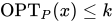

Note that whenever OPT falls between the thresholds, there is no requirement on what the output should be. A valid algorithm for the c-gap problem may answer anything if OPT is in the middle of the gap. The value c does not need to be constant; it can depend on the size of the instance of P. Note that c-approximating the solution to an instance of P is at least as hard as solving the c-gap version of P.
One can define an (a,b)-gap problem similarly. The difference is that the thresholds do not depend on the input; instead, the lower threshold is a and the upper threshold is b.
Gap-producing reduction
A gap-producing reduction is a reduction from an optimization problem to a c-gap problem, so that solving the c-gap problem quickly would enable solving the optimization problem quickly. The term gap-producing arises from the nature of the reduction: the optimal solution in the optimization problem maps to the opposite side of the gap from every other solution via reduction. Thus, a gap is produced between the optimal solution and every other solution.
A simple example of a gap-producing reduction is the nonmetric Traveling Salesman problem (i.e. where the graph's edge costs need not satisfy the conditions of a metric). We can reduce from the Hamiltonian path problem on a given graph G = (V, E) to this problem as follows: we construct a complete graph G' = (V, E'), for the traveling salesman problem. For each edge e ∈ G', we let the cost of traversing it be 1 if e is in the original graph G and ∞ otherwise. A Hamiltonian path in the original graph G exists if and only if there exists a traveling salesman solution with weight (|V|-1). However, if no such Hamiltonian path exists, then the best traveling salesman tour must have weight at least |V|. Thus, Hamiltonian Path reduces to |V|/(|V|-1)-gap nonmetric traveling salesman.
Gap-preserving reduction
A gap-preserving reduction is a reduction from a c-gap problem to a c'-gap problem. More specifically, we are given an instance x of a problem A with |x| = n and want to reduce it to an instance x' of a problem B with |x'| = n'. A gap-preserving reduction from A to B is a set of functions (k(n), k'(n'), c(n), c'(n')) such that
For minimization problems:
- OPTA(x) ≤ k ⇒ OPTB(x') ≤ k', and
- OPTA(x) ≥ c⋅k ⇒ OPTB(x') ≥ c'⋅k'
For maximization problems:
- OPTA(x) ≥ k ⇒ OPTB(x') ≥ k', and
- OPTA(x) ≤ k/c ⇒ OPTB(x') ≤ k'/c'
If c' > c, then this is a gap-amplifying reduction.