Gas electron diffraction
From Wikipedia, the free encyclopedia
Gas electron diffraction (GED) is one of the applications of electron diffraction techniques.[1] The target of this method is the determination of the structure of gaseous molecules, i.e., the geometrical arrangement of the atoms from which a molecule is built up. GED is one of two experimental methods (besides microwave spectroscopy) to determine the structure of free molecules, undistorted by intermolecular forces, which are omnipresent in the solid and liquid state. The determination of accurate molecular structures[2] by GED studies is fundamental for an understanding of structural chemistry.[3][1]
Diffraction occurs because the wavelength of electrons accelerated by a potential of a few thousand volts is of the same order of magnitude as internuclear distances in molecules. The principle is the same as that of other electron diffraction methods such as LEED and RHEED, but the obtainable diffraction pattern is considerably weaker than those of LEED and RHEED because the density of the target is about one thousand times smaller. Since the orientation of the target molecules relative to the electron beams is random, the internuclear distance information obtained is one-dimensional. Thus only relatively simple molecules can be completely structurally characterized by electron diffraction in the gas phase. It is possible to combine information obtained from other sources, such as rotational spectra, NMR spectroscopy or high-quality quantum-mechanical calculations with electron diffraction data, if the latter are not sufficient to determine the molecule's structure completely.
The total scattering intensity in GED is given as a function of the momentum transfer, which is defined as the difference between the wave vector of the incident electron beam and that of the scattered electron beam and has the reciprocal dimension of length.[4] The total scattering intensity is composed of two parts: the atomic scattering intensity and the molecular scattering intensity. The former decreases monotonically and contains no information about the molecular structure. The latter has sinusoidal modulations as a result of the interference of the scattering spherical waves generated by the scattering from the atoms included in the target molecule. The interferences reflect the distributions of the atoms composing the molecules, so the molecular structure is determined from this part.

Experiment


Figure 1 shows a drawing and a photograph of an electron diffraction apparatus. Scheme 1 shows the schematic procedure of an electron diffraction experiment. A fast electron beam is generated in an electron gun, enters a diffraction chamber typically at a vacuum of 10−7 mbar. The electron beam hits a perpendicular stream of a gaseous sample effusing from a nozzle of a small diameter (typically 0.2 mm). At this point, the electrons are scattered. Most of the sample is immediately condensed and frozen onto the surface of a cold trap held at -196 °C (liquid nitrogen). The scattered electrons are detected on the surface of a suitable detector in a well-defined distance to the point of scattering.


The scattering pattern consists of diffuse concentric rings (see Figure 2). The steep decent of intensity can be compensated for by passing the electrons through a fast rotation sector (Figure 3). This is cut in a way, that electrons with small scattering angles are more shadowed than those at wider scattering angles. The detector can be a photographic plate, an electron imaging plate (usual technique today) or other position sensitive devices such as hybrid pixel detectors (future technique).
The intensities generated from reading out the plates or processing intensity data from other detectors are then corrected for the sector effect. They are initially a function of distance between primary beam position and intensity, and then converted into a function of scattering angle. The so-called atomic intensity and the experimental background are subtracted to give the final experimental molecular scattering intensities as a function of s (the change of momentum).
These data are then processed by suitable fitting software like UNEX for refining a suitable model for the compound and to yield precise structural information in terms of bond lengths, angles and torsional angles.
Theory


GED can be described by scattering theory. The outcome if applied to gases with randomly oriented molecules is provided here in short:[5][4]
Scattering occurs at each individual atom (), but also at pairs (also called molecular scattering) (), or triples (), of atoms.


is the scattering variable or change of electron momentum, and its absolute value is defined as

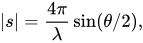
with being the electron wavelength defined above, and being the scattering angle.


The above-mentioned contributions of scattering add up to the total scattering

where is the experimental background intensity, which is needed to describe the experiment completely.

The contribution of individual atom scattering is called atomic scattering and easy to calculate:
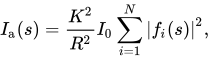
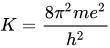
with , being the distance between the point of scattering and the detector, being the intensity of the primary electron beam, and being the scattering amplitude of the i-th atom. In essence, this is a summation over the scattering contributions of all atoms independent of the molecular structure. is the main contribution and easily obtained if the atomic composition of the gas (sum formula) is known.


The most interesting contribution is the molecular scattering, because it contains information about the distance between all pairs of atoms in a molecule (bonded or non-bonded):
![{\displaystyle I_{\text{m}}(s)={\frac {K^{2}}{R^{2}}}I_{0}\sum _{i=1}^{N}\sum _{j=1,i\neq j}^{N}|f_{i}(s)|\,|f_{j}(s)|{\frac {\sin[s(r_{ij}-\kappa s^{2})]}{sr_{ij}}}e^{-{\frac {1}{2}}l_{ij}s^{2}}\cos[\eta _{i}(s)-\eta _{i}(s)],}](https://wikimedia.org/api/rest_v1/media/math/render/svg/a131cb24e812d7b7f71bbb5a180e8f2d79acae0b)
with being the parameter of main interest: the atomic distance between two atoms, being the mean square amplitude of vibration between the two atoms, the anharmonicity constant (correcting the vibration description for deviations from a purely harmonic model), and is a phase factor, which becomes important if a pair of atoms with very different nuclear charge is involved.


The first part is similar to the atomic scattering, but contains two scattering factors of the involved atoms. Summation is performed over all atom pairs.
is negligible in most cases and not described here in more detail. is mostly determined by fitting and subtracting smooth functions to account for the background contribution.
So it is the molecular scattering intensity that is of interest, and this is obtained by calculation all other contributions and subtracting them from the experimentally measured total scattering function.
