Geiselbach
From Wikipedia, the free encyclopedia
Geiselbach | |
|---|---|
 A view of Geiselbach from the north, with the church St. Maria Magdalena | |
 Coat of arms | |
Location of Geiselbach
within Aschaffenburg district 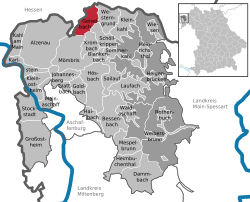 | |
 | |
| Location of Geiselbach | |
  Geiselbach  Geiselbach | |
| Coordinates: 50°07′N 9°12′E / 50.117°N 9.200°E | |
| Country | Germany |
| State | Bavaria |
| Admin. region | Unterfranken |
| District | Aschaffenburg |
| Subdivisions | 2 Ortsteile |
| Government | |
| • Mayor (2020–26) | Marianne Krohnen[1] (CSU) |
| Area | |
• Total | 9.50 km2 (3.67 sq mi) |
| Elevation | 270 m (890 ft) |
| Population (2023-12-31)[2] | |
• Total | 2,138 |
| • Density | 225/km2 (583/sq mi) |
| Time zone | UTC+01:00 (CET) |
| • Summer (DST) | UTC+02:00 (CEST) |
| Postal codes | 63826 |
| Dialling codes | 06024 |
| Vehicle registration | AB |
| Website | geiselbach.de |
Geiselbach is a municipality in the Aschaffenburg district in the Regierungsbezirk of Lower Franconia (Unterfranken) in Bavaria, Germany.
Location

Geiselbach lies on the Hesse-Bavaria boundary, 20 km north of Aschaffenburg and 50 km east of Frankfurt am Main.
Elevations in the municipality reach from 272 m above sea level at the church up to 381 m at the Ziegelberg.
The municipal area comprises 535 ha in the Gemeindeteil of Geiselbach and 415 ha in the Gemeindeteil of Omersbach.
History
In 1269, Geiselbach had its first documentary mention in a purchase agreement between the Seligenstadt Monastery and the Archbishopric of Mainz, between Abbot Conrad and Archbishop Werner.
There also exists an earlier document from 1250 in which was about a dispute between the brothers Friedrich and Heinrich von Rannenberg and Reinhard von Hanau about holdings and rights in Geiselbach.
After 1269, the Seligenstadt Monastery relinquished its rights in Geiselbach to the noble families of Büdingen, Hanau and Rannenberg and to the knight Erpho von Orb.
In 1278, the patrician from Gelnhausen Irmgard Ungefüge took over the Geiselbach Vogtei with the villages of Geiselbach, Omersbach and Hofstädten. In three documents from 25 May 1278 it was agreed between the Seligenstadt Abbey and Madam Irmgard that the Abbey could reacquire all rights from her in better times. Even before the turn of the century, in 1290, Sir Erpho von Orb was once again named the Vogt in Geiselbach.
The Seligenstadt Monastery held the lordship over Geiselbach until Secularization in 1802. Most of the villages of the upper Kahlgrund then passed to the Principality of Aschaffenburg. Geiselbach, on the other hand, as a Seligenstadt Monastery holding, passed into ownership of the Landgrave of Hesse, who moved the Vogtei administration from Geiselbach to Seligenstadt.
In 1811, the three villages were united with the Grand Ducal Hessian Amt in Alzenau, which itself became Bavarian in 1816.
In 1972 the formerly self-administering municipality of Omersbach was amalgamated with Geiselbach, while the municipality of Hofstädten, which had likewise belonged to the Vogtei of Geiselbach, passed to Schöllkrippen in 1978.


