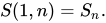
The first group homology group – concretely, the abelianization – is  (for m odd this is isomorphic to
  ): the
  factors (which are all conjugate, hence must map identically in an abelian group, since conjugation is trivial in an abelian group) can be mapped to (concretely, by taking the product of all the values), while the sign map on the symmetric group yields the
  These are independent, and generate the group, hence are the abelianization.
The second homology group – in classical terms, the Schur multiplier – is given by (Davies & Morris 1974):

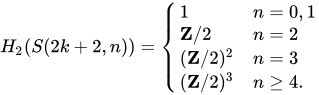
Note that it depends on n and the parity of m:  and
and  which are the Schur multipliers of the symmetric group and signed symmetric group.