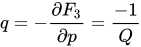
Sometimes a given Hamiltonian can be turned into one that looks like the harmonic oscillator Hamiltonian, which is

For example, with the Hamiltonian
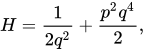
where p is the generalized momentum and q is the generalized coordinate, a good canonical transformation to choose would be
 | | 1 |
This turns the Hamiltonian into
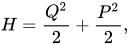
which is in the form of the harmonic oscillator Hamiltonian.
The generating function F for this transformation is of the third kind,
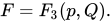
To find F explicitly, use the equation for its derivative from the table above,

and substitute the expression for P from equation (1), expressed in terms of p and Q:
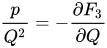
Integrating this with respect to Q results in an equation for the generating function of the transformation given by equation (1):
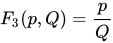
To confirm that this is the correct generating function, verify that it matches (1):