Genetically, they are categorized into three separate, but related groups: Ainu, Ryukyuan and Mainland (Yamato). According to modern genetic analyses, they primarily have Northeast Asian, East Asian, and to a lesser extent, heterogeneous Jōmon ancestries.[6][7]
A common origin of the Japanese people has been proposed by a number of scholars since Arai Hakuseki first brought up the theory. Fujii Sadamoto (藤井 貞幹), also known as Teikan Tou[ja] (藤 貞幹), a pioneer of modern archaeology in Japan, also treated the issue in 1781.[14] After the end of World War II, Kotondo Hasebe[ja] (長谷部 言人) and Hisashi Suzuki [ja] (鈴木 尚) claimed that Japanese people originated from the peoples of the Jōmon period instead of newcomers from the Yayoi period (300 BCE – 300 CE).[6]
Kazuro Hanihara[ja] (埴原 和郎) announced a new racial admixture theory in 1984.[6] Hanihara also announced the theory "dual structure model" in English in 1991.[15] According to Hanihara, modern Japanese lineages began with Jōmon people, who moved into the Japanese archipelago during the Paleolithic. Hanihara believed that there was a second wave of immigrants, from Northeast Asia to Japan during the Yayoi period.
Following a population expansion in Neolithic times, these newcomers found their way to the Japanese archipelago sometime during the Yayoi period. As a result, miscegenation was common in the island regions of Kyūshū, Shikoku, and Honshū, but did not prevail in the outlying islands of Okinawa and Hokkaidō, and the Ryukyuan and Ainu people continued to dominate there. Mark J. Hudson claimed that the main ethnic image of Japanese people was biologically and linguistically formed from 400 BCE to 1,200 CE.[6] Currently, the most well-regarded theory is that present-day Japanese have dual descent from the indigenous Jōmon people and the immigrant Yayoi people.
The main migration routes into Japan during the Jōmon and Yayoi period.Phylogenetic tree of Ainu, Ryukyuan, Mainland Japanese, and other Asian ethnic groups. The Ainu and the Ryukyuan were clustered with 100% bootstrap probability, followed by the Mainland Japanese. The three populations in the Japanese archipelago clustered with the Korean with 100% bootstrap probability.[16][17]
The modern Japanese cluster is said to be the most similar with the Korean one; in a haplotype-based study, the Japanese cluster was found to share 87–94% of its genetic components with the Korean cluster, compared with a Han Chinese result of only 0–8%, a distinct contrast. The genetic affinity to the Korean cluster was particularly strong among a cluster hailing from Shimane specifically and Honshu more broadly, but relatively less pronounced, albeit still overwhelming, in the Kyushu clusters. In any case, the study clarifies that "the estimate of ancestry profile cannot provide the definitive history of original migration, unless it will be further verified against historical evidence."[9]
A 2011 study by Sean Lee and Toshikazu Hasegawa[18] reported that a common origin of Japonic languages had originated around 2,182 years before present.[19]
A 2015 study revealed that modern Japanese possess 2.2% West Eurasian ancestry, which likely originated from interactions with Silk Road traders around 1700 years ago.[20]
A study in 2017 estimates the Jōmon ancestry in people from Tokyo at approximately 12%.[21]
In 2018, an independent research conducted by director Kenichi Shinoda [ja] (篠田 謙一) and his team at National Museum of Nature and Science was broadcast on NHK Science ZERO and it was discovered that the modern day Japanese are genetically close to the modern day Koreans.[22] A genome study (Takahashi et al. 2019) shows that modern Japanese (Yamato) do not have much Jōmon ancestry at all. Nuclear genome analysis of Jōmon samples and modern Japanese samples show strong differences.[23] Various studies estimate the proportion of Jōmon ancestry in Japanese people at around 9–13%, with the remainder derived from later migrations from Asia including the Yayoi people.[21][24][25]
According to a March 2021 study on genetic distance measurements from a large scale genetic study titled 'Genomic insights into the formation of human populations in East Asia', the modern "Japanese populations can be modelled as deriving from Korean (91%) and Jōmon (9%)."[26]
Some studies suggest a genetic connection between Koreans and Southeast Asian populations. A 2017 study by Ulsan University analyzed a 7,700-year-old skull in Korea, finding evidence of genetic links to ancient populations, including those from Southeast Asia, such as Vietnamese people. This research highlights the complex migration patterns in East Asia's prehistory.[27]
Similarly, Japanese research conducted in 1999 proposed that the Yayoi people, an ancient population contributing to modern Japanese ancestry, may have migrated from the Yangtze River basin in southern China. This was supported by DNA analyses showing similarities between Yayoi remains in southwestern Japan and early Han Dynasty remains from China's Jiangsu Province.[28]
Other studies suggest that modern Koreans share closer genetic ties with Central Asian and Northern East Asian populations. A mitochondrial DNA analysis revealed a genetic affinity between Koreans and Mongolians, indicating a shared Central Asian ancestry. Additionally, genetic research suggests that while Koreans share some common ancestry with other East Asian populations, their genetic ties with the Chinese are relatively more distant.[29] Genome-wide studies further demonstrate that Koreans are genetically closest to Yamato Japanese and Manchu populations, reflecting shared ancestry and historical interactions, while genetic connections between Koreans and Southeast Asians are more limited.[30][31][32] According to a 2023 study, the Hondo Japanese are genetically intermediate between the Chinese/Korean and Ryukyuan clusters.[33]
A population genomic PCA graph, showing the substructure of Eastern Asian populations, including analyzed Japanese Jōmon samples. Japanese people's cluster (squares) is almost indistinguishable to the Korean people's cluster (circles), while the Jōmon samples are shifted towards the Siberian cluster in a more distinct position.[34] (2020)
According to Alexander Vovin, the Yayoi were present in the central and southern parts of Korea before they were displaced and assimilated by arriving proto-Koreans.[39][40] A similar view was raised by Whitman (2012), further noting that the Yayoi are not closely related to the proto-Koreanic speakers and that Koreanic arrived later from Manchuria to Korea at around 300 BC and coexisted with the Japonic speakers. Both had influence on each other and a later founder effect diminished the internal variety of both language families.[41]
Jared Diamond, the author of Guns, Germs, and Steel, suggested that the Yayoi period in Japan was initiated by immigrants from the Korean peninsula. Citing research findings, he stated that Yayoi Japan likely received millions of immigrants from Korea. These immigrants, during the Yayoi transition, are believed to have overwhelmed the genetic contribution of the Jōmon people, whose population was estimated to be around 75,000 at that time.[42]
According to a 2020 study, Japanese exhibit high genetic similarities with Koreans and inherited their East Asian-related components during the Yayoi period. Proto-Koreans received genetic input from Siberian-related and Austroasiatic-related populations, along with combined Vat Komnou-related and Nui Nap-related sources from Southern China after the Bronze Age, which significantly shaped the genetic variaiton of modern Koreans.[43] Other studies also show this Southeast Asian contribution in proto-Koreans.[44][45][46][47]
Ishiya et al. (2024) states that present Japanese and Koreans possess genetic components related to Ancient Northeast Asians (ANA), especially those from Mongolia and the Baikal region. Yayoi individuals were also closely related to Middle Neolithic individuals from Inner Mongolia, Miaozigou and the Haminmangha site, as well as early Neolithic individuals (Xiaojingshan and Boshan) from Shandong, China. They also have ancestry related to Papuans and Vanutuans which is found in Jōmon peoples but this might reflect a different diverged ancestry shared with other Asians.[48]
Kim et al. (2024) states that the Yayoi have the highest genetic affinities to the ancient "Korean_Ando (Antu)" population and drift further away from other contemporary Korean populations, like those from Gunsan and Gimhae.[49]
Previous studies state that the Middle Neolithic "Korean_Ando" population derive 100% of their ancestry from Hongshan culture-related populations.[50]
A September 2021 study published by Cooke et al. in Science Advances proposed that the people of Japan bore genetic signatures from three ancient populations rather than just two as previously thought.[51]
Proposed tripartite styled genomic transitions in parallel with cultural transitions in pre- and protohistoric Japan. (2021)Cooke at al. states that in addition to the previously discovered Jōmon and Yayoi components, a new component (i.e. Kofun) was hypothesized to have been introduced, most likely from the southern Korean peninsula, during the Yayoi–Kofun transition period, where there was strong cultural and political affinity with Korea and China.[52] According to Cooke et al., the genetic profile of the modern Japanese population was established in the Kofun period. The Kofun component, however, is specifically concentrated in Kinki, Hokuriku and Shikoku.[53] Overall, the average modern Japanese derives over 70% of their ancestry from the Kofun component, with 15-20% being derived from the Yayoi component and the rest from the Jōmon component. The study's authors also note that modern Japanese have slightly more East Asian ancestry than Kofun peoples.[52] Cooke et al. hypothesized that the Kofun component was related to ancient Yellow River populations from the Late Bronze Age to Iron Age, who themselves had 40% Northeast Asian ancestry and 60% East Asian ancestry.
The same paper showcased that the Yayoi component has excess affinities to populations with no cultural relations to rice farming such as those from the West Liao River basin in Northeast China, Baikal and Northeast Siberia. No significant affinities to the Yellow River populations were likewise found. The research also found that rice farming was introduced to Japan from the Shandong peninsula to the Liaodong Peninsula and finally to the Korean peninsula, where it was directly spread to Japan.[51]
In a 2023 study, Cooke et al. attributes the presence of mutations in the Kofun population, such as those related to the ADH1B gene, to their East Asian-dominant ancestry. They explain that the mutation arose in the Yellow River basin after the Late Neolithic period and was previously unobservable in West Liao River, Amur River and Neolithic Baikal populations, who all contributed to the genetic makeup of Yayoi populations. This mutation was also spread to the Korean peninsula, where the Kofun population received it.[54]
According to Pere Gelabert in a 2022 paper, ancient Koreans of the Three Kingdoms period of Korea (i.e. "Korea-TK"), bore close genetic similarity with Kofun-era Japanese people. In particular, "Korea-TK_2" is closely related to "present-day Japanese, the ancient Kofun, and other ancient Japanese populations with Jomon ancestry" due to their higher Jōmon-like ancestry. "Korea-TK_2" can be modeled as having 66% ± 7% Bronze Age West Liao River-related ancestry and 34% ± 7% Jōmon-related ancestry. Or 32% Northeast Asian, 43% Han, and 25% Japan Jōmon. In regards to the Japanese Kofun population themselves, they could be modeled as having 71% ± 10% "Korea-TK_2"-related ancestry and 29% ± 10% Late Bronze Age to Iron Age Yellow River-related ancestry.[55]
Ruì Wáng (王瑞) and Chún-chāo Wāng (汪群超) (2022) reiterated that Yayoi immigrants did not demographically replace the Jōmon. Instead, they co-existed and intermarried with indigenous Jōmon, which led the Yayoi to have 60% Jōmon ancestry. The rest of their ancestry was Northeast Asian. Jōmon ancestry eventually decreased when ancestries related to Northern Han Chinese (Yellow River ancestry) were introduced in the Kofun period.[56]
They later clarified in another paper (2023) that overall, modern Japanese cluster with the "Korean_Antu (Ando)" population, covering Koreans from the Antu County, who share more genetic drift with mainland Koreans, followed by the Han Chinese, Hmong-Mien and Tai-Kadai.[57]
Xiǎoxī Liú (刘小晰) et. al (2024) stated that Jōmon ancestry in contemporary Japanese people varies depending on region, with Jōmon ancestry being the highest in Southern Japan, especially Okinawa (28.5%), followed by Northeastern Japan (19%) and Western Japan (12%). Western Japan had more East Asian affinities, especially towards Yellow River or Upper Yellow River populations from the Late Bronze Age to Iron Age. Similarly, Northeastern Japan had more Northeast Asian affinities, especially towards ancient Koreans from the Three Kingdoms period.[58]
According to Yamamoto et. al (2024), the Yamato, on average, have 66.4% East Asian ancestry, 21.2% Northeast Asian ancestry and 12.4% Jōmon ancestry. These admixture proportions are best representative of Mainland Yamato Japanese. Jōmon ancestry exhibits regional variation, ranging from 9.8% in Kinki to 26.1% in Okinawa, with some populations in Hokkaido having 31.6% Jōmon ancestry. East Asian ancestry was represented by Han Chinese whilst Northeast Asian ancestry was represented by Middle Neolithic and Bronze Age West Liao River populations, especially "China_WLR_BA_o" and "China_HMMH_MN" populations.[59]
According to an analysis by historian Makoto Takemitsu[ja] (武光 誠) in 2025, about 1.3 to 1.4 million migrants settled in Japan from Korea, especially from Goguryeo, Paekche, and Silla, during the Kofun period. They made up 25% of the total population (5.5 to 5.6 million) of Japan in that period.[60] He himself referred to the Kofun strand as "Kansai ancestry" rather than any previous names given by other researches, comparing it to the Neo-Mongoloids found in East Asia. He cites a recent study from Riken that newly posits that modern Japanese people carry around 25% of the Kansai (East Asian) ancestry at most while the majority of their genetic makeup derives from the Yayoi (Northeast Asian) ancestry and to a lesser extent, Jōmon ancestry.[61]
Takemitsu describes the Kofun migrations as a gradual process, where migrants settled in "village communities" that were ruled by powerful chiefs or clans. There, they married with locals of Jōmon and Northeast Asian ancestry and became part of a group that's later known as the "Japanese".[61]
Criticism
Genetic drift of the East Asian demographics. (2024)[62]
However, the tripartite theory is being met with criticism since its introduction in 2021. In essence, Japanese researchers claim that a tripartite theory is redundant as the genealogical difference between Yayoi and Kofun groups is not significant enough and that the temporal discrepancy of the periods is minuscule. Japanese linguists also state that the languages spoken during the periods are generally related to each another and that the speakers were most likely related.
A study published in April 2024 by Hisashi Nakao (中尾 央), claims that Kofun and Yayoi populations were more related to each other than either were with the Jōmon population.[63] Nakao stated that "[the results] suggest that the Jōmon people were rather different from the Yayoi and Kofun people in the facial height and the anterior–posterior length [...] indicating that temporal differences are not significant among the Yayoi and Kofun periods. [...] the large overlap in morphological variation between the Yayoi and Kofun people could be an important step in further research."[63] The research also boasts of using the largest Kofun samples to date.[63]
According to a study published in October 2024, the Doigahama Yayoi individual, who is representative of the Yayoi population, already possessed substantial East Asian ancestry. The individual is closely related to the succeeding Kofun population and modern Japanese and Koreans. The study's authors also note that Northeastern Siberian and East Asian ancestries were already admixed within ancient Koreans and thus, were not introduced separately in the Yayoi and Kofun periods, respectively. Instead, it is more likely that the peopling of Japan involved continuous migrations from the Korean peninsula until the Kofun period. However, the study noted that a significant genetic difference between Yayoi and Kofun populations is not completely ruled out.[64]The migration routes of proto-Japonic and proto-Koreanic speakers.[65] (2022)
The lead researcher and professor at the University of Tokyo's Department of Biological Sciences, Jun Ohashi (大橋 順) spoke with Science Daily,[4] further explaining the new findings and criticizing the previous assumption. "Our results suggest that between the Yayoi and Kofun periods, the majority of immigrants to the Japanese archipelago originated primarily from the Korean peninsula," says Ohashi. "The results also mean the three-way admixture model, which posits that a Northeast Asian group migrated to the Japanese archipelago during the Yayoi period and an East Asian group during the Kofun period, is incorrect."[4]
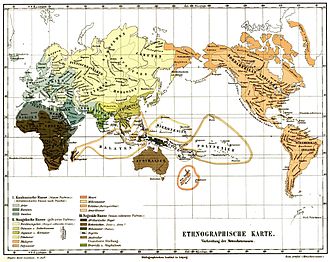
The concept of "Mongoloid" was popularized by the Meyers Konversations-Lexikon (1885–1890), a late 19th century ethnographic map created by Joseph Meyer. The Japanese were marked as "Neo-Mongoloids" and were classified under the "Japanese & Korean" cluster.A recent interview with the director of the National Museum of Nature and Science, Kenichi Shinoda [ja] (篠田 謙一) in December 2024 summarized the current consensus in regards to the genomic makeup of the modern Japanese. Shinoda stated that over 90% of the modern Japanese DNA derives from an ancient strand that originated at an area near the Liao River around 50,000 years ago, where it was then introduced to the Korean peninsula (which in turn mixed with the Southern Jōmon-like inhabitants) and 10,000 years later was introduced into the Japanese archipelago.[5] Shinoda also remarked that these migrations happened throughout the later Yayoi period and that the Japanese genes remained homogenous since then, stating that "the genetic makeup of the ancient Yayoi people and us (Yamato people) are almost identical".[5] The director did not mention "Kofun", but insisted on calling the later settlers as "Toraijin (Immigrants)" or more specifically "late-Yayoi period settlers", despite taking part in previous studies surrounding the strand and mentioning it at the time of its proposal.[66]
Linguist, author, and lecturer Makoto Mogi[ja] (茂木 誠) (2025) insisted that the immigrants with the "East Asian ancestry" were ethnically different from the Han Chinese due to having northern origins and different lingustic backgrounds.[67] According to Mogi, East Asian-related immigrants such as Empress Jingū's ancestor, Amenohiboko and other famous immigrants during the Yayoi period, were most likely proto-Koreanic speakers due to the similarities in grammar with modern Korean,[68][67] an argument made similar by fellow linguist Alexander Vovin.[69] Mogi posited that these proto-Koreanic speakers entered the peninsula by replacing or absorbing the pre-existing Peninsular Japonic speaking natives (Southern Jōmon-like inhabitants) before entering Japan,[67] an argument that aligns closely with the anthropological argument made by aforementioned Kenichi Shinoda (2024).[70]
A similar observation was made previously by Kazuo Miyamoto[ja] (宮本 一夫), a renowned linguist and emeritus professor at Kyushu University in 2022. Miyamoto noted that "Central Japanese was heavily influenced by Old Korean (possibly through Baekje) during the Kofun and Asuka periods, from the 4th to 7th centuries AD"[65] which supports Mogi and Vovin's assumptions. He linked the Yayoi period with the Mumun period of Korea and stated that the proto-Japonic language was spread during this time.[Quotes 1][65] He also remarked that the proto-Japonic of the Yayoi/Mumun period and proto-Koreanic that was introduced during Kofun/Asuka period stemmed from the same ancestral language, stating that "the homeland of both languages is the same based on archeological evidence, and they are kindred language families"[65] and that "Proto-Japonic and Proto-Koreanic split off from the Transeurasian languages in southern Manchuria"[65] positing that the Yayoi (proto-Japonic) and Kofun (proto-Koreanic) migrations were heavily related, a conclusion made similar to Hisashi Nakao (2024).
Populations of Northeast Asia/Eurasia region showed the highest genetic affinity with the Mainland Japanese.
In essence, the Tripartite ancestry theory is divided into two conclusions; one positing that there was a new component, one that is distinct from the previous Jōmon and Yayoi component, that was introduced from Korea during the Kofun period,[71] and the other rejecting the notion due to high genetic similarities between the Yayoi and Kofun although some differences cannot be ruled out.[72][63][67] The theory, however, clearly lays the foundation for several points that are crucial to the anthropometric studies on the Japanese populations:
Japanese people, especially the Yamato people, possess certain amounts of the "East Asian" ancestry with the percentage fluctuating from 25%,[61] 35%,[73] 66.7%[74] to 80%,[62] depending on the study. This ancestry was shown in high frequencies among immigrants during the Kofun period (300–538 CE).
Western Yamato Japanese, on average, have more affinities with East Asian populations, reflective of Western Japan's historic role in facilitating cross-cultural exchange with continental East Asia. Jōmon affinities peak in Northern and Southern Yamato Japanese although Northeast Yamato Japanese also exhibit close affinities with Northeast Asian populations.[73][74]
The East Asian ancestry is often associated with the ancient Yellow River farmers populations; a common ancestry found in East Asia that is shared by the modern day Han Chinese, Tibetans, Manchus, Mongolians, Koreans, Japanese, Vietnamese, etc, in varying degrees, which in turn is classified under the Ancient Northern East Asian (ANEA) cluster that formed around 20,000–26,000 BCE.[75] However, it is speculated that this variant of the ancestry is related to the proto-Koreanic speakers who entered Japan during the Kofun period which was assimilated by the proto-Japonic speakers of the Yayoi period based on archaeological and linguistical evidence.[41][65]Korea in the mid-late 5th century, middle of the Kofun period. Multiple waves of migration to Japan happened due to constant wars and political unrest.
According to Higasa et al. (2025), the Hondo Japanese predominantly have an ancestral component that's shared by Koreans and Northern Chinese, and to some extent, a Japanese-specific component that peaks in the Ryukyuan and Ainu subpopulations. Overall, all Japanese subpopulations share the most substantial history with the Koreans. For the Hondo Japanese, they share similar history with Northeast Eurasian populations (e.g. Ulchi, Mongolian, Yakut, and Even), as well as Oceanian populations (e.g. Igorot, Dusun, and Hawaiian).[76]
Immigrants from the Kofun period align closely with the Three Kingdoms period of Korea, a turbulent period of constant wars and political unrest. Genetic markers have also indicated that the Kofun period individuals bear close resemblance with the Three Kingdoms period Koreans.[77] Also, majority of the Kofun period immigrants were from the Three Kingdoms, especially from Goguryeo, Paekche, and Silla.[61]
It is said that the Japanese remained homogenous since then as its modern population is almost identical to the immigrants of the Kofun period, genetically.[5]
Rajvir Yadav et al. (2000) stated the sitting height to stature ratios of different populations: South Indian (0.4922), female Indian (0.4974), Eastern Indian (0.4991), Southeastern African (0.5096), Central Indian (0.5173), US (0.5202), Western Indian (0.5243), German (0.5266) and Japanese (0.5452).[80]
Hirofumi Matsumura et al. (2001) and Hideo Matsumoto et al. (2009) said that the Japanese and Vietnamese people are regarded to be a mix of Northeast Asians and Southeast Asians. However, the amount of Northern genetics is higher in Japanese people compared to Vietnamese, who are closer to other Southeast Asians (Thai or Bamar people).[81][82]
Neville Moray (2005) said that, for Korean and Japanese pilots, sitting height is more than 54% of their stature, with about 46% of their stature from leg length. Moray said that, for Americans and most Europeans, sitting height is about 52% of their stature, with about 48% of their stature from leg length. Moray indicated that modifications in basic cockpit geometry are required to accommodate Japanese and Vietnamesepilots. Moray said that the Japanese have longer torsos and a higher shoulder point than the Vietnamese, but the Japanese have about similar arm lengths to the Vietnamese, so the control stick would have to be moved 8cm closer to the pilot for the Japanese and 7cm closer to the pilot for the Vietnamese. Moray said that, due to having shorter legs than Americans, rudder pedals must be moved closer to the pilot by 10cm for the Japanese and 12cm for the Vietnamese.[83]
Ann Kumar (1998) said that Michael Pietrusewsky (1992) said that, in a craniometric study, the cranial bones of Southeast Asians (Borneo, Vietnam, Sulu, Java, and Sulawesi etc.) are closer to Japanese, in that order, than Mongolian and Chinese populations are close to Japanese. In the craniometric study, Michael Pietrusewsky said that, even though Japanese peoplecluster with Mongolians, Chinese and Southeast Asians in the larger Asian cluster, the cranial bones of Japanese people are more closely aligned with several Mainland and Island Southeast Asian samples than with Mongolians and Chinese. However, Pietrusewsky also said, more research is needed on the similarity of the cranial bones between Japanese and Southeast Asians.[86][87]
In a 1994 craniometric study, Pietrusewsky found that the Japanese series, which was a series that spanned from the Yayoi period to modern times, formed a single branch with Korea. Later, Pietrusewsky (1999) found, however, significant differences between the Korean and Yayoi people in the East Asian cluster, indicating that the connection that Japanese have with Korea would not have derived from Yayoi people.[12]
However, in a follow-up study, Pietrusewsky (2010) stated that East Asians and Southeast Asians were markedly separated from each other. He found that the modern Japanese cranial series was the closest to Manchurians and Koreans. To some extent, they were also close to the inhabitants of Anyang, Atayal and Mongolians.[8] A common origin of Northeast Asians could be traced, with entry to the Japanese archipelago commencing at the start of the Yayoi period.[8]
Between 1996 and 1999, a team of Japanese researchers found that Yayoi remains from Yamaguchi and Fukuoka shared similarities with remains from Jiangsu, a coastal province of China.[88][89]
Park Dae-kyoon et al. (2001) said that distance analysis based on thirty-nine non-metric cranial traits showed that Koreans are closer craniometrically to Kazakhs and Mongols than to the populations in China and Japan.[90]
Ishida et al. (2009) states that modern mainland Japanese are phenotypically intermediate between Jōmon and Yayoi groups, supporting the dual structure model of Japan's population history. The Jōmon exhibit the most similarities with the Iron Age Tagar from southern Siberia and share similar "European-like features" whilst the Yayoi exhibit the most similarities with Northern Chinese and Neolithic Baikalians.[91]
Enfield (2011) sees phenotypic similarities between present Japanese populations and Dong Son populations from northern Vietnam and Neolithic populations from southern China. Based on dental analyses, they were Australo-Melanesians who heavily mixed with migrants related to ancient Chinese populations, affecting them genetically and phenotypically.[13]
Dudzik (2015) states that southern Japanese are morphologically the most similar to Jōmon and Ainu groups, as well as Yayoi groups. Conversely, northern Japanese are significantly more influenced by northeast Asian groups due to external migration from the north since the fifth century or earlier. This also affected subpopulations like Ainu, suggesting that 'parental population traits' were better preserved in the southernmost parts of the Japanese archipelago.[92]
According to Matsumura et al. (2019), Japanese belong to the wider "Northeast Asian" cluster, like modern Chinese, North and South Koreans, Mongolians and Far East Russians, including Siberians. They exhibit similar features such as relatively long flat faces and short heads, reflective of cold adaptation. However, the indigenous Jōmon hunter-gatherers exhibited similar features to prehistoric hunter-gatherers from Southeast Asia and southern China and Zhoukoudian remains from Beijing.[10]
According to Harrington (2020), Koreans and Japanese share similar cranial variation but Japanese are more likely to be dolichocephalic, have shorter cranial height and smaller facial features, especially in terms of their cheek height, nasal length, and facial width. However, both populations underwent brachycephalization as their societies modernized. Physical differences between modern Japanese and Koreans is also attributed to outside gene flow in Japanese but it can be explained by smaller sample sizes in the study, which didn't fully capture the variation within both populations.[93]
According to Watanabe et. al (2021), contemporary Kinki populations phenotypically differ the most from Jōmon people, especially Hokkaido Ainu. Other Japanese subpopulations were more intermediate although morphological similarities exist between Hokkaido Ainu and contemporary Tohoku populations.[94]
Several studies show quantifiable dimorphism in the cranium of Japanese people,[95][96] similar to Thais, Indonesians, Filipinos and Malays.[96] Japanese skulls also share some similarities with Hispanics and Filipinos,[97] implied by the frequency of Hispanic skulls from southwestern United States being misclassified as Asian, particularly Japanese and Filipino.[97][96] However, Japanese craniums can be distinguished from Filipino craniums, with the former having higher upper facial height and shorter inferior malar lengths on average.[98] Nasal height and breadth were also greater and smaller than those found in Filipino craniums respectively although Thai craniums exhibited greater nasal height and breadth than those found in Japanese craniums. Japanese craniums also differ from Southeast Asian craniums by exhibiting adaptation to dry and cold climates and orbits that are more circular and rhomboid in shape.[96][11] Japanese craniums also greatly differ from populations like 'typical' Western Australians, with the latter having longer and taller skulls and narrower frontal bones. On average, they also have greater maximum cranial length and basion-nasion length and lower mastoid height. However, Japanese exhibit similarities with North American populations in terms of their mandibular shape, which is attributed to their malleability after puberty or inter-individual variability within the Japanese population. Overall, population-specific facial morphology is established prenatally, beginning at the second trimester, before gradually diverging via growth-related processes.[99][100]
According to Nakao et al. (2024), there is more overlap between Kofun and Yayoi craniums than with Jōmon craniums, with Kofun craniums exhibiting high similarities with contemporary migrants from the Korean peninsula. These craniums are typically characterized by shorter anterior–posterior lengths.[101]
Boer, Elisabeth de; Yang, Melinda A.; Kawagoe, Aileen; Barnes, Gina L. (2020). "Japan considered from the hypothesis of farmer/language spread". Evolutionary Human Sciences. 2 e13. doi:10.1017/ehs.2020.7. ISSN2513-843X. PMC10427481. PMID37588377. S2CID218926428. The term Yayoi has four uses, which can create much confusion. First, it is the designation of the period beginning with the introduction of rice agriculture around 1000 BC until the advent of the Mounded Tomb Culture in the third century AD. Yayoi is a period designation exclusive to Japan; it includes both farmers and hunter–gatherers and entails the agricultural transition in a time-transgressive and regionally disparate process. Second, 'Yayoi people' may refer to anyone living in the Japanese Islands in the Yayoi period, or third, Yayoi may refer specifically to admixed people (Mumun + Jōmon in varying in proportions and across great distances). Fourth, Yayoi may indicate acculturation: the adoption of (rice) agriculture (and other continental material culture) by Jōmon-lineage people in the Yayoi period. All of these conflicting aspects of Yayoi must be kept in mind and clearly defined in any discussion.
Kim, Young Jin; Jin, Han Jun (2013). "Dissecting the genetic structure of Korean population using genome-wide SNP arrays". Genes Genom. 35 (3): 355–363. doi:10.1007/s13258-013-0082-8.
Mitsuru Sakitani (2009). 『DNA・考古・言語の学際研究が示す新・日本列島史』[New History of the Japanese Islands Shown by Interdisciplinary Studies on DNA, Archeology, and Language] (in Japanese). Bensei Publishing. ISBN978-4-585-05394-1.
Janhunen, Juha (2010). "Reconstructing the Language Map of Prehistorical Northeast Asia". Studia Orientalia Electronica. 108: 281–304. there are strong indications that the neighbouring Baekje state (in the southwest) was predominantly Japonic-speaking until it was linguistically Koreanized.
Vovin, Alexander (31 December 2013). "From Koguryǒ to T'amna: Slowly riding to the South with speakers of Proto-Korean". Korean Linguistics. 15 (2): 217–235. doi:10.1075/kl.15.2.03vov.
Gelabert, Pere; Blazyte, Asta; Chang, Yongjoon; Fernandes, Daniel M.; Jeon, Sungwon; Hong, Jin Geun; Yoon, Jiyeon; Ko, Youngmin; Oberreiter, Victoria; Cheronet, Olivia; Özdoğan, Kadir T.; Sawyer, Susanna; Yang, Songhyok; Greytak, Ellen McRae; Choi, Hansol; Kim, Jungeun; Kim, Jong-Il; Jeong, Choongwon; Bae, Kidong; Bhak, Jong; Pinhasi, Ron (August 2022). "Northeastern Asian and Jomon-related genetic structure in the Three Kingdoms period of Gimhae, Korea". Current Biology. 32 (15): 3232–3244.e6. Bibcode:2022CBio...32E3232G. doi:10.1016/j.cub.2022.06.004. PMID35732180.
Ishiya, Koji; Mizuno, Fuzuki; Gojobori, Jun; etal. (2024). "High-coverage genome sequencing of Yayoi and Jomon individuals shed light on prehistoric human population history in East Eurasian". bioRxiv10.1101/2024.08.09.606917.
Nikkei Science (23 June 2021). "渡来人、四国に多かった? ゲノムが明かす日本人ルーツ"[Were there many migrants in Shikoku? Japanese roots revealed by genome analysis]. nikkei.com (in Japanese). Retrieved 1 May 2022.
Gelabert, Pere; Blazyte, Asta; Chang, Yongjoon; Fernandes, Daniel M.; Jeon, Sungwon; Hong, Jin Geun; Yoon, Jiyeon; Ko, Youngmin; Oberreiter, Victoria; Cheronet, Olivia; Özdoğan, Kadir T.; Sawyer, Susanna; Yang, Songhyok; Greytak, Ellen McRae; Choi, Hansol; Kim, Jungeun; Kim, Jong-Il; Jeong, Choongwon; Bae, Kidong; Bhak, Jong; Pinhasi, Ron (August 2022). "Northeastern Asian and Jomon-related genetic structure in the Three Kingdoms period of Gimhae, Korea". Current Biology. 32 (15): 3232–3244.e6. Bibcode:2022CBio...32E3232G. doi:10.1016/j.cub.2022.06.004. PMID35732180.
『近年発表された古代人のDNA解析の成果により、古墳時代の人びとの25%は朝鮮半島からの移住者であることが明らかになり、歴史教科書で学んだ「渡来人」をとりまくイメージは一変しています。これは、日本の文化の成り立ちにも関わってくるトピックです。』 "Recent results from DNA analysis of ancient people have revealed that 25% of the people of the Kofun period were immigrants from the Korean Peninsula, completely changing the image of "immigrants" that we learned in history textbooks. This is a topic that also relates to the origins of Japanese culture."
『[東アジア系先祖は] 漢民族とは明らかに違うと思います。中国南部にいたので全く違います。朝鮮語ていうか、韓国語とは文法がほぼ同じという状況であります。』 "[The East Asian ancestry immigrants] were clearly different from the Han Chinese. They're from the lower parts of China, so the two are completely different. The consensus is that the immigrants spoke a language with a grammar almost identical to the modern Korean language."
Zhang, Ming; Fu, Qiaomei (June 2020). "Human evolutionary history in Eastern Eurasia using insights from ancient DNA". Current Opinion in Genetics & Development. 62: 78–84. doi:10.1016/j.gde.2020.06.009. PMID32688244.
Gelabert, Pere; Blazyte, Asta; Chang, Yongjoon; Fernandes, Daniel M.; Jeon, Sungwon; Hong, Jin Geun; Yoon, Jiyeon; Ko, Youngmin; Oberreiter, Victoria; Cheronet, Olivia; Özdoğan, Kadir T.; Sawyer, Susanna; Yang, Songhyok; Greytak, Ellen McRae; Choi, Hansol; Kim, Jungeun; Kim, Jong-Il; Jeong, Choongwon; Bae, Kidong; Bhak, Jong; Pinhasi, Ron (August 2022). "Northeastern Asian and Jomon-related genetic structure in the Three Kingdoms period of Gimhae, Korea". Current Biology. 32 (15): 3232–3244.e6. Bibcode:2022CBio...32E3232G. doi:10.1016/j.cub.2022.06.004. PMID35732180.
Pheasant, Stephen. (2003). Bodyspace: Anthropometry, ergonomics and the design of work (2nd. ed.). Taylor & Francis. Page 159. Retrieved 14 March 2018, from Google Books.
Matsumura, Hirofumi; Cuong, Nguyen Lan; Thuy, Nguyen Kim; Anezaki, Tomoko (2001). "Dental Morphology of the Early Hoabinian, the Neolithic da but and the Metal Age Dong Son Civilized Peoples in Vietnam". Zeitschrift für Morphologie und Anthropologie. 83 (1): 59–73. doi:10.1127/zma/83/2001/59. JSTOR25757578. PMID11372468.
Park, Dae Kyoon; Lee, U. Young; Lee, Jun Hyun; Choi, Byoung Young; Koh, Ki Seok; Kim, Hee Jin; Park, Sun Joo; Han, Seung Ho (June 2001). "Non -metric Traits of Korean Skulls". Korean Journal of Physical Anthropology. 14 (2): 117–126. doi:10.11637/kjpa.2001.14.2.117 (inactive 24 October 2025).{{cite journal}}: CS1 maint: DOI inactive as of October 2025 (link)
Harrington, Katherine (2020). Distinguishing Closely Related Modern Human Populations Using Cranial Morphometrics: A View from Korea and Japan (Thesis). hdl:10125/70340.[pageneeded]
Watanabe, Yusuke; Ohashi, Jun (2022). "Modern Japanese ancestry-derived variants revealed the formation process of the current Japanese regional gradations". bioRxiv10.1101/2020.12.07.414037.
Hayashi, Atsuko; Pietrusewsky, Michael (3 September 2023). "Discriminant function analysis of craniometric data for distinguishing Japanese and Filipino crania". Australian Journal of Forensic Sciences. 55 (5): 621–644. doi:10.1080/00450618.2022.2057589. hdl:10125/105029.
[...] the beginning of the Yayoi culture was heavily influenced by the Mumun culture of the southern Korean Peninsula, and some migrants from this region are thought to have moved into northern Kyushu. If Proto-Japonic spread to northern Kyushu from the southern Korean Peninsula at the beginning of the Yayoi culture with migrants, then we can assume that Proto-Japonic was spoken by the people of the Mumun culture. [...] Proto-Japonic languages are thought to have gradually replaced the local Jomon languages in these areas from the Late Yayoi to the beginning of the Kofun period, 2nd – 3rd centuries AD.
—Kazuo Miyamoto, The emergence of 'Transeurasian' language families in Northeast Asia as viewed from archaeological evidence


.png)