Genetic purging
From Wikipedia, the free encyclopedia
Genetic purging is the increased pressure of natural selection against deleterious alleles prompted by inbreeding.[1]
Purging occurs because deleterious alleles tend to be recessive, which means that they only express all their harmful effects when they are present in the two copies of the individual (i.e., in homozygosis). During inbreeding, as related individuals mate, they produce offspring that are more likely to be homozygous so that deleterious alleles express all their harmful effects more often, making individuals less fit.
Purging reduces both the overall number of recessive deleterious alleles and the decline of mean fitness caused by inbreeding (the inbreeding depression for fitness).
The term "purge" is sometimes used for selection against deleterious alleles in a general way. It would avoid ambiguity to use "purifying selection" in that general context, and to reserve "purging" to its more strict meaning defined above.
Deleterious alleles segregating in populations of diploid organisms have a remarkable trend to be, at least, partially recessive. This means that, when they occur in homozygosis (double copies), they reduce fitness by more than twice than when they occur in heterozygosis (single copy). In other words, part of their potential deleterious effect is hidden in heterozygosis but expressed in homozygosis, so that selection is more efficient against them when they occur in homozygosis. Since inbreeding increases the probability of being homozygous, it increases the fraction of the potential deleterious effect that is expressed and, therefore, exposed to selection. This causes some increase in the selective pressure against (partially) recessive deleterious alleles, which is known as purging. Of course, it also causes some reduction in fitness, which is known as inbreeding depression.
Purging can reduce the average frequency of deleterious alleles across the genome below the value expected in a non-inbred population during long periods.[2] which reduces the negative impact of inbreeding on fitness. If inbreeding is due just to random mating in a finite population, due to purging the fitness mean fitness declines less than would be expected just from inbreeding and, after some initial decline, it can even rebound up to almost its value before inbreeding. Another consequence is the reduction of the so-called inbreeding load. This means that, after purging, further inbreeding is expected to be less harmful. The efficiency of purging is reduced by genetic drift and, therefore, in the long term, purging is less efficient in smaller populations.[1] Purging can be increased if individuals mate with relatives more often than expected by random mating.
The joint effect of inbreeding and purging on fitness
Accounting for purging when predicting inbreeding depression is important in evolutionary genetics, because the fitness decline caused by inbreeding can be determinant in the evolution of diploidy, sexual reproduction and other main biological features. It is also important in animal breeding and, of course, in conservation genetics, because inbreeding depression may be a relevant factor determining the extinction risk of endangered populations, and because conservation programs can allow some breeding handling in order to control inbreeding.[3]
In brief: due to purging, inbreeding depression does not depend on the standard measure of inbreeding (Wright's inbreeding coefficient F), since this measure only applies to neutral alleles. Instead, fitness decline it depends on the "purged inbreeding coefficient" g, which takes into account how deleterious alleles are being purged.
Purging reduces inbreeding depression in two ways: first, it slows its progress; second, it reduces the overall inbreeding depression expected in the long term. The slower the progress of inbreeding, the more efficient is purging.
A more detailed explanation
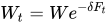
In the absence of natural selection, mean fitness would be expected to decline exponentially as inbreeding increases, where inbreeding is measured using Wright's inbreeding coefficient F[4] (the reason why decline is exponential on F instead of linear is just that fitness is usually considered a multiplicative trait). The rate at which fitness declines as F increases (the inbreeding depression rate δ) depends on the frequencies and deleterious effects of the alleles present in the population before inbreeding.
The above coefficient F is the standard measure of inbreeding, and gives the probability that, at any given neutral locus, an individual has inherited two copies of a same gene of a common ancestor (i.e. the probability of being homozygous "by descent"). In simple conditions, F can be easily computed in terms of population size or of genealogical information. F is often denoted using lowercase (f), but should not be confused with the coancestry coefficient.
However, the above prediction for the fitness decline rarely applies, since it was derived assuming no selection, and fitness is precisely the target trait of natural selection. Thus, Wright's inbreeding coefficient F for neutral loci does not apply to deleterious alleles, unless inbreeding increases so fast that the change in gene frequency is governed just by random sampling (i.e., by genetic drift).
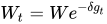
Therefore, according to the model, the decline of fitness can be predicted using, instead of the standard inbreeding coefficient F, a "purged inbreeding coefficient" (g) that gives the probability of being homozygous by descent for (partially) recessive deleterious alleles, taking into account how their frequency is reduced by purging.[1] Due to purging, fitness declines at the same rate δ than in the absence of selection, but as a function of g instead of F.
This purged inbreeding coefficient g can also be computed, to a good approximation, using simple expressions in terms of the population size, as explained below, or of the genealogy of individuals. However this requires some information on the magnitude of the deleterious effects that are hidden in the heterozygous condition but become expressed in homozygosis. The larger this magnitude, denoted purging coefficient d, the more efficient is purging.
An interesting property of purging is that, during inbreeding, while F increases approaching a final value F = 1, g can approach a much smaller final value. Hence, it is not just that purging slows the fitness decline, but also that it reduces the overall fitness loss produced by inbreeding in the long term. This is illustrated below for the extreme case of inbreeding depression caused by recessive lethals, which are alleles that cause death before reproduction but only when they occur in homozygosis. Purging is less effective against mildly deleterious alleles than against lethal ones but, in general, the slower is the increase of inbreeding F, the smaller becomes the final value of the purged inbreeding coefficient g and, therefore, the final reduction in fitness. This implies that, if inbreeding progresses slowly enough, no relevant inbreeding depression is expected in the long term. implies, for example, that the average fitness of a population that has been moderately small for a long time, can be very similar to that of a large population with more genetic diversity. In conservation genetics, it would be very useful to ascertain the maximum rate of increase of inbreeding that allows for such efficient purging.


![{\displaystyle g_{t}=\left[\left(1-{\frac {1}{2N}}\right)g_{t-1}+{\frac {1}{2N}}\right]\left[1-2dF_{t-1}\right]}](https://wikimedia.org/api/rest_v1/media/math/render/svg/79f5343c6d07102ddc3f1066b12a9880094ce9c7)

