Geometrically necessary dislocations
From Wikipedia, the free encyclopedia
Geometrically necessary dislocations are like-signed dislocations needed to accommodate for plastic bending in a crystalline material.[1] They are present when a material's plastic deformation is accompanied by internal plastic strain gradients.[2] They are in contrast to statistically stored dislocations, with statistics of equal positive and negative signs, which arise during plastic flow from multiplication processes like the Frank-Read source.
Statistically stored dislocations
As straining progresses, the dislocation density increases and the dislocation mobility decreases during plastic flow. There are different ways through which dislocations can accumulate. Many of the dislocations are accumulated by multiplication, where dislocations encounters each other by chance. Dislocations stored in such progresses are called statistically stored dislocations, with corresponding density .[2] In other words, they are dislocations evolved from random trapping processes during plastic deformation.[3]

Geometrically necessary dislocations
In addition to statistically stored dislocation, geometrically necessary dislocations are accumulated in strain gradient fields caused by geometrical constraints of the crystal lattice. In this case, the plastic deformation is accompanied by internal plastic strain gradients. The theory of geometrically necessary dislocations was first introduced by Nye[4] in 1953. Since geometrically necessary dislocations are present in addition to statistically stored dislocations, the total density is the accumulation of two densities, e.g. , where is the density of geometrically necessary dislocations.


Concept
Single crystal
The plastic bending of a single crystal can be used to illustrate the concept of geometrically necessary dislocation, where the slip planes and crystal orientations are parallel to the direction of bending. The perfect (non-deformed) crystal has a length and thickness . When the crystal bar is bent to a radius of curvature , a strain gradient forms where a tensile strain occurs in the upper portion of the crystal bar, increasing the length of upper surface from to . Here is positive and its magnitude is assumed to be . Similarly, the length of the opposite inner surface is decreased from to due to the compression strain caused by bending. Thus, the strain gradient is the strain difference between the outer and inner crystal surfaces divided by the distance over which the gradient exists


. Since , .


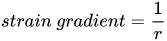

The surface length divided by the interatomic spacing is the number of crystal planes on this surface. The interatomic spacing is equal to the magnitude of Burgers vector . Thus the numbers of crystal planes on the outer (tension) surface and inner (compression) surface are and , respectively. Therefore, the concept of geometrically necessary dislocations is introduced that the same sign edge dislocations compensate the difference in the number of atomic planes between surfaces. The density of geometrically necessary dislocations is this difference divided by the crystal surface area


.

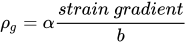
More precisely, the orientation of the slip plane and direction with respect to the bending should be considered when calculating the density of geometrically necessary dislocations. In a special case when the slip plane normals are parallel to the bending axis and the slip directions are perpendicular to this axis, ordinary dislocation glide instead of geometrically necessary dislocation occurs during bending process. Thus, a constant of order unity is included in the expression for the density of geometrically necessary dislocations

.
Polycrystalline material
Between the adjacent grains of a polycrystalline material, geometrically necessary dislocations can provide displacement compatibility by accommodating each crystal's strain gradient. Empirically, it can be inferred that such dislocations regions exist because crystallites in a polycrystalline material do not have voids or overlapping segments between them. In such a system, the density of geometrically necessary dislocations can be estimated by considering an average grain. Overlap between two adjacent grains is proportional to where is average strain and is the diameter of the grain. The displacement is proportional to multiplied by the gage length, which is taken as for a polycrystal. This divided by the Burgers vector, b, yields the number of dislocations, and dividing by the area () yields the density


which, with further geometrical considerations, can be refined to
.[2]

Nye's tensor
Nye has introduced a set of tensor (so-called Nye's tensor) to calculate the geometrically necessary dislocation density.[4]
For a three dimension dislocations in a crystal, considering a region where the effects of dislocations is averaged (i.e. the crystal is large enough). The dislocations can be determined by Burgers vectors. If a Burgers circuit of the unit area normal to the unit vector has a Burgers vector


()


where the coefficient is Nye's tensor relating the unit vector and Burgers vector . This second-rank tensor determines the dislocation state of a special region.

Assume , where is the unit vector parallel to the dislocations and is the Burgers vector, n is the number of dislocations crossing unit area normal to . Thus, . The total is the sum of all different values of . Assume a second-rank tensor to describe the curvature of the lattice, , where is the small lattice rotations about the three axes and is the displacement vector. It can be proved that where for , and for .
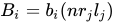


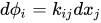





The equation of equilibrium yields . Since , thus . By substituting for , . Due to the zero solution for equations with are zero and the symmetry of and , only nine independent equations remain of all twenty-seven possible permutations of . The Nye's tensor can be determined by these nine differential equations.


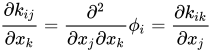




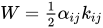
Thus the dislocation potential can be written as , where .