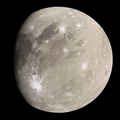
Gilgamesh is approximately 590 kilometres (370 mi) in diameter, making it the largest fully preserved impact structure on Ganymede. It is a multi-ring impact basin, with at least 4 concentric rings surrounding a smooth central plain 150 kilometres (93 mi) across. The central plain domes upward by up to 500 metres (1,600 ft),[5]: 42 and several small hills are arranged in a 50 kilometres (31 mi) diameter arc surrounding the center.[6]: 391 Surrounding the central plain is a discontinuous inward-facing scarp averaging 1 kilometre (0.62 mi) high, marking the inner boundary of a 225-kilometre-wide (140 mi) annular region of hummocky terrain hosting discontinuous concentric ridges and angular mountains. Another prominent inward-facing scarp marks the outer boundary, averaging 1 km in height and about 585 kilometres (364 mi) in diameter. Some segments of this scarp are quasi-linear, suggesting that pre-existing terrain may have influenced its shape. The location and prominence of the outer scarp suggests it is likely Gilgamesh's rim.[2]: 433–434 The angular mountains are 20–40 kilometres (12–25 mi) long, and their long axes point radially toward the basin center.[7]: 945 Structurally, Gilgamesh resembles Argyre Planitia on Mars, which also exhibits numerous discontinuous concentric ridges.[5]: 42
Gilgamesh is surrounded by a 200-kilometre-wide (120 mi) ring of mottled terrain where the pre-existing grooved terrain has been covered or obliterated by its ejecta blanket.[2]: 434 A vast field of secondary craters and crater chains extends up to 400–1,000 kilometres (250–620 mi) from the basin.[6]: 391 Most of the secondary craters and crater chains are concentrated to the north and south of the basin;[4]: 867 no secondary craters are identifiable to Gilgamesh's west, suggesting that it was formed by an oblique impact.[2]: 434 Many of the secondary craters are larger than a few kilometers in size and are thus complex craters [4]: 870 A 2018 study led by planetary scientist Kelsi N. Singer calculated the theoretical size of fragments blasted out by Gilgamesh's formative impact event, yielding a maximum fragment size of 360 metres (1,180 ft). This maximum fragment size implies that secondary craters formed by Gilgamesh's impact event are no larger than 2–3 kilometres (1.2–1.9 mi) in diameter.[4]: 877–879
Gilgamesh, by the law of superposition, is younger than the surrounding grooved terrain since no grooves cut into its structure.[6]: 484 In combination with the crater counting method on younger craters superposed on the basin rim, Gilgamesh's constrained age likely lies between 3.5 and 3.2 billion years (Gyr).[6]: 517 The projectile that formed Gilgamesh is estimated to have been around 60 kilometres (37 mi) in size.[2]: 451 Gilgamesh is structurally distinct from large impact basins on Callisto such as Valhalla, which have organized incomplete concentric rings and moderate topographical relief. Gilgamesh's closer resemblance to large impact basins on Earth's Moon indicates that at the time of its formation, Ganymede's crust was thicker and more rigid than Callisto's at the time of Valhalla's formation.[6]: 484 The preservation of Gilgamesh's structure post-formation may be partially due to its location in Ganymede's polar regions where the crust cooled more rapidly, preventing viscous relaxation.[6]: 505
.jpg)