Good quantum number
From Wikipedia, the free encyclopedia
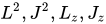
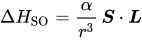
In quantum mechanics, the eigenvalue of an observable is said to be a good quantum number if the observable is a constant of motion. In other words, the quantum number is good if the corresponding observable commutes with the Hamiltonian. If the system starts from the eigenstate with an eigenvalue , it remains on that state as the system evolves in time, and the measurement of always yields the same eigenvalue .[1]


Good quantum numbers are often used to label initial and final states in experiments. For example, in particle colliders:[2]
- Particles are initially prepared in approximate momentum eigenstates; the particle momentum being a good quantum number for non-interacting particles.
- The particles are made to collide. At this point, the momentum of each particle is undergoing change and thus the particles’ momenta are not a good quantum number for the interacting particles during the collision.
- A significant time after the collision, particles are measured in momentum eigenstates. Momentum of each particle has stabilized and is again a good quantum number a long time after the collision.
An operator, , which commutes with the Hamiltonian, , will share its eigenstates.[3] A measurement of the system in one of these common eigenstates will definitely yield an eigenvalue of . That value is a good quantum number. An eigenstate of the Hamiltonian is a stationary state,[4] which means that even if the system is left to evolve for some time before the measurement is made, it will still yield the same eigenvalue.[3]

States which can be labelled by good quantum numbers
States which can be labelled by good quantum numbers are eigenstates of the Hamiltonian. They are also called stationary states.[5] They are so called because the system remains in the same state as time elapses, in every observable way.
Such a state satisfies:
- ,

where is a quantum state, is the Hamiltonian operator, and is the energy eigenvalue of the state .


The evolution of the state ket is governed by the Schrödinger equation:

It gives the time evolution of the state of the system as:

The time evolution only involves a steady change of a complex phase factor, which can't be observed. The state itself remains the same.