Grete Scherzer
Austrian pianist (1932–2007)
From Wikipedia, the free encyclopedia
Grete Scherzer (9 August 1932 – 11 March 2007) was an Austrian classical pianist who gained international prominence in the late 1940s and early 1950s. A child prodigy, she rose to national fame at age 14 after winning the 1947 Austrian Music Competition, finishing ahead of future notable pianists Jörg Demus, Ingrid Haebler, and Paul Badura-Skoda. Following her success at the 1949 Geneva International Music Competition, she established a prestigious concert and recording career in Great Britain, performing at major venues including Wigmore Hall and the Royal Festival Hall.
.png)
- Kärntner Landeskonservatorium (Carinthian State Conservatory)
- Academy of Music and Performing Arts in Vienna
Grete Scherzer | |
|---|---|
Grete Scherzer before 1950 | |
| Born | 9 August 1932 Wolfsberg, Carinthia, Austria |
| Died | 11 March 2007 (aged 74) Winterbach, Germany |
| Education |
|
| Occupation | Classical pianist |
| Years active | 1947–1957 |
| Known for | Schubert Prize (Geneva 1949) |
| Spouse | Rex Raab |
A prolific recording artist for the Parlophone label, Scherzer was particularly acclaimed for her interpretations of Mozart, Schubert, Schumann, and Ravel. She was also a pioneer in broadcast media; her performances were frequently featured on the BBC Third Programme, and she was among the first pianists to perform on British television.
In 1957, following her marriage to the British-born anthroposophical architect Rex Raab, Scherzer withdrew from the international concert stage and moved to Germany, where she lived until her death at 74. Interest in her musical legacy was revitalised in 2024 with the remastering and reissue of her early 1950s recordings.
Early life and education
Grete Scherzer was born on 9 August 1932 in Wolfsberg. Although little is known about her parents, they supported her passion for the piano. Scherzer herself recalled, "I've been playing the piano since I was three years old".[1] Her sister Hedi, about seven years older, taught her, aged five, "the notes".[2] While attending the girls' school in Wolfsberg, the headmistress gave her strong support, furthering her musical development. As a result, at age 9, Scherzer was accepted at the Carinthian State Conservatory (Kärntner Landeskonservatorium) at Klagenfurt am Wörthersee, where her piano teacher was Hilde Frodl. Within six months of starting at the conservatory, Scherzer achieved success at "her first public performance with the Klagenfurt City Orchestra". Subsequently, her reputation continued to grow through academic achievements, "student concerts, radio appearances, and a tour with opera singer Emmerich" during and after the wartime period.[2] In 1947, following these accomplishments, the Conservatory recommended her for an upcoming Austrian Music Competition in Vienna, which was established to discover and further promote Austrian talent among "performing" musicians.[3]

At just fourteen, Scherzer won against "competitors Jörg Demus, Ingrid Haebler, and Paul Badura-Skoda" at the 1947 Austrian Music Competition in Vienna, which was chaired by former Music Academy director Joseph Marx.[4] Her interpretation of one of Mozart's concertos during the public final stage in the Great Hall of the Musikverein secured her first prize. Not only did she receive a certificate, but she was also awarded a scholarship from the Gesellschaft der Musikfreunde for postgraduate studies at the Academy of Music and Performing Arts in Vienna in Professor Josef Dichler's class.[5] Just a month later, in July 1947, she again performed as a soloist in Mozart's Piano Concerto No. 23, in Bad Aussee as part of the Austrian Music Students' Festival. Music critics noted her "flawless rhythm and warmest feeling", and described the concert as "one spirited soul" in both the orchestra and the soloist.[6]
Career
Austria: Concerts, competitions and awards
Scherzer began her master's studies in piano with Professor Josef Dichler in Vienna in February 1948, at the age of 15.[7] Just one year later, "after an audition", she was selected by the "Ministry of Education" to represent Austria at the Schubert Competition in Geneva.[5]
The 1949 Schubert Competition was held as a special event within the Geneva International Music Competition and was dedicated exclusively to Schubert's piano compositions. In the final, Scherzer won over five competitors with her interpretation of the Schubert Sonata in B-flat major, D. 960, winning first prize. Geneva music critics were astonished by Scherzer's youth, but even more so by "the grace of her great talent", characterised by "balance, naturalness, musical expressiveness, elegance, and a fluid touch". Her success was "triumphant", and she was celebrated as "an exceptionally gifted young pianist".[8]

Scherzer's 1949 Schubert Prize was widely reported in the Austrian press and recognised musically, leading to her nomination as an "Austrian candidate" for the International Chopin Competition in Warsaw,[9] taking place in October 1949. The candidates' concert, held in Vienna on 8 September 1949 and attended by Austrian and Polish officials, was a great success for Scherzer. In the Austria-Musik-Kurier, published by the Gesellschaft der Musikfreunde and the Vienna Concert Hall Society, she was highlighted as the "central figure" that evening. Her "masterful" performance of Chopin's Piano Concerto No. 1, with "refinement of touch" and "polish of melodic lines" – her "remarkable transformation within a few months" was noted. Scherzer was characterised as a young artist who displayed "more than just talent".[10]
This established Scherzer as one of Austria's most sought-after pianists. However, "illness" prevented her from participating in the 1950 Chopin Competition.[7] Despite this setback, Scherzer continued her ascent in 1950, successfully launching her career in Great Britain.[11]
Scherzer's successes in Great Britain, which garnered significant attention in the Austrian media, along with her internationally recognised Schubert Prize and her achievements in Austria, led to her being awarded the "Vienna Critics' Prize for the Promotion of Young Musicians" in 1951.[12]
Great Britain: Concerts, radio and television broadcasts
In the autumn of 1950, at the age of 17, Scherzer undertook her first tour of Great Britain, travelling on a "six-week work visa".[7]
She made her London concert hall debut on 11 October 1950 at Chelsea Town Hall with a recital featuring works by Bach, Schubert, Schumann, and Chopin.[13] Writing for The Kensington News and West London Times, critic Denby Richards noted that she displayed an "unusual musical maturity for her young age" from "the very first bars of Bach's Chromatic Fantasia and Fugue". Richards further emphasised that this impression was "fully confirmed in Schubert's great posthumously published sonata" (Sonata in B-flat major, D. 960), describing her performance as being among the "most intimate and expressive interpretations" he had ever heard.[14]
Scherzer's BBC broadcast activities that year were limited to two single appearances. Her first radio broadcast took place on 11 September 1950 on the Third Programme,[15] followed by her television debut on 6 October 1950 in the children's programme series For the Children. The latter was announced with the introduction: "Grete Scherzer, seventeen-year-old Viennese pianist, winner of the first award at the International Music Festival, Geneva, 1949, makes her television appearance".[16]
Contemporary press coverage of her first stay in Great Britain often highlighted her appearance alongside her musical successes. She was described as being "Five feet tall, with a halo of fair hair about her face and pigtails hanging down below her waist",[17] with reports remarking that she looked "like a Dresden china figure" in her first elegant evening dress.[13]
Establishing a career (1951–1952)
In 1951, Scherzer shifted her career focus fully to Great Britain, "embarking on a 2,500-mile tour of the provinces, including the Midlands".[18] In the autumn of that year, she performed successfully at the newly opened Royal Festival Hall,[19] as well as the Wigmore Hall, Wimbledon Town Hall,[20] and Birmingham Town Hall.[20]
 Royal Festival Hall
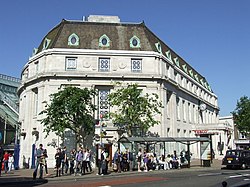 Wimbledon Town Hall
 Birmingham Town Hall

.jpg)

At the Royal Festival Hall, she made her first appearance with the London Symphony Orchestra under the baton of Hugo Rignold in September 1951. The music press noted that she performed Schumann's Piano Concerto with "such a mature interpretation and with enough confidence, without a hint of precociousness".[19]
"After her Wigmore Hall recital", she also gave a concert in October 1951 at Wimbledon Town Hall. The program included Chopin's Piano Sonata No. 3, the Toccata in G major, BWV 916, by Bach, arranged by Busoni, and the Brahms Piano Sonata No. 3, a performance "in which she showed her powers to the full".[20] Following a November 1951 recital at Birmingham Town Hall featuring works by Chopin and Ravel, critics wrote that the "gifted pianist's first quality lies in an uncanny understanding of the shape of music: her playing convinces us of the structure of musical thought even when it is lyrical and diffuse". Furthermore, it was noted that Scherzer’s "range has a masculine breadth, yet it is touched with a delicate imagery that is purely feminine".[20]
In the following years, Scherzer fulfilled "engagements with the B.B.C., London Philharmonic Orch., The Parlophone Co. (long and short recordings)" and continued to give regular recitals.[21]
Repertoire shifts and later reviews (1953–1957)

From 1953 onwards, however, increasingly concerned reviews began to appear regarding her performances. Following her rendition of Rachmaninoff's Piano Concerto No. 2 at the Royal Festival Hall in April 1953, it was remarked that "Miss Scherzer, who has been admired for her playing of Schubert and of French music, was unwise to play Rachmaninov". The critic suggested that her small hand span did not allow her "touch ... to the roaring of the klaviertiger".[22]
Scherzer's last known public concert in Great Britain took place at the Wigmore Hall on 12 October 1957. The program included Bach's Chromatic Fantasia and Fugue, Mozart's Piano Sonata No. 10, and Schumann's Humoreske. On this occasion, she faced a more critical perspective on her work. Although the reviewer acknowledged that Scherzer possessed a "pleasing articulation of phrases" and an "exquisitely graded pianissimo touch" ("matters for wonder"), they described her Bach playing as "pompous", though the performance was not "at least ... didactic". Her Mozart was criticised for being "so meticulously refined" that it "emerged dwarf-size", and in the Schumann, the critic claimed, "she drilled into the starch and lace of an old-fashioned governess".[23]
Recordings
In 1950, Scherzer signed with Parlophone. Throughout the early 1950s, the label released numerous recordings of her performing works by composers including Brahms, Chopin, Debussy, Marx, Mendelssohn, Mozart, Prokofiev, Schubert, Schumann, Scarlatti and Ravel.[a] Her first release in 1951 featured the Prelude in E-flat minor, from the cycle Six Piano Pieces (1916) by the Austrian composer Joseph Marx. Originally released as a 78 rpm record (R 3437), the performance was later remastered and included in the 2012 Naxos anthology Women at the Piano, Vol. 5 (1923–1955).[27]
Scherzer's last release was Mozart's Piano Concerto No. 14, recorded with the London Baroque Ensemble conducted by Karl Haas. The recording was first released in the United Kingdom in October 1954 (LP PMA 1012). In 1955, it was licensed to Decca Records in the United States (DL 9776). Critical reception of the Mozart recording was mixed. The New York Times critic Ross Parmenter described Scherzer's interpretation as "uninspiring",[28] and DownBeat magazine suggested the performance lacked "vitality".[29] Conversely, the August 1955 issue of The New Records praised her as a "first-rate Mozart interpreter",[30] while Audio magazine described the concerto as being "most gracefully and refreshingly played".[31]
In 2024, the French label Classica re-released some of Scherzer's recordings "from 1952 to 1956 for Parlophone" as part of the "Les Introuvables" (The Lost Treasures) series, Volume 39. The CD was included with issue 259 of Classica magazine in February 2024 and contains her recordings of Schubert's Impromptus, Op. 90, Six moments musicaux, Impromptus, op. 142, Ravel's Gaspard de la nuit and the Schumann Fantasy in C.[32]
French music critic Thomas Deschamps wrote about this reissue of Grete Scherzer's recordings from the 1950s: "Further works by Debussy, including Pour le piano, two sonatas by Scarlatti, piano pieces by Brahms and Chopin, as well as concertos by Haydn and Mozart", which are not included in the 2024 Classica release, "are waiting to be discovered".[33]
Marriage and life after 1957
_Ortskern.JPG)
In 1957, Scherzer married the British architect Rex Raab, who had "established his own office in southern Germany" around that time.[34] They had first met c. 1947 when Raab, serving as a "British Red Cross Welfare Officer", worked in her hometown of Wolfsberg for the "Friends' Relief Service".[35] During his time there, Raab organised various educational activities and an "impressive Schubert concert".[36]
Raab had been a member of the Anthroposophical Society since 1938 and was dedicated to the application of Rudolf Steiner's teachings. Following their marriage, Scherzer – then known as Scherzer-Raab – supported his work and withdrew from the public stage and recording studios.[b] Why she finally ended her piano career after her last concert at Wigmore Hall on 14 October 1957 – "love, ideological proselytising, social conventions" – remains a "mystery".[33]
Scherzer died in Winterbach, Germany, her chosen long-time residence, on 11 March 2007.[c]