Gök Medrese, Sivas
Madrasa in Sivas, Turkey
From Wikipedia, the free encyclopedia
Gökmedrese or Gök Medrese (literally: "Blue Madrasah"), also known as Sahibiye Medresesi, is a 13th-century medrese, an Islamic educational institution, in the city of Sivas, Turkey.

| Gökmedrese Sahibiye Medresesi | |
|---|---|
| |
| Religion | |
| Affiliation | Islam |
| Location | |
| Location | Sivas, Turkey |
 Interactive map of Gökmedrese Sahibiye Medresesi | |
| Coordinates | 39.74424°N 37.01666°E |
| Architecture | |
| Architect | Kaloyan[1] |
| Type | Madrasah |
| Style | Seljuk |
| Completed | 1271 |
| Specifications | |
| Direction of façade | west-southwest |
| Width | 31.25 m (102.5 ft) |
| Minaret | 2 |
| Minaret height | 25 m (82 ft) |
| Website | |
| www | |
History
The medrese was commissioned by Sahip Ata Fahrettin Ali, a vizier and the de facto ruler of Seljuk Sultanate of Rûm after the death of Pervane in 1277. Up to 1271, he was usually in good terms with Pervane. He commissioned many buildings in Anatolia. Gökmedrese is one of the most imposing of all. The original name of the medrese is Sahibiye, referring to Sahip Ata. But it is usually known as Gökmedrese, because of the sky-blue tiles used at the building.
The medrese was constructed by an architect[a] known as "Kaloyan" (Byzantine Greek: Καλό Γιάννη, "Kalo Yianni," literally 'good John') from Konya.[1] Originally, it was a two-story building. There were also a hamam (Turkish bath) and a soup kitchen for 30 people. But presently, only the 13 rooms of the lower floor exist. It was restored in 1823 and was in use up until 1926.[2]
Technical details
Vakıf
In middle age Islamic countries Vakıf was a source of revenue, endowed for the exploitation and the maintenance of the foundations as well as for the salaries of the staff. In Gökmedrese case, there were 85 markets, nine villages, two farms and some other sources endowed as vakfiye.
Gallery
 Muqarnas on the portal.
 Gök Medrese during restoration shot from right side
 Gök Medrese before restoration Portal from left side
 Gök Medrese before restoration Decoration corner
 Gök Medrese before restoration Ceiling inside
 Gök Medrese during restoration Minarets
 Gök Medrese before restoration Portal
 Gök Medrese before restoration Portal detail
 Gök Medrese before restoration Portal detail
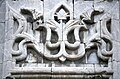 Gök Medrese before restoration Portal detail closer up
 Gök Medrese before restoration Portal side
 Gök Medrese before restoration Decoration
 Gök Medrese before restoration shot from side


