
HD 131399
Star in the constellation Centaurus
From Wikipedia, the free encyclopedia
HD 131399 is a star system in the constellation of Centaurus. Based on the system's electromagnetic spectrum, it is located around 350 light-years (107.9 parsecs) away.[6] The total apparent magnitude is 7.07,[6] but because of interstellar dust between it and the Earth, it appears 0.22±0.09 magnitudes dimmer than it should.[6]

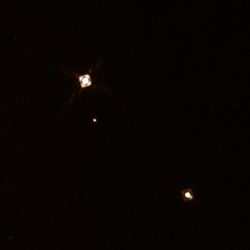 SPHERE image of HD 131399 A (top left), B and C (bottom right), and the background object (center) Credit: ESO/K. Wagner et al. | |
| Observation data Epoch J2000 Equinox J2000 | |
|---|---|
| Constellation | Centaurus[1] |
| Right ascension | 14h 54m 25.30919s[2] |
| Declination | −34° 08′ 34.0412″[2] |
| Apparent magnitude (V) | 7.07[3] |
| Characteristics | |
| Spectral type | A1V + G + K[4] |
| Astrometry | |
| Radial velocity (Rv) | 0.30±1.3[5] km/s |
| Distance | 351+15 −12 ly (107.9+4.5 −3.7[6] pc) |
| A | |
| Proper motion (μ) | RA: −30.702[7] mas/yr Dec.: −30.774[7] mas/yr |
| Parallax (π) | 9.7480±0.0357 mas[7] |
| Distance | 335 ± 1 ly (102.6 ± 0.4 pc) |
| Absolute magnitude (MV) | 1.89[8] |
| BC | |
| Proper motion (μ) | RA: −31.523[9] mas/yr Dec.: −31.047[9] mas/yr |
| Parallax (π) | 9.3021±0.0633 mas[9] |
| Distance | 351 ± 2 ly (107.5 ± 0.7 pc) |
| Orbit[4] | |
| Primary | A |
| Name | BC |
| Period (P) | 3,556±36 yr |
| Semi-major axis (a) | 3.56±0.03" (349±28 au) |
| Eccentricity (e) | 0.13±0.05 |
| Inclination (i) | 45 to 65° |
| Longitude of the node (Ω) | 265±20[note 1]° |
| Periastron epoch (T) | B 502±33 |
| Argument of periastron (ω) (secondary) | 145.3±15[note 2]° |
| Details | |
| Age | 21.9+4.1 −3.8[6] Myr |
| HD 131399 A | |
| Mass | 1.95+0.08 −0.06[8] M☉ |
| Radius | 1.51+0.13 −0.10[8] R☉ |
| Luminosity | 14.8+2.6 −2.2[8] L☉ |
| Surface gravity (log g) | 4.37±0.10[8] cgs |
| Temperature | 9,200±100[8] K |
| Rotational velocity (v sin i) | 26±2[8] km/s |
| HD 131399 B | |
| Mass | 0.95±0.04[6] M☉ |
| Surface gravity (log g) | 4.40±0.03[6] cgs |
| Temperature | 4,890+190 −170[6] K |
| HD 131399 C | |
| Mass | 0.35±0.04[6] M☉ |
| Surface gravity (log g) | 4.45±0.05[6] cgs |
| Temperature | 3,460±60[6] K |
| Other designations | |
| CD−33°10153, HIP 72940, SAO 206071 | |
| Database references | |
| SIMBAD | data |
The brightest star, is a young A-type main-sequence star, and further out are three lower-mass stars.[4] A Jupiter-mass planet or a low-mass brown dwarf was once thought to be orbiting the central star, but this has been ruled out.[6][10]
Stellar system
The brightest star in the HD 131399 system is designated HD 131399 A. Its spectral type is A1V,[4] and it is 2.08 times as massive as the Sun.[6] The two lower-mass stars are designated HD 131399 B and C, respectively. B is a G-type main-sequence star, while HD 131399 C is a K-type main-sequence star.[4] Both stars are less massive than the Sun.[6] A lower-mass companion to HD 131399 A was announced in 2017, at a separation of 0.12 astronomical units (au).[11]
HD 131399 B and C are located very close to each other, and the two orbit each other at about 10 AU.[12] In turn, the B-C pair orbits the central star A at a distance of 349 AU. This orbit takes about 3,600 years to complete, and it has an eccentricity of about 0.13[4] The entire system is about 21.9 million years old.[6]
One paper has reported that HD 131399 A has a companion in an inclined 10-day orbit with a semi-major axis of 0.1 AU.[13] HD 131399 A has been described as a "nascent Am star"; although it has a very slow projected rotation rate and would be expected to show chemical peculiarities, its spectrum is relatively normal, possibly due to its young age.[8]
Claims of a planetary system

The claimed discovery of a massive planet, named HD 131399 Ab, was announced in a paper published in the journal Science.[4] The object was imaged using the SPHERE imager of the Very Large Telescope at the European Southern Observatory, located in the Atacama Desert of Chile, and announced in a July 2016 paper in the journal Science.[4][14] It was thought to be a T-type object with a mass of 4±1 MJ,[4] but its orbit would have been unstable, causing it to be ejected between the primary's red giant phase and white dwarf phase.[15] This was the first exoplanet candidate to be discovered by SPHERE. The image was created from two separate SPHERE observations: one to image the three stars and one to detect the faint planet.[16] After its discovery, the team unofficially named the system "Scorpion-1" and the planet "Scorpion-1b", after the survey that prompted its discovery, the Scorpion Planet Survey (principal investigator: Daniel Apai).[17]
In May 2017, observations made by the Gemini Planet Imager and including a reanalysis of the SPHERE data suggest that this target is, in fact, a background star. This object's spectrum seems to be like that of a K-type or M-type dwarf, not a T-type object as first thought. It also initially appeared to be associated with HD 131399, but this was because of its unusually high proper motion (in the top 4% fastest-moving stars).[6] After subsequent data published in 2022 confirmed that the object is a background star,[18] the paper announcing the putative discovery was retracted.[10][19]