HD 32453
From Wikipedia, the free encyclopedia
| Observation data Epoch J2000.0 Equinox J2000.0 (ICRS) | |
|---|---|
| Constellation | Caelum[1] |
| Right ascension | 05h 01m 34.5225s[2] |
| Declination | −39° 43′ 04.964″[2] |
| Apparent magnitude (V) | 6.01±0.01[3] |
| Characteristics | |
| Spectral type | G8 III[4] |
| B−V color index | +0.88[5] |
| Astrometry | |
| Radial velocity (Rv) | 5.73±0.12[2] km/s |
| Proper motion (μ) | RA: −5.456[2] mas/yr Dec.: +32.717[2] mas/yr |
| Parallax (π) | 8.0168±0.0344 mas[2] |
| Distance | 407 ± 2 ly (124.7 ± 0.5 pc) |
| Absolute magnitude (MV) | +0.78[1] |
| Details | |
| Mass | 2.40[6] M☉ |
| Radius | 10.03[7][8] R☉ |
| Luminosity | 50.1[9] L☉ |
| Surface gravity (log g) | 3.18±0.14[10] cgs |
| Temperature | 5,032±61[9] K |
| Metallicity [Fe/H] | −0.02±0.13[10] dex |
| Rotational velocity (v sin i) | 2±1.4[11] km/s |
| Age | 700[6] Myr |
| Other designations | |
| CD−39°1744, HD 32453, HIP 23377, HR 1631, SAO 195501 | |
| Database references | |
| SIMBAD | data |
HD 32453 (HR 1631) is a solitary star located in the southern constellation Caelum. With an apparent magnitude of 6.01,[3] it's barely visible to the naked eye under ideal conditions. This star is located 407 light years away based on its parallax shift, but is drifting away at a rate of 5.73 km/s.[2]
This star was designated Epsilon Caeli by Johann Elert Bode in his 1801 Uranographia, but this is now no longer used.[12]
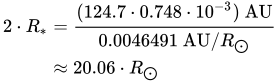
HD 32453 has a classification of G8 III,[4] which states it is an evolved G-type star that exhausted hydrogen at its core and left the main sequence. At present it has 2.40[6] times the Sun's mass, but at an age of 700 million years,[6] HD 32453 has expanded to 10[7] times the latter's girth (radius detected from an angular diameter of 0.748 mas[8]). It radiates at 50[9] solar luminosities from its enlarged photosphere at an effective temperature of 5,032 K,[9] which gives it a yellow hue. HD 32453 is slightly metal deficient,[10] and spins slowly with a projected rotational velocity of 2 km/s,[11] common for a giant star.