HRDetect
From Wikipedia, the free encyclopedia
HRDetect [1] (Homologous Recombination Deficiency Detect) is a whole-genome sequencing (WGS)-based classifier designed to predict BRCA1 and BRCA2 deficiency based on six mutational signatures. Additionally, the classifier is able to identify similarities in mutational profiles of tumors to that of tumors with BRCA1 and BRCA2 defects, also known as BRCAness. This classifier can be applied to assess the implementation of PARP[1] inhibitors in patients with BRCA1/BRCA2 deficiency. The final output is a probability of BRCA1/2 mutation.

BRCA1/BRCA2
BRCA1 and BRCA2 play crucial roles in maintaining genome integrity, mainly through homologous recombination (HR) for DNA double-strand breaks (DSB)repair. The mutations of BRCA1 and BRCA2 can lead to a reduced capacity of HR machinery, increased genomic instability, and elicit a predisposition to malignancies.[2] People with BRCA1 and BRCA2 deficiency have higher risks of developing certain cancers such as breast and ovarian cancers. Germline defects in BRCA1/BRCA2 genes account for up to 5% of breast cancer cases.[1]
PARP inhibitors

Poly (ADP ribose) polymerase (PARP) inhibitors are designed to treat BRCA1- and BRCA2- defect tumors owing to their homologous recombination deficiency.[4] These drugs have been majorly implemented in breast and ovarian cancers,[5] and their clinical efficacy among patients with other types of cancers, such as pancreatic cancer, is still being investigated.[6] It is vital to identify adequate patients with BRCA1/BRCA2 deficiency to utilize PARP inhibitors optimally. PARP inhibitors operate on the concept of synthetic lethality by selectively causing cell death in BRCA-mutant cells while sparing normal cells.
HRDetect
HRDetect was implemented to detect tumors with BRCA1/BRCA2 deficiency using the data from whole-genome sequencing. This model quantitatively aggregates six HRD-associated signatures into a single score called HRDetect to accurately classify breast cancers by their BRCA1 and BRCA2 status. The machine learning algorithm assigns weight values to these signatures prior to computing the final score. The six signatures, ranked by decreasing weight, include microhomology-mediated indels, the HRD index, base- substitution signature 3, rearrangement signature 3, rearrangement signature 5, and base- substitution signature 8. Additionally, this weighted approach is able to identify BRCAness, which refers to mutational phenotypes displaying homologous recombination deficiency similar to tumors with BRCA1/BRCA2 germline defects.[7]
Methodology
Input
HRDetect requires four types of inputs:
- Counts of mutations associated with each signature of single-base substitutions
- Indels with microhomology at the indel breakpoint junction, indels at polynucleotide-repeat tracts and other complex indels as proportions
- Counts of rearrangements associated with each signature
- HRD index (Arithmetic sum of loss of heterozygosity (LOH), telomeric-allelic imbalance (TAI), and large-scale state transitions (LST) scores)
Statistical Analysis
It is based on a supervised learning method using a lasso logistic regression model to distinguish samples into those with and without BRCA 1/2 deficiency. Optimal coefficients are obtained by minimizing the objective function.
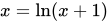
Log Transformation
To account for a high substitution count in samples, the genomic data is first log transformed:
Standardization
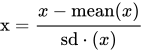
The transformed data is then standardized to make mutational class values comparable giving each object a mean of 0 and a standard deviation (sd) of 1:
Lasso Logistical Regression Modelling

To be able to distinguish between those affected and not affected by BRCA1/BRCA2 deficiency, a lasso logistic regression model is used:
![{\displaystyle \min _{((\beta _{0},\,\beta ))\in \mathbb {R} ^{p+1}}{\left(-\left[{\frac {1}{N}}\sum _{i=1}^{N}y_{i}\cdot \left(\beta _{0}+x_{i}^{T}\beta \right)-\log \left(1+e^{\left(\beta _{0}+x_{i}^{T}\beta \right)}\right)\right]+\lambda \|\beta \|_{1}\right)}}](https://wikimedia.org/api/rest_v1/media/math/render/svg/39e2bdf0541a4e289e9a1738e87d4743ee35ce2a)
where:
: BRCA status of a sample || yi = 1 for BRCA1/BRCA2-null samples || yi = 0 otherwise
: Intercept, interpreted as the log of odds of = 1 when = 0
: Vector of weights
: Number of features characterizing each sample
: Number of samples
: Vector of features characterizing the ith sample
: Penalty promoting the sparseness of the weights
: L1 norm of the vector of weights


The β weights are constrained to be positive to reflect the presence of mutational actions due to BRCA1/BRCA2 defects. Setting the constraint of nonnegative weights ensures that all samples would be scored on the basis of the presence of relevant mutational signatures associated with BRCA1/BRCA2 deficiency, irrespective of whether these signatures are the dominant mutational process in the cancer.
HRDetect Score
Lastly, the weights obtained from the lasso regression are used to give a new sample a probabilistic score using the normalized mutational data and application of the model parameters(, ):

where:
: variable encoding the status of the ith sample
: Intercept weight
: Vector encoding features of the ith sample
: Vector of weights

Interpretation
The probability value quantifies the degree of BRCA1/BRCA2 defectiveness. A cut-off probability value should be chosen while maintaining a high sensitivity. These scores can be utilized to guide therapy.