Hammer throw
Throwing event in track and field competitions
From Wikipedia, the free encyclopedia
The hammer throw (Abbreviated as HT[1]) is one of the four throwing events in regular outdoor track-and-field competitions, along with the discus throw, shot put and javelin.

 Yuriy Sedykh 86.74 m (284 ft 6 in) (1986)
 Anita Włodarczyk 82.98 m (272 ft 2 in) (2016) Sergey Litvinov 84.80 m (278 ft 2 in) (1988) Anita Włodarczyk 82.29 m (269 ft 11 in) (2016)
| Athletics Hammer throw | |
|---|---|
Jack Dalton competing in Nunawading, Victoria | |
| World records | |
| Men | Yuriy Sedykh 86.74 m (284 ft 6 in) (1986) |
| Women | Anita Włodarczyk 82.98 m (272 ft 2 in) (2016) |
| Olympic records | |
| Men | Sergey Litvinov 84.80 m (278 ft 2 in) (1988) |
| Women | Anita Włodarczyk 82.29 m (269 ft 11 in) (2016) |
| World Championship records | |
| Men |  Ethan Katzberg 84.70 m (277 ft 10 in) (2025) Ethan Katzberg 84.70 m (277 ft 10 in) (2025) |
| Women | Anita Włodarczyk 80.85 m (265 ft 3 in) (2015) |
The hammer used in this sport is not like any of the tools also called by that name. It consists of a metal ball attached by a steel wire to a grip. These three components are each separate and can move independently. Both the size and weight of the ball vary between men's and women's events. The men's hammer weighs 7.26 kilograms (16 lb) for college and professional meets; the women's hammer weighs 4 kilograms (8.8 lb).[2]
History
Tradition traces it to the Tailteann Games in Tara, Ireland, around the year 1830 BC.[3] Some time later the Celtic warrior Culchulainn reputedly took a chariot axle with a wheel still attached, spun it around and hurled it a long way.[2] The wheel was later replaced by a rock with a wooden handle attached.[2] A sledgehammer began to be used for the sport in Scotland and England during the Middle Ages.[2] In current times, the hammer has changed to the more modern 16 lb. ball attached to a wire and a handle, but the Scottish hammer throw as seen in Highland Games still feature the older style of hammer throw with the rock and the solid wood handle.
While the men's hammer throw has been part of the Olympics since 1900, the International Association of Athletics Federations did not start ratifying women's marks until 1995. Women's hammer throw was first included in the Olympics at the 2000 summer games in Sydney, Australia, after having been included in the World Championships a year earlier.[citation needed]
Competition
The men's hammer weighs 7.26 kilograms (16 lb) and the women's weighs 4 kg (8.8 lb), with the wire in either case no more than 122 centimetres (48 in) in length.[2] Like the other throwing events, the competition is decided by who can throw the implement the farthest.
The throwing motion starts with the thrower swinging the hammer back-and-forth about two times to generate momentum. The thrower then makes three, four or (rarely) five full rotations using a complex heel-toe foot movement, spinning the hammer in a circular path and increasing its angular velocity with each rotation. Rather than spinning the hammer horizontally, it is instead spun in a plane that angles up towards the direction in which it will be launched. The thrower releases the hammer as its velocity is upward and toward the target.[4]
Throws are made from a throwing circle. The thrower is not allowed to step outside the throwing circle before the hammer has landed and may only enter and exit from the rear of the throwing circle. The hammer must land within a 34.92º throwing sector that is centered on the throwing circle. The sector angle was chosen because it provides a sector whose bounds are easy to measure and lay out on a field (10 metres out from the center of the ring, 6 metres across).[2][5] A violation of the rules results in a foul and the throw not being counted.[citation needed]
As of 2025[update] the men's hammer world record is held by Yuriy Sedykh, who threw 86.74 m (284 ft 6+3⁄4 in) at the 1986 European Athletics Championships in Stuttgart, West Germany on 30 August. The world record for the women's hammer is held by Anita Włodarczyk, who threw 82.98 m (272 ft 2+3⁄4 in) during the Kamila Skolimowska Memorial on 28 August 2016.[citation needed] Sedykh's 1986 world record has been noted for its longevity, and for dating from "a time when track and field was starting to realize the scale of performance-enhancing drug use" (AP).[6] According to Russian doping whistleblower Grigory Rodchenkov, Sedykh was a heavy user of steroids, which Sedykh denied.[6]
The throwing distance depends on the velocity and height at which the hammer is released, but also on other factors that are not under the athlete's control.[7] In particular, Earth's rotation affects it via the location's latitude (due to the centrifugal force, the hammer will fly a bit further in a location closer to the equator) and to a lesser extent also via the throw's azimuth (i.e. its compass direction, due to Coriolis forces).[7] According to a 2023 study, such effects are large enough that the top 20 world-record rankings for both men and women at the time could somewhat change if they were adjusted for latitude and azimuth.[7]
 The traditional Highland games version of the event
 Thrower inside a hammer cage, with the markings for the throwing circle and the throwing sector visible on the ground
 Scottish hammer throw illustration from Frank R. Stockton's book Round-about Rambles in Lands of Fact and Fancy
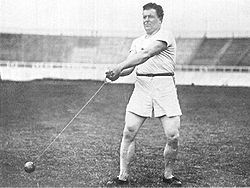 John Flanagan in the hammer throw competition at the Summer Olympics 1908 in London
 The contemporary version of the hammer throw
 Athlete practicing the hammer throw event
- Men's Hammer Throw Final – 28th Summer Universiade


Safety issues
Hammer throwing has been described as involving "inherent danger [...]. Athletes, coaches, and spectators participating in the event are at risk; steel hammers [...] are hurled through the air at great speeds, [travel] far distances, and [are] sometimes difficult to spot in flight."[8] For example, hammer throws resulted in four deaths in Europe in 2000 alone,[9] and have caused deaths and permanent brain damage injuries in the United States too.[8]
To mitigate such risks, a C-shaped "hammer cage" was introduced, which is built around the throwing circle, preventing the hammer from flying off in unwanted directions.[8] In 2004, the IAAF changed its rules to increase the mandatory height of hammer cages to 10m and reduce their "danger zone" angle to around 53°.[8] The change also moved the cage gates further away from the throwing circle, thus reducing the risk of a misdirected hammer bouncing back on the thrower.[10]
All-time top 25
| Tables show data for two definitions of "Top 25" - the top 25 hammer throw marks and the top 25 athletes: |
| - denotes top performance for athletes in the top 25 hammer throw marks |
| - denotes lesser performances, still in the top 25 hammer throw marks, by repeat athletes |
| - denotes top performance (only) for other top 25 athletes who fall outside the top 25 hammer throw marks |
Men
- Correct as of September 2025.[11]
| Ath.# | Perf.# | Mark | Athlete | Nation | Date | Place | Ref. |
|---|---|---|---|---|---|---|---|
| 1 | 1 | 86.74 m (284 ft 6 in) | Yuriy Sedykh | Soviet Union | 30 August 1986 | Stuttgart | |
| 2 | 86.66 m (284 ft 3 in) | Sedykh #2 | 22 June 1986 | Tallinn | |||
| 3 | 86.34 m (283 ft 3 in) | Sedykh #3 | 3 July 1984 | Cork | |||
| 2 | 4 | 86.04 m (282 ft 3 in) | Sergey Litvinov | Soviet Union | 3 July 1986 | Dresden | |
| 5 | 85.74 m (281 ft 3 in) | Litvinov #2 | 30 August 1986 | Stuttgart | |||
| 6 | 85.68 m (281 ft 1 in) | Sedykh #4 | 11 August 1986 | Budapest | |||
| 7 | 85.60 m (280 ft 10 in) | Sedykh #5 | 13 July 1984 | London | |||
| Sedykh #6 | 17 August 1984 | Moscow | |||||
| 9 | 85.20 m (279 ft 6 in) | Litvinov #3 | 3 July 1984 | Cork | |||
| 10 | 85.14 m (279 ft 3 in) | Litvinov #4 | 11 July 1986 | London | |||
| Sedykh #7 | 4 September 1988 | Moscow | |||||
| 12 | 85.02 m (278 ft 11 in) | Sedykh #8 | 20 August 1984 | Budapest | |||
| 13 | 84.92 m (278 ft 7 in) | Sedykh #9 | 3 July 1986 | Dresden | |||
| 3 | 14 | 84.90 m (278 ft 6 in) | Vadim Devyatovskiy |  Belarus Belarus | 21 July 2005 | Minsk | |
| 15 | 84.88 m (278 ft 5 in) | Litvinov #5 | 10 September 1986 | Rome | |||
| 4 | 16 | 84.86 m (278 ft 4 in) | Koji Murofushi |  Japan Japan | 29 June 2003 | Prague | |
| 17 | 84.80 m (278 ft 2 in) | Litvinov #6 | 26 September 1988 | Seoul | |||
| 18 | 84.72 m (277 ft 11 in) | Sedykh #10 | 9 July 1986 | Moscow | |||
| 5 | 19 | 84.70 m (277 ft 10 in) | Ethan Katzberg | Canada | 16 September 2025 | Tokyo | [12] |
| 20 | 84.64 m (277 ft 8 in) | Litvinov #7 | 9 July 1986 | Moscow | |||
| 6 | 21 | 84.62 m (277 ft 7 in) | Igor Astapkovich |  Belarus Belarus | 6 June 1992 | Seville | |
| 22 | 84.60 m (277 ft 6 in) | Sedykh #11 | 14 September 1984 | Tokyo | |||
| 23 | 84.58 m (277 ft 5 in) | Sedykh #12 | 8 June 1986 | Leningrad | |||
| 7 | 24 | 84.51 m (277 ft 3 in) | Ivan Tsikhan | Belarus | 9 July 2008 | Grodno | |
| 8 | 25 | 84.48 m (277 ft 1 in) | Igor Nikulin | Soviet Union | 12 July 1990 | Lausanne | |
| 9 | 84.40 m (276 ft 10 in) | Jüri Tamm | Soviet Union |
9 September 1984 | Banská Bystrica | ||
| 10 | 84.19 m (276 ft 2 in) | Adrián Annus |  Hungary Hungary |
10 August 2003 | Szombathely | ||
| 11 | 83.93 m (275 ft 4 in) | Paweł Fajdek | Poland |
9 August 2015 | Szczecin | [13] | |
| 12 | 83.68 m (274 ft 6 in) | Tibor Gécsek | Hungary |
19 September 1998 | Zalaegerszeg | ||
| 13 | 83.46 m (273 ft 9 in) | Andrey Abduvaliyev | Soviet Union |
26 May 1990 | Adler | ||
| 14 | 83.43 m (273 ft 8 in) | Aleksey Zagornyi |  Russia Russia |
10 February 2002 | Adler | ||
| 15 | 83.40 m (273 ft 7 in) | Ralf Haber |  East Germany East Germany |
16 May 1988 | Athens | ||
| 16 | 83.38 m (273 ft 6 in) | Szymon Ziółkowski | Poland |
5 August 2001 | Edmonton | ||
| 17 | 83.30 m (273 ft 3 in) | Olli-Pekka Karjalainen |  Finland Finland |
14 July 2004 | Lahti | ||
| 18 | 83.18 m (272 ft 10 in) | Bence Halasz | Hungary |
12 August 2025 | Budapest | [14] | |
| 19 | 83.16 m (272 ft 10 in) | Rudy Winkler |  United States United States |
5 July 2025 | Eugene | [15] | |
| 20 | 83.04 m (272 ft 5 in) | Heinz Weis |  Germany Germany |
29 June 1997 | Frankfurt | ||
| 21 | 83.00 m (272 ft 3 in) | Balázs Kiss | Hungary |
4 June 1998 | Saint-Denis | ||
| 22 | 82.78 m (271 ft 7 in) | Karsten Kobs | Germany |
26 June 1999 | Dortmund | ||
| 23 | 82.77 m (271 ft 6 in) | Merlin Hummel | Germany |
16 September 2025 | Tokyo | [12] | |
| 24 | 82.69 m (271 ft 3 in) | Krisztián Pars | Hungary |
16 August 2014 | Zürich | ||
| 25 | 82.64 m (271 ft 1 in) | Günther Rodehau | East Germany |
3 August 1985 | Dresden |
Annulled marks
- Ivan Tsikhan of Belarus also threw 86.73 in Brest on 3 July 2005. This performance was annulled due to doping offences.
Women
- Correct as of April 2026.[16]
| Ath.# | Perf.# | Mark | Athlete | Nation | Date | Place | Ref. |
|---|---|---|---|---|---|---|---|
| 1 | 1 | 82.98 m (272 ft 2 in) | Anita Włodarczyk | Poland |
28 August 2016 | Warsaw | [17] |
| 2 | 82.87 m (271 ft 10 in) | Włodarczyk #2 | 29 July 2017 | Władysławowo | |||
| 3 | 82.29 m (269 ft 11 in) | Włodarczyk #3 | 15 August 2016 | Rio de Janeiro | |||
| 2 | 4 | 81.13 m (266 ft 2 in) | Camryn Rogers | Canada |
2 April 2026 | Austin | [18] |
| 5 | 81.08 m (266 ft 0 in) | Włodarczyk #4 | 1 August 2015 | Władysławowo | |||
| 6 | 80.85 m (265 ft 3 in) | Włodarczyk #5 | 27 August 2015 | Beijing | |||
| 7 | 80.79 m (265 ft 0 in) | Włodarczyk #6 | 23 July 2017 | Białystok | |||
| 8 | 80.51 m (264 ft 1 in) | Rogers #2 | 15 September 2025 | Tokyo | [19] | ||
| 3 | 9 | 80.31 m (263 ft 5 in) | DeAnna Price | United States |
26 June 2021 | Eugene | [20] |
| 10 | 80.26 m (263 ft 3 in) | Włodarczyk #7 | 12 July 2016 | Władysławowo | |||
| 4 | 11 | 80.17 m (263 ft 0 in) | Brooke Andersen | United States |
20 May 2023 | Tucson | [21] |
| 12 | 80.03 m (262 ft 6 in) | Rogers #3 | 24 April 2026 | Nairobi | [22] | ||
| 13 | 79.92 m (262 ft 2 in) | Andersen #2 | 4 May 2024 | Tucson | [23] | ||
| 14 | 79.80 m (261 ft 9 in) | Włodarczyk #8 | 15 August 2017 | Warsaw | |||
| Andersen #3 | 20 April 2023 | Charlottesville | [24] | ||||
| 16 | 79.73 m (261 ft 6 in) | Włodarczyk #9 | 6 May 2017 | Doha | |||
| 17 | 79.72 m (261 ft 6 in) | Włodarczyk #10 | 27 June 2017 | Ostrava | |||
| 18 | 79.63 m (261 ft 3 in) | Rogers #4 | 10 April 2026 | Ramona | [25] | ||
| 19 | 79.61 m (261 ft 2 in) | Włodarczyk #11 | 18 June 2016 | Szczecin | |||
| 20 | 79.59 m (261 ft 1 in) | Włodarczyk #12 | 22 July 2018 | Lublin | |||
| 21 | 79.58 m (261 ft 1 in) | Włodarczyk #13 | 31 August 2014 | Berlin | |||
| 22 | 79.48 m (260 ft 9 in) | Włodarczyk #14 | 21 May 2016 | Halle | |||
| 23 | 79.45 m (260 ft 7 in) | Włodarczyk #15 | 29 May 2016 | Forbach | |||
| 5 | 24 | 79.42 m (260 ft 6 in) | Betty Heidler | Germany |
21 May 2011 | Halle | |
| 25 | 79.29 m (260 ft 1 in) | Andersen #4 | 24 May 2025 | Tucson | [26] | ||
| 6 | 78.80 m (258 ft 6 in) | Rachel Richeson | United States |
11 April 2025 | Ramona | [27] | |
| 7 | 78.51 m (257 ft 6 in) | Tatyana Lysenko | Russia |
5 July 2012 | Cheboksary | ||
| 8 | 78.22 m (256 ft 7 in) | Zhao Jie |  China China |
3 April 2026 | Chengdu | [28] | |
| 9 | 78.00 m (255 ft 10 in) | Janee' Kassanavoid | United States |
21 May 2022 | Tucson | [29] | |
| 10 | 77.78 m (255 ft 2 in) | Gwen Berry | United States |
8 June 2018 | Chorzów | [30] | |
| 11 | 77.68 m (254 ft 10 in) | Wang Zheng | China |
29 March 2014 | Chengdu | ||
| 12 | 77.64 m (254 ft 8 in) | Anthonett Nabwe |  Liberia Liberia |
23 April 2026 | Des Moines | ||
| 13 | 77.33 m (253 ft 8 in) | Zhang Wenxiu | China |
28 September 2014 | Incheon | ||
| 14 | 77.32 m (253 ft 8 in) | Aksana Miankova | Belarus |
29 June 2008 | Minsk | ||
| 15 | 77.26 m (253 ft 5 in) | Gulfiya Agafonova | Russia |
12 June 2006 | Tula | ||
| 16 | 77.24 m (253 ft 4 in) | Zhang Jiale | China |
2 August 2025 | Quzhou | [31] | |
| 17 | 77.14 m (253 ft 1 in) | Krista Tervo | Finland |
11 June 2025 | Lahti | [32] | |
| 18 | 77.13 m (253 ft 0 in) | Oksana Kondratyeva | Russia |
30 June 2013 | Zhukovskiy | ||
| 19 | 77.10 m (252 ft 11 in) | Hanna Skydan |  Azerbaijan Azerbaijan |
23 August 2023 | Budapest | [33] | |
| 20 | 77.07 m (252 ft 10 in) | Silja Kosonen | Finland |
15 March 2025 | Nicosia | [34] | |
| 21 | 76.90 m (252 ft 3 in) | Martina Hrašnová |  Slovakia Slovakia |
16 May 2009 | Trnava | ||
| 22 | 76.85 m (252 ft 1 in) | Malwina Kopron | Poland |
26 August 2017 | Taipei City | [35] | |
| 23 | 76.83 m (252 ft 0 in) | Kamila Skolimowska | Poland |
11 May 2007 | Doha | ||
| 24 | 76.72 m (251 ft 8 in) | Mariya Bespalova | Russia |
23 June 2012 | Zhukovsky | ||
| 25 | 76.66 m (251 ft 6 in) | Volha Tsander | Belarus |
21 July 2005 | Minsk |
Annulled marks
The following athletes had their performances (over 77.00 m) annulled due to doping offences:
- Tatyana Lysenko (Russia) 78.80 (2013) and 78.15 (2013).
- Aksana Miankova (Belarus) 78.69 and 78.19 (both 2012).
- Gulfiya Agafonova (Russia) 77.36 (2007).
Olympic medalists
Men


Women

World Championships medalists
Men
Medal table
| Rank | Nation | Gold | Silver | Bronze | Total |
|---|---|---|---|---|---|
| 1 | Poland (POL) | 7 | 3 | 4 | 14 |
| 2 | Soviet Union (URS) | 3 | 3 | 0 | 6 |
| 3 | Germany (GER) | 2 | 2 | 1 | 5 |
| 4 | Belarus (BLR) | 2 | 2 | 0 | 4 |
| 5 |  Tajikistan (TJK) Tajikistan (TJK) | 2 | 1 | 0 | 3 |
| 6 | Canada (CAN) | 2 | 0 | 0 | 2 |
| 7 | Japan (JPN) | 1 | 1 | 1 | 3 |
 Slovenia (SLO) Slovenia (SLO) | 1 | 1 | 1 | 3 | |
| 9 | Hungary (HUN) | 0 | 4 | 5 | 9 |
| 10 |  Ukraine (UKR) Ukraine (UKR) | 0 | 1 | 1 | 2 |
| 11 |  France (FRA) France (FRA) | 0 | 1 | 0 | 1 |
| – |  Authorised Neutral Athletes (ANA) Authorised Neutral Athletes (ANA) | 0 | 1 | 0 | 1 |
| 12 | Russia (RUS) | 0 | 0 | 3 | 3 |
| 13 |  Czech Republic (CZE) Czech Republic (CZE) | 0 | 0 | 1 | 1 |
| East Germany (GDR) | 0 | 0 | 1 | 1 | |
| Finland (FIN) | 0 | 0 | 1 | 1 | |
 Norway (NOR) Norway (NOR) | 0 | 0 | 1 | 1 | |
| Slovakia (SVK) | 0 | 0 | 1 | 1 | |
| Totals (17 entries) | 20 | 20 | 21 | 61 | |
Women


World leading marks
Men
|
Women
|
.jpg)