Hankyu 7000 series
Japanese electric multiple unit train type
From Wikipedia, the free encyclopedia
The Hankyu 7000 series (阪急電鉄7000系) is an electric multiple unit (EMU) train type operated in Japan by the private railway operator Hankyu since 1980.[1]

| Hankyu 7000 series | |
|---|---|
Hankyu 7017 at Ōji-kōen Station on a service to Shinkaichi | |
| In service | 1980–present |
| Manufacturer | Alna Kōki |
| Constructed | 1980–1988 |
| Refurbished | 2009– |
| Number built | 210 vehicles |
| Number in service | 202 vehicles (Hankyu Railway) 8 vehicles (Nose Electric Railway) |
| Formation | 2/4/6/8 cars per trainset |
| Fleet numbers | 7001–7027, 7030–7037 |
| Operators | |
| Depots | Hirai, Nishinomiya |
| Lines served | |
| Specifications | |
| Car body construction | Steel Aluminum (Sets 7011, 7021 and later) |
| Car length | 19,000 mm (62 ft 4 in) |
| Width | 2,750 mm (9 ft 0 in) |
| Height | 4,095 mm (13 ft 5.2 in) |
| Doors | 3 pairs per side |
| Maximum speed |
|
| Traction system | Field chopper control Variable frequency (IGBT, sets 7011–7015, 7018, 7019, 7021, 7022, 7027 and Nose Electric Railway 7200 series) |
| Traction motors | DC compound motor Permanent-magnet synchronous motor (sets 7011–7015, 7018, 7019, 7021, 7022, 7027 and Nose Electric Railway 7200 series) |
| Power output | 150 kW (201 hp) per motor |
| Acceleration | 2.8 km/(h⋅s) (1.7 mph/s) |
| Deceleration | 3.7 km/(h⋅s) (2.3 mph/s) (operation) 4.2 km/(h⋅s) (2.6 mph/s) (emergency) |
| Electric systems | 1,500 V DC (overhead catenary) |
| Current collection | Pantograph |
| Bogies | Minden German style direct mount air spring bogie FS-369A (M car) |
| Braking systems | Regenerative brake Electronically controlled pneumatic brakes |
| Safety system | ATS |
| Coupling system | Shibata-type Knuckle-type |
| Multiple working | 7300 series, 8000 series |
| Track gauge | 1,435 mm (4 ft 8+1⁄2 in) |
Overview
The 7000 series were built between 1980 and 1988 by Japanese rolling stock manufacturer Alna Koki.[2] This type is the most common in the Hankyu fleet at 210 cars.
The trains are based on the previous 6000 series. In addition, the 7300 series are a derivative of the 7000 series.[1]
Formations
8-car sets
As of November 2020, there are 19 eight-car sets in service;[3] 16 sets are allocated to Kobe Line services while three sets are set aside for service on the Takarazuka Line.
| Car No. | 1 | 2 | 3 | 4 | 5 | 6 | 7 | 8 |
|---|---|---|---|---|---|---|---|---|
| Designation | Mc | M' | T | T | T | T | M | M'c |
| Numbering | Mc 7000 | M 7500 | T 7550 | T 7550 | T 7550 | T 7550 | M 7600 | Mc 7100 |
- The "Mc" and "M" cars are fitted with two scissors-type pantographs.
Kobe Line 8-car mixed 7000/8000 series sets
In June 2019, set 8042 was transferred over to Kobe Line operations and attached to 6-car set 7001.[3][4]
| Car No. | 1 | 2 | 3 | 4 | 5 | 6 | 7 | 8 |
|---|---|---|---|---|---|---|---|---|
| Designation | Mc1 | Tc | Mc | M' | T | T | M | M'c |
| Numbering | Mc 8000 | Tc 8150 | Mc 7000 | M 7500 | T 7550 | T 7550 | M 7600 | Mc 7100 |
Takarazuka Line 8-car mixed 7000/8000 series set
In 2016, two-car sets 7025 and 7026 and four-car set 7024 underwent inspection. In April 2017, two-car set 7025 was connected to two 6000 series cars and transferred to Nose Electric Railway as a four-car formation leaving 7024 and 7026 as a six-car set along with 8000 series two-car set 8030.[5] Later in August, two-car set 7026 was divided from the train along with two-car set 8030.[3] The resulting trainset is a 2–2–4 set with two-car sets 8040 and 8041 and four-car set 7024.[6]
| Car No. | 1 | 2 | 3 | 4 | 5 | 6 | 7 | 8 |
|---|---|---|---|---|---|---|---|---|
| Designation | Mc1 | Tc | Mc1 | Tc | Mc | T | T | M'c |
| Numbering | Mc 8000 | Tc 8150 | Mc 8000 | Tc 8150 | Mc 7000 | T 7550 | T 7550 | Mc 7100 |
Kobe Line 4-car set
In March 2016, two-car sets 7034 and 7035 were combined to make a semi-permanent four-car train.[5]
| Car No. | 1 | 2 | 3 | 4 |
|---|---|---|---|---|
| Designation | Mc | Tc | Mc | Tc |
| Numbering | Mc 7000 | Tc 7150 | Mc 7000 | Tc 7150 |
 Four-car set 7034 on a local service

Takarazuka Line 4-car set
In August 2019, two-car 7031 was connected to two cars formerly belonging to Kobe line set 6050 to form a four-car set for the Minoo Line.[7]
| Car No. | 1 | 2 | 3 | 4 |
|---|---|---|---|---|
| Designation | Mc | T | M | Tc |
| Numbering | Mc 7000 | T 7550 | M 7600 | Tc 7150 |
Nose Electric Railway 4-car set
| Car No. | 1 | 2 | 3 | 4 |
|---|---|---|---|---|
| Designation | Mc | T | M | M'c |
| Numbering | Mc 7000 | T 7550 | M 7600 | Mc 7100 |
2-car sets
| Car No. | 1 | 2 |
|---|---|---|
| Designation | Mc | Tc |
| Numbering | Mc 7000 | Tc 7150 |
- The "Mc" car is fitted with two scissors-type pantographs.
Interior
Passenger accommodation consists of longitudinal seating throughout. Paneling inside the car is composed of a light-brown faux wood finish.
Kyo-Train "Garaku"

On 22 May 2018, Hankyu announced that they would be introducing a second train to their Kyo-Train lineup. It would be composed of six-car set 7006. The train was named the "Kyo-Train Garaku" in December of that year[8][9] and entered service on 23 March 2019.[10] This set has the middle door removed on all cars, effectively making it two doors per side per car.[11]
| Car No. | 1 | 2 | 3 | 4 | 5 | 6 |
|---|---|---|---|---|---|---|
| Designation | Mc | M' | T | T | M | M'c |
| Numbering | Mc 7006 | M 7506 | T 7566 | T 7576 | M 7606 | Mc 7106 |
 Interior of car 1
 Interior of car 2
 Interior of car 3
 Interior of car 4
 Interior of car 5
 Interior of car 6


Nose Electric Railway 7200 series
As of April 2020, two four-car sets operate for Nose Electric Railway as 7200 series.[12]
| Car No. | 1 | 2 | 3 | 4 |
|---|---|---|---|---|
| Designation | Mc | M' | T | Tc |
| Numbering | Mc 7000 | T 7550 | M 7600 | Tc 7150 |
 Four-car set 7200 in April 2018
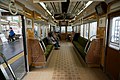 Inside of car 7250


Gallery
 Lone 8-car second refurbished set 7008 featuring alternative front end design
 Lone 8-car VVVF refurbished set 7021 featuring alternative front end design
 Interior of car 7503
 Eight-car set 7003 in 1988


_IMG_4577-2_140830.JPG)

