Hanshin 5700 series
From Wikipedia, the free encyclopedia
| Hanshin 5700 series | |
|---|---|
 Set 5717 in service in December 2021 | |
| Manufacturer | Kinki Sharyo |
| Built at | Osaka |
| Family name | Jet-Silver 5700 |
| Constructed | 2015– |
| Entered service | 24 August 2015 |
| Number built | 28 vehicles (7 sets) |
| Number in service | 28 vehicles (7 sets) |
| Formation | 4 cars per trainset |
| Fleet numbers | 5701– |
| Capacity | 514 (173 seated) |
| Operators | Hanshin Electric Railway |
| Depots | Amagasaki |
| Specifications | |
| Car body construction | Stainless steel |
| Car length | 18,800 mm (61 ft 8 in) |
| Width | 2,800 mm (9 ft 2 in) |
| Height | 4,085 mm (13 ft 4.8 in) |
| Doors | 3 pairs per side |
| Maximum speed | 110 km/h (68 mph) |
| Traction system | Variable frequency (IGBT) |
| Traction motors | Permanent-magnet synchronous motor |
| Acceleration | 4.0 km/(h⋅s) (2.5 mph/s) |
| Deceleration | 4.5 km/(h⋅s) (2.8 mph/s) |
| Electric system(s) | 1,500 V DC |
| Current collection | Overhead catenary |
| Track gauge | 1,435 mm (4 ft 8+1⁄2 in) |
| Notes/references | |
 | |
The Hanshin 5700 series (阪神電鉄5700系) is a commuter electric multiple unit (EMU) train type operated by the private railway operator Hanshin Electric Railway in Japan since August 2015.[1]
The trains feature passenger-operated door buttons, unusual in the Kansai region.[1]
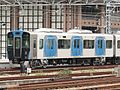 Set 5701 in July 2015

Formation
As of 1 April 2016[update], one four-car set is in service.[2] Trains are formed as four-car sets, as shown below, with all cars motored, although only one bogie on each of the end cars is motored.[3]
| Car No. | 1 | 2 | 3 | 4 |
|---|---|---|---|---|
| Designation | Mc1 | M1 | M2 | Mc2 |
| Numbering | 570x (odd) | 580x (odd) | 580x (even) | 570x (even) |
| Designation | Mc1 | M1 | M2 | Mc2 |
| Weight (t) | 34.0 | 37.0 | 37.0 | 34.0 |
| Capacity (total/seated) | 124/41 | 133/46 | 133/45 | 124/41 |
The M1 car has two single-arm pantographs, and the M2 car has one.[3]
 Mc2 car 5704 of set 5703 in May 2017
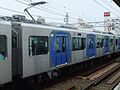 M2 car 5804 of set 5703 in May 2017
 M1 car 5803 of set 5703 in May 2017
 Mc1 car 5703 of set 5703 in May 2017


Interior
Passenger accommodation consists of longitudinal bench seating throughout. Regular seating areas use blue moquette seat covers and grab handles, and priority seating areas use green seat covers and grab handles.[3] LED lighting is used in the interiors, and 32-inch half-height LCD passenger information screens are provided above three out of six doorways per car, with information provided in four languages: Japanese, English, Chinese, and Korean.[3]
 Interior view
 Priority seating with wheelchair space
 LCD information screen
 Door button


