Harmonic bin packing
From Wikipedia, the free encyclopedia
Harmonic bin-packing is a family of online algorithms for bin packing. The input to such an algorithm is a list of items of different sizes. The output is a packing - a partition of the items into bins of fixed capacity, such that the sum of sizes of items in each bin is at most the capacity. Ideally, we would like to use as few bins as possible, but minimizing the number of bins is an NP-hard problem.
The harmonic bin-packing algorithms rely on partitioning the items into categories based on their sizes, following a Harmonic progression. There are several variants of this idea.
The Harmonic-k algorithm partitions the interval of sizes harmonically into pieces for and such that . An item is called an -item, if .
![{\displaystyle (0,1]}](https://wikimedia.org/api/rest_v1/media/math/render/svg/7e70f9c241f9faa8e9fdda2e8b238e288807d7a4)

![{\displaystyle I_{j}:=(1/(j+1),1/j]}](https://wikimedia.org/api/rest_v1/media/math/render/svg/67b092df56eb6cc874da75aa583e277af828c700)

![{\displaystyle I_{k}:=(0,1/k]}](https://wikimedia.org/api/rest_v1/media/math/render/svg/730bd4257fab7c9624208342c583fd6f24789c54)
![{\displaystyle \bigcup _{j=1}^{k}I_{j}=(0,1]}](https://wikimedia.org/api/rest_v1/media/math/render/svg/82202aee1458710ed56d842032167a9135e6d0a5)


The algorithm divides the set of empty bins into infinite classes for , one bin type for each item type. A bin of type is only used for bins to pack items of type . Each bin of type for can contain exactly -items. The algorithm now acts as follows:


- If the next item is an -item for , the item is placed in the first (only open) bin that contains fewer than pieces or opens a new one if no such bin exists.
- If the next item is an -item, the algorithm places it into the bins of type using Next-Fit.


This algorithm was first described by Lee and Lee.[1] It has a time complexity of where n is the number of input items. At each step, there are at most open bins that can be potentially used to place items, i.e., it is a k-bounded space algorithm.

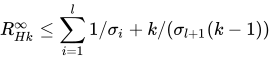
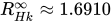
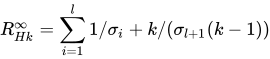
Lee and Lee also studied the asymptotic approximation ratio. They defined a sequence , for and proved that for it holds that . For it holds that . Additionally, they presented a family of worst-case examples for that







![{\displaystyle I_{1}:=(59/96,1]}](https://wikimedia.org/api/rest_v1/media/math/render/svg/8c8e745275c1bd2f4e792c16a5c3ca54af0ab8b1)
![{\displaystyle I_{a}:=(1/2,59/96]}](https://wikimedia.org/api/rest_v1/media/math/render/svg/51f3dbd42c9ea50f28b9c37d7249f00a3672427c)
![{\displaystyle I_{2}:=(37/96,1/2]}](https://wikimedia.org/api/rest_v1/media/math/render/svg/31cbe507ee9035b7c6ed8865d0af029f132403b4)
![{\displaystyle I_{b}:=(1/3,37/96]}](https://wikimedia.org/api/rest_v1/media/math/render/svg/92ab306ff8c81d6ee09d32d9d5ab33033e64bad1)








