Hatherton Flush
From Wikipedia, the free encyclopedia
| Site of Special Scientific Interest | |
  Location within Cheshire | |
| Location | Cheshire |
|---|---|
| Grid reference | SJ672483 |
| Coordinates | 53°01′51″N 02°29′27″W / 53.03083°N 2.49083°W |
| Interest | Biological |
| Area | 1.935 hectares (4.78 acres) |
| Notification | 18 October 1985[1] |
| Natural England website | |
Hatherton Flush is a Site of Special Scientific Interest (SSSI) by the River Weaver in Hatherton, near Wybunbury, Cheshire, England. It is protected for its variety of wetland plants. Species found at the site include the locally rare plants marsh helleborine, marsh lousewort and tubular water dropwort. Hatherton Flush is the largest example of this kind of flush in the county.[2][3] The site was assessed as being in an "unfavourable"/"recovering" condition in 2008.
Photographs
Hatherton Flush SSSI is located at SJ672483, on the east bank of the River Weaver.[2][4] It is on private land, immediately southeast of a public footpath from the A529 at Chapel Farm that crosses the Weaver via a footbridge.[5] Mineral-bearing groundwater from local aquifers gradually drips down the steep riverbank, forming a flush, a type of wetland which is similar to a spring-fed fen, but with a slower water flow. The type of vegetation depends on the underlying geology, here glacial deposits.[2][6]
The SSSI covers an area of 1.935 hectares (4.78 acres).[1] The flush is designated for the variety of wetland plants it supports, described by Natural England as an "excellent assemblage,"[2] and much of the site supports a wide range of plants. These include several species of orchid, which grow in abundance at the site, particularly common spotted orchid (Dactylorhiza fuchsii) and southern marsh orchid (Dactylorhiza praetermissa), and also the locally rare species, marsh helleborine (Epipactis palustris).[2][3] Seven species of sedge (Carex) are found in this area of the SSSI, as well as the locally rare species marsh lousewort (Pedicularis palustris) and tubular water dropwort (Oenanthe fistulosa), and the locally scarce species bog pimpernel (Lysimachia tenella, syn. Anagallis tenella) and marsh valerian (Valeriana dioica). Other plants include marsh pennywort (Hydrocotyle vulgaris), marsh arrowgrass (Triglochin palustris) and great horsetail (Equisetum telmateia).[2][3]
The southern part of the flush is less diverse, supporting predominantly a mix of rushes (Juncus) and fleabane (Pulicaria dysenterica).[2]
The flush is situated within an area of acidic grassland, part of which has not been improved, and is limited to a few plant species. Typical grass species are crested dog's-tail (Cynosurus cristatus) and heathgrass (Danthonia decumbens), while broad-leaved flowering plants include bird's-foot trefoil (Lotus corniculatus), devil's-bit scabious (Succisa pratensis) and sheep's sorrel (Rumex acetosella). The locally scarce spiny restharrow (Ononis spinosa) also grows on the site.[2][3]
Some of the species found at the SSSI (not photographed there); flush species:
 Common spotted orchid
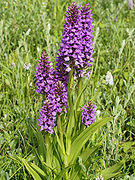 Southern marsh orchid
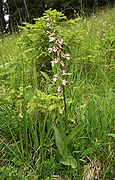 Marsh helleborine
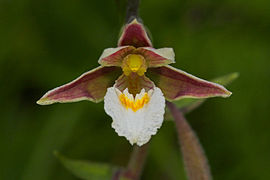 Marsh helleborine flower
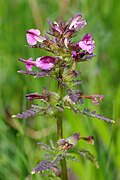 Marsh lousewort
 Bog pimpernel
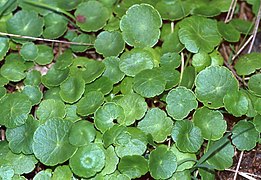 Marsh pennywort
 Marsh arrowgrass
 Great horsetail

.jpg)


Grassland species:
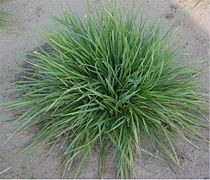 Crested dog's-tail
 Bird's-foot trefoil
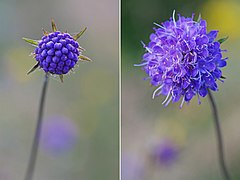 Devil's-bit scabious
 Sheep's sorrel
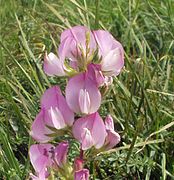 Spiny restharrow
.jpg)


.jpg)

