Hausdorff gap
From Wikipedia, the free encyclopedia
In mathematics, a Hausdorff gap consists roughly of two collections of sequences of integers, such that there is no sequence lying between the two collections. The first example was found by Hausdorff (1909). The existence of Hausdorff gaps shows that the partially ordered set of possible growth rates of sequences is not complete.
Let be the set of all sequences of non-negative integers, and define to mean .



If is a poset and and are cardinals, then a -pregap in is a set of elements for and a set of elements for such that:


- The transfinite sequence is strictly increasing;
- The transfinite sequence is strictly decreasing;
- Every element of the sequence is less than every element of the sequence .


A pregap is called a gap if it satisfies the additional condition:
- There is no element greater than all elements of and less than all elements of .

A Hausdorff gap is a -gap in such that for every countable ordinal and every natural number there are only a finite number of less than such that for all we have .


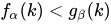
There are some variations of these definitions, with the ordered set replaced by a similar set. For example, one can redefine to mean for all but finitely many . Another variation introduced by Hausdorff (1936) is to replace by the set of all subsets of , with the order given by if has only finitely many elements not in but has infinitely many elements not in .


