Hauts-de-France
Administrative region of France
From Wikipedia, the free encyclopedia
Hauts-de-France (French: [o d(ə) fʁɑ̃s] ⓘ; Picard: Heuts d'Franche; lit. 'Heights of France'), also referred to in English as Upper France,[3] is the northernmost region of France, created by the territorial reform of French regions in 2014, from a merger of Nord-Pas-de-Calais and Picardy. Its prefecture is Lille. The new region came into existence on 1 January 2016, after regional elections in December 2015.[4] The Conseil d'État approved Hauts-de-France as the name of the region on 28 September 2016, effective the following 30 September.[5][6]

Hauts-de-France
Heuts-d'Franche (Picard) Upper France | |
|---|---|
Grand Place in Lille | |
 Flag  | |
 | |
| Coordinates: 49.9206°N 2.7030°E | |
| Country |  France France |
| Prefecture | Lille |
| Departments | 5
|
| Government | |
| • President of the Regional Council | Xavier Bertrand (LR) |
| Area | |
• Total | 31,813 km2 (12,283 sq mi) |
| • Rank | 9th |
| Population (2023)[1] | |
• Total | 5,992,194 |
| • Density | 188.36/km2 (487.84/sq mi) |
| GDP | |
| • Total | €185.472 billion (2022) |
| • Per capita | €30,900 (2022) |
| Time zone | UTC+01:00 (CET) |
| • Summer (DST) | UTC+02:00 (CEST) |
| ISO 3166 code | FR-HDF |
| NUTS Region | FRE |
| Website | www |
With 6,009,976 inhabitants as of 1 January 2015 and a population density of 189 inhabitants per km2, it is the third most populous region in France and the second-most densely populated in metropolitan France after its southern neighbour Île-de-France. It is bordered by Belgium to the north and by the United Kingdom to the northwest through the Channel Tunnel, a railway tunnel crossing the English Channel. The region is a blend mixture of French and (southern-) Dutch cultures.
Toponymy
The region's interim name Nord-Pas-de-Calais-Picardie was a hyphenated placename, created by hyphenating the merged regions' names—Nord-Pas-de-Calais and Picardie—in alphabetical order.[7]
On 14 March 2016, well ahead of the 1 July deadline, the regional council decided on Hauts-de-France as the region's permanent name.[5][7] The provisional name of the region was retired on 30 September 2016, when the new name of the region, Hauts-de-France, took effect.[6]
Geography
The region covers an area of more than 31,813 km2 (12,283 sq mi). It borders Belgium (Flanders and Wallonia) to the northeast, the North Sea to the north, the English Channel to the west, as well as the French regions of Grand Est to the east-southeast, Île-de-France to the south, and Normandy to the west-southwest. It is connected to the United Kingdom (England) via the Channel Tunnel.

Departments
Hauts-de-France comprises five departments: Aisne, Nord, Oise, Pas-de-Calais, and Somme.
Major communities
- Lille (227,560; region prefecture; surrounding area is home to over 1.5 million inhabitants)
- Amiens (133,448)
- Roubaix (94,713)
- Tourcoing (91,923)
- Dunkirk (90,995)
- Calais (72,589)
- Villeneuve-d'Ascq (62,308)
- Saint-Quentin (55,978)
- Beauvais (54,289)
- Valenciennes (42,691)
 Notre Dame de Laon, France
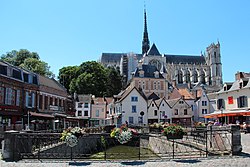


.JPG)

Economy
The gross domestic product (GDP) of the region was 161.7 billion euros in 2018, accounting for 6.9% of French economic output. GDP per capita adjusted for purchasing power was 24,200 euros or 80% of the EU27 average in the same year. The GDP per employee was 101% of the EU average.[8]
Transport
Air
There are only 2 operating airports in the region which are Lille Airport and Paris–Beauvais Airport. Residents in the region normally use other major airports such as Brussels Airport and Paris's Charles de Gaulle Airport which both can easily be reached by train and car.
Rail
The region is an important transport corridor between France, Belgium and the United Kingdom. Lille-Europe station is served by TGV and continental Eurostar high-speed rail services linking the region with Paris, Brussels and Amsterdam. There are further connections to London via the Channel Tunnel.
Sea
The ports of Calais and Dunkirk provide passenger and freight ferry services across the English Channel, while LeShuttle provides a car-train service between Coquelles and Folkstone through the Channel Tunnel.
