Let  and
and 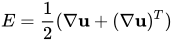 be the velocity, pressure and strain rate tensor of the Stokes flow and
  and
and 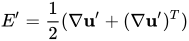 be the velocity, pressure and strain rate tensor of any other incompressible motion with
  on the boundary. Let
  and
and  be the representation of velocity and strain tensor in index notation, where the index runs from one to three. Let
  be a bounded domain with boundary
  of class
  .[7]
.[7]
Consider the following integral,

where in the above integral, only symmetrical part of the deformation tensor remains, because the contraction of symmetrical and antisymmetrical tensor is identically zero. Integration by parts gives

The first integral is zero because velocity at the boundaries of the two fields are equal. Now, for the second integral, since satisfies the Stokes flow equation, i.e.,  , we can write

Again doing an Integration by parts gives

The first integral is zero because velocities are equal and the second integral is zero because the flow is incompressible, i.e.,  . Therefore we have the identity which says,

The total rate of viscous dissipation energy over the whole volume  of the field
  is given by
![{\displaystyle D'=\int _{\Omega }\Phi 'dV=2\mu \int _{\Omega }e_{ij}'e_{ij}'\ dV=2\mu \int _{\Omega }[e_{ij}e_{ij}+e_{ij}'e_{ij}'-e_{ij}e_{ij}]\ dV}](https://wikimedia.org/api/rest_v1/media/math/render/svg/6901a2e31b1147a56d93195c0932dea49029b94a)
and after a rearrangement using above identity, we get
![{\displaystyle D'=2\mu \int _{\Omega }[e_{ij}e_{ij}+(e_{ij}'-e_{ij})(e_{ij}'-e_{ij})]\ dV}](https://wikimedia.org/api/rest_v1/media/math/render/svg/42f4f0880a7ca144bd72f3473940863317fbe443)
If  is the total rate of viscous dissipation energy over the whole volume of the field
  , then we have
 .
.
The second integral is non-negative and zero only if  , thus proving the theorem (
 ).
).

